A sloped ceiling is not a small space. It is three different spaces, and shelving it as one is why most of it goes to waste.
By Scooter M.Published September 6, 2026Content updated September 6, 2026Prices verified September 14, 2026How we pick
Bin & Basket earns a commission when you buy through our links, at no extra cost to you. We are an Amazon Associate. We accept no free products, no sponsored placements and no paid inclusion, and commission rate plays no part in what we recommend. Full disclosure.
Measure the headroom at three points — the tall end, the middle and the short end — and treat them as three separate storage zones rather than one cupboard. Put full-height shelving at the tall end, half-height units in the middle, and pull-out bins or drawers at the short end where nothing can stand up. The mistake that wastes an under-stairs pantry is shelving it to a single height, which throws away everything above the shelf at the tall end and makes the short end unreachable.
Use freestanding units rather than a fixed build. A staircase soffit is rarely square to anything, and a freestanding unit only has to fit under the slope at one point instead of matching it along its whole length.
Measure at three points, not one
Tall end. Floor to soffit at the highest usable point, taken about 6 inches in from the opening rather than at the very edge.
Middle. Floor to soffit at the midpoint of the depth you can actually reach into.
Short end. Floor to soffit at the point where the height drops below about 18 inches, which is roughly where standing storage stops being possible.
Depth at each of those three points, floor to back wall. On many under-stairs cupboards the depth is generous and the height is not, which is the reverse of a normal pantry.
Door opening width, measured to the inside face of the closed door. Everything has to pass through it, including the shelving unit in its box.
Write those five numbers down before you look at a single product. The standard pantry depth and spacing bands still apply inside each zone, and they are on pantry shelf depth and spacing.
What goes where
Zoning an under-stairs pantry by available headroom
Zone
Typical headroom
What belongs here
Storage type
Tall end
Full standing height
Cereal boxes, tall bottles, small appliances, anything you use weekly
Full-height freestanding shelving unit
Middle
Roughly 3 to 5 ft
Tins, jars, packets — the bulk of a pantry
Short shelving unit or a stack of two
Short end
Under about 18 in
Backstock, bulk paper goods, things you reach for monthly
Pull-out bins or a low rolling drawer unit
The headroom bands are the practical consequence of a staircase slope rather than a published standard. Measure your own; a staircase pitch varies with the building.
The short end is where under-stairs pantries fail. It is deep, it is dark, and you cannot see into it. The only thing that works there is storage that comes out to you — a bin with a handle, or a low unit on casters. Shelving it and reaching in means the back of it is lost within a month, which is the same failure documented on organizing deep pantry shelves.
#
Product
Best for
Score
Price
01
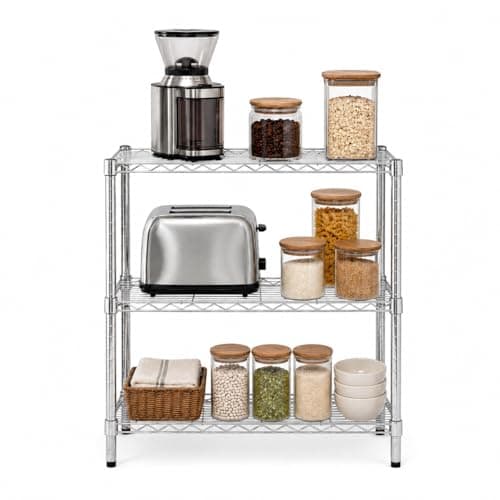
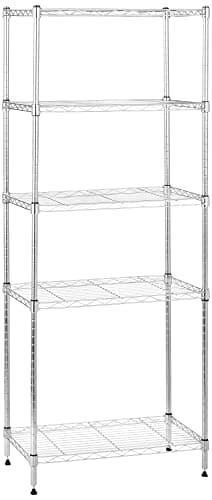
Amazon Basics 5-Shelf Adjustable Storage UnitThe commodity version of a wire rack: adjustable posts, no drilling, and a price that makes it the default first pantry.
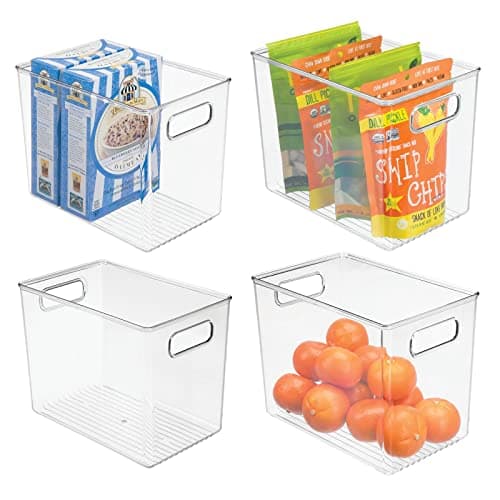
mDesign Clear Plastic Pantry Bins with HandlesOpen-top clear bins that turn the pile of half-open packets into a category you can pull out in one movement.
Scores are our own, from the published rubric on the methodology page. They are editorial judgments about published specifications, not test results — we have not handled these units.
01
A cheap pantry rack
Amazon Basics 5-Shelf Adjustable Storage Unit
The commodity version of a wire rack: adjustable posts, no drilling, and a price that makes it the default first pantry.
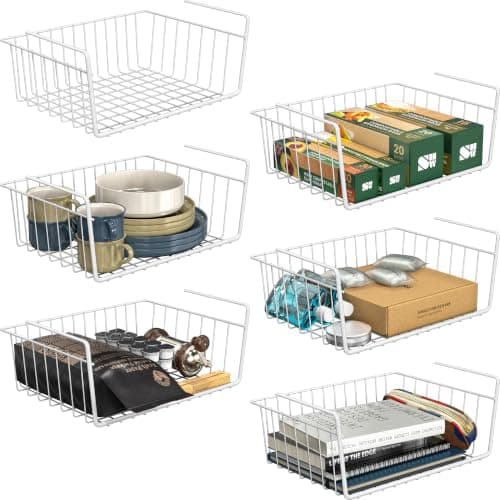
The hook opening is sized for a specific shelf thickness. Thick wooden shelves and some wire shelves will not accept it.
Headroom needed
The basket hangs below the shelf, so it consumes the spacing below
Published dimensions
Stated per model on the listing, including the hook opening
What it gets right
Uses space that is otherwise pure waste
No fixings, no tools, no damage
Cheap enough to fit several
What it does not
Hook opening is the whole compatibility question and is easy to get wrong
Steals headroom from the shelf below
Who it is for
A pantry with tall shelf spacing and short items on the shelves.
Skip this if
Your shelf is thicker than the basket's stated hook opening. This is the single most common reason these get returned — measure the shelf, not the gap.
Why freestanding beats a fixed build here
The instinct is to build shelving that follows the slope, and it is usually the wrong call in a rented or recently-bought house.
The slope is rarely square. A staircase soffit meets the wall at an angle set by the stair pitch, and matching it along a run is joinery rather than shelving.
A freestanding unit only has to clear the slope at its own tallest point. That is one measurement instead of a profile.
Wire and steel units publish load ratings. A site-built shelf publishes nothing, and under-stairs storage tends to attract heavy things — cases of drinks, bulk flour, tools.
It moves. If you change how you use the space, or move house, the shelving goes with you.
Lighting, because you cannot organize what you cannot see
An under-stairs pantry almost never has a window and frequently has no fixed light. That is not a cosmetic problem: the back half of a deep, dark cupboard is functionally not storage, because nobody puts anything there they expect to find again.
A battery or rechargeable motion light on the underside of the soffit costs very little and changes how much of the space gets used. The options are the same ones covered for closets on best closet lighting.
What under-stairs space is genuinely good for
Bulk and backstock. It is usually deeper than a normal pantry, which suits duplicate stock you rotate forward.
Heavy things. It is at floor level with a solid floor, so cases of drinks and bulk flour belong here rather than on a wall shelf.
Low-frequency items. Anything you reach for monthly rather than daily.
Not: daily cooking staples, if the cupboard is away from the kitchen. Walking distance beats storage volume for things you use every day.
What we are not telling you
The headroom bands in the table above are the practical consequence of an ordinary staircase pitch, not a published standard, and the table says so. Staircase geometry varies with the building and the only figures that matter are the five you measure yourself.
The load ratings on the shelving units recommended here are the manufacturers' published figures, cited at the foot of this page. We have not assembled any of them. The method is on how we pick.
FAQ
Questions people ask about this
How do you shelve an under-stairs pantry?
Measure headroom at three points — tall end, middle and short end — and treat them as three zones. Full-height shelving at the tall end, half-height units in the middle, and pull-out bins at the short end where nothing can stand. Shelving the whole space to one height is what wastes it.
Should under-stairs shelving be built in or freestanding?
Freestanding, in most cases. A staircase soffit is rarely square, so a fitted run is joinery rather than shelving, while a freestanding unit only has to clear the slope at its own tallest point. Freestanding units also publish load ratings and need no fixings.
What should you store in an under-stairs cupboard?
Bulk and backstock, heavy items such as cases of drinks or bulk flour, and anything you reach for monthly rather than daily. Keep daily cooking staples nearer the kitchen — walking distance beats storage volume for things you use constantly.
How do you use the low end of an under-stairs space?
With storage that comes out to you: bins with handles, or a low unit on casters. It is deep, dark and unreachable, so anything shelved there is lost within a month. Pull-out is the only approach that works below about 18 inches of headroom.
Do you need a light in an under-stairs pantry?
Effectively yes. These cupboards rarely have a window or a fixed light, and the back half of a dark, deep space is functionally not storage because nobody trusts it. A battery or rechargeable motion light on the soffit costs very little and changes how much gets used.
How deep should under-stairs pantry shelves be?
The same 12 to 16 inch band that suits any pantry, even though the space is often deeper. Past about 16 inches you are storing food behind food regardless of which cupboard it is in — use the extra depth for pull-out bins instead of deeper shelves.
Availability check, 6 September 2026Every product added for these pages was confirmed on sale at a national retailer on that date. Products that could not be confirmed in stock were not featured.
What is not a source hereWe have not handled these products. Nothing on this page is a test result, and no figure comes from a retailer listing, another publisher, or memory.