No holes, no patching, no deposit argument. Ranked by what they actually hold rather than by how little damage they do.
By Scooter M.Published September 1, 2026Content updated September 1, 2026Prices shown live on AmazonHow we pick
Bin & Basket earns a commission when you buy through our links, at no extra cost to you. We are an Amazon Associate. We accept no free products, no sponsored placements and no paid inclusion, and commission rate plays no part in what we recommend. Full disclosure.
The strongest no-drill option is a freestanding NSF wire rack, which publishes up to 800 lb per shelf and up to 4,000 lb per unit with no wall involvement at all. That is roughly ten times the per-bracket figure of a wall-mounted closet system, and it needs no permission from anyone. The hanging fabric tower and the over-door organizer are the ones that fit inside an existing closet; the tension rod is last because nobody publishes a load-versus-span figure for it.
Renting is usually treated as a compromise in this category. On the numbers it is not — the constraint pushes you toward floor-supported storage, and floor-supported storage is stronger than anything screwed to drywall. What you actually lose is neatness: nothing here disappears into the wall line.
#
Product
Best for
Score
Price
01
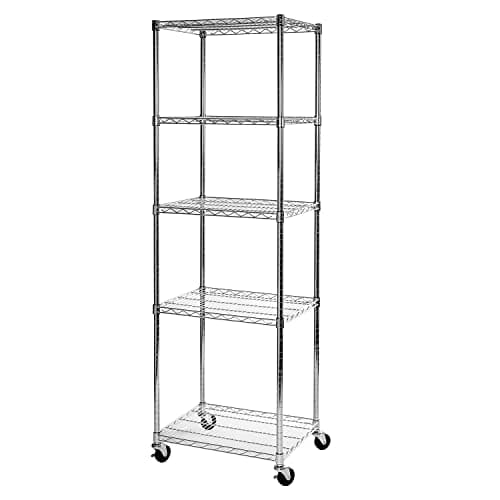
Seville Classics UltraDurable 5-Tier NSF Steel Wire ShelvingA freestanding NSF-rated rack with the highest published per-shelf load in this entire set, and no drilling at all.
No imageSimple Houseware Hanging Closet Organizer with ShelvesA fabric shelf tower that hangs off the existing rod, adding folded storage with no hardware and no holes.
No imageSongmics Heavy-Duty Spring Tension RodPressure alone holds it up, which is either exactly what a renter needs or a slow-motion accident, depending on load.
Scores are our own, from the published rubric on the methodology page. They are editorial judgments about published specifications, not test results — we have not handled these units.
Hangs from the existing closet rod on a hook-and-loop strap
Wall damage
None
Depth needed
Fabric shelf modules are shallower than a 24 in closet, so the door still closes
Published shelf load
Not published by the manufacturer in a form we could verify for fabric hanging organizers.
What it gets right
Zero holes and zero tools, which is the entire point in a rental
Turns dead vertical rod space into folded storage
Comes down and packs flat when you move
What it does not
It hangs off the rod, so it adds to the rod's load rather than relieving it
Fabric sags under books or anything dense
Who it is for
Anyone who cannot drill: a rental, a dorm, a room where the lease says no fixings.
Skip this if
Your rod is already bowing. A hanging organizer full of sweaters is a concentrated point load in the middle of the span, which is the worst place to add weight.
03
A closet with a solid door and no floor left
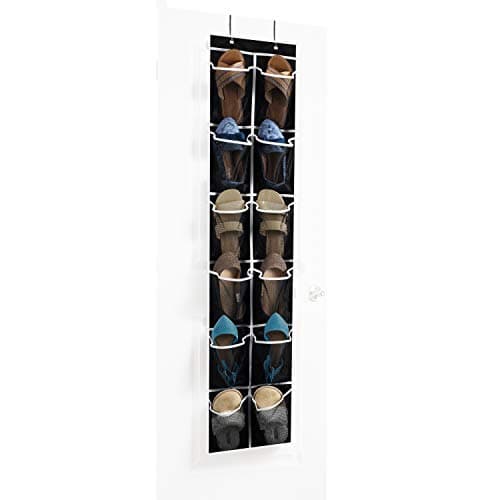
Zober Over-the-Door Shoe Organizer
Twenty-odd pockets on the back of the door, which is the only surface in most closets nobody is using.
Spring tension between two opposing walls. No fixings.
Load behavior
Capacity falls sharply as span increases — tension rods are a short-span device
Published load at span
Not published by the manufacturer in a form we could verify as a load-versus-span curve by any manufacturer we found.
What it gets right
No holes at all
Installs in under a minute and moves just as fast
Genuinely useful in an alcove or a niche with no rod
What it does not
Every tension rod eventually slips; the only question is under what load
Nobody publishes a load-versus-span figure, so you are guessing
Who it is for
A short alcove, a laundry drying run, or a rental where a real rod is not permitted.
Skip this if
The span is over about four feet or the clothes are coats. This is the classic failure: a wide tension rod holding heavy winter coats comes down in the night.
Why freestanding wins on the numbers
A wall-mounted shelf transmits its load into a few screws in some drywall, and every manufacturer conditions its published rating on hitting studs. ClosetMaid asks for at least three screws into studs in the hang track and three in the middle standards. Rubbermaid states directly that maximum rated capacity is not achievable at 24 inch stud spacing.
A freestanding rack transmits its load straight down through four posts into the floor. There is no condition to satisfy and no wall to be disappointed by, which is why its published figure is an order of magnitude higher. The full comparison is on shelf span and weight.
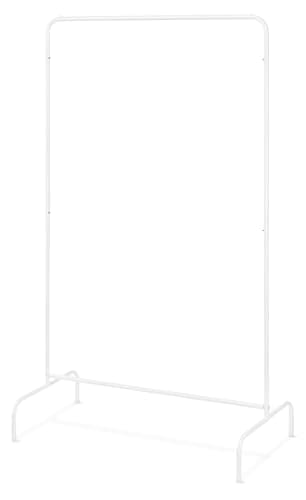
Where a tension rod fails, a freestanding rack is the honest substitute: it carries the same clothes into the floor instead of into two friction points. Ranked on published capacity and rod span on best garment racks.
If the room has no closet at all, the freestanding answer with doors is a wardrobe, and it stands on the floor exactly as a rack does. Most wardrobes sold online are too shallow to hang a shirt square, and the ones that are deep enough are on best wardrobe closets.
The tension rod warning, in detail
Spring tension rods are the classic renter product and the classic renter failure. They hold by friction between two opposing walls, and their capacity falls sharply as span increases — but no manufacturer we could find publishes a load-versus-span curve. That means you are guessing, and the guess fails at night, all at once, with everything on the floor.
Keep the span short. Under about four feet is where these behave.
Keep the load light. Shirts, not coats.
Check the tension every few weeks; it relaxes.
If it is a full wardrobe of clothes, buy the freestanding rack instead. It costs more and it does not fall down.
The other no-damage option worth knowing is a hanging closet organizer, which hooks over the existing rod and needs no fixings at all. It costs you rod length rather than wall, which is the trade to check before buying one.
What you can do to a rented closet without damage
Renter options by damage and capacity
Option
Damage
What it holds
Where it fits
Freestanding NSF rack
None
Up to 800 lb per shelf, published
Floor — needs the footprint
Hanging fabric tower
None
Folded clothing; sags under books
Off the existing rod
Over-door organizer
Scuffs the door top edge
Shoes and small items
Solid hinged doors only
Freestanding garment rack
None
Hanging clothes; frames flex when full
Floor, in the room
Tension rod
None if it stays up
Light garments, short span
Between two opposing walls
Adhesive hooks and strips
Can pull paint on removal
Very light items
Anywhere flat
Freestanding figures per the Seville Classics UltraDurable specification. The others have no published load figure, which is itself the finding.
FAQ
Questions people ask about this
What is the best closet organizer for renters?
A freestanding NSF wire rack, if you have the floor space. It publishes up to 800 lb per shelf with no wall fixing at all, which is roughly ten times the per-bracket figure of a wall-mounted closet system. Inside an existing closet, a hanging fabric tower adds folded storage with no hardware.
How do you organize a closet without drilling holes?
Use the rod you already have with a hanging tower, use the door with an over-door organizer, and use the floor with a stackable rack or a freestanding unit. Avoid relying on tension rods for anything heavy.
Are tension rods safe for hanging clothes?
For a short span and light garments, yes. Beyond about four feet, or with coats, they are the most common renter storage failure. No manufacturer publishes a load-versus-span figure for them, so there is no number to work to.
Do over-the-door organizers damage the door?
They scuff the top edge where the hooks sit, and on a tight frame they stop the door closing flush. They do not work at all on bifold or sliding doors, which have no top edge to hook over.
Can renters install closet shelving?
Only with permission, because every wall-mounted system needs screws into studs to reach its published rating. Adhesive-only installations are not covered by any manufacturer figure in this category.
Rubbermaid, FastTrack Rail and Shelving Installation GuideRail load rating, stud-count requirement per rail length, and anchor spacing between studs.
What is not a source hereWe have not handled these products. Nothing on this page is a test result, and no figure comes from a retailer listing, another publisher, or memory.