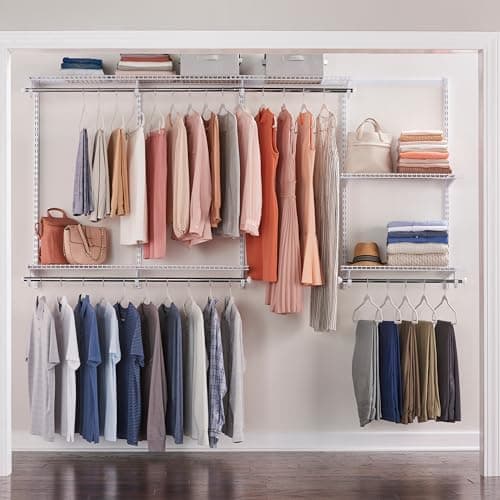
Every system here is sold as easy. They are not equally easy, and the difference is measured in tools you may not own.
By Scooter M.Published September 13, 2026Content updated September 13, 2026Prices verified September 14, 2026How we pick
Bin & Basket earns a commission when you buy through our links, at no extra cost to you. We are an Amazon Associate. We accept no free products, no sponsored placements and no paid inclusion, and commission rate plays no part in what we recommend. Full disclosure.
If this is your first closet, buy Rubbermaid Configurations — it telescopes to width instead of requiring you to cut steel, and it hangs from one rail, so there is one level line to get right instead of several. ClosetMaid ShelfTrack is cheaper and more adjustable but expects you to cut the shelf to the opening. Easy Track gets you a laminate finish and expects a circular saw. And if you do not want to touch the wall at all, a freestanding rack needs no install and no studs.
Difficulty here is not about the product's quality. It is about which tools you own and whether you have hung anything level before.
How we ranked install difficulty
Four questions, in the order they will actually bite you on the day:
Do you have to cut anything, and with what? A hacksaw is one thing; a circular saw on laminate that chips is another.
How many independent level lines are there? One rail is forgiving. A hang track plus several standards means every error compounds downward.
Does the published load rating depend on finding studs? Almost all of them do, and that decides whether the figure describes your closet at all.
Can it be adjusted afterwards without new holes? The cost of getting the layout wrong is much lower on an adjustable system.
Install difficulty, side by side
What each system actually asks of you
System
Cutting required
Level lines
Load depends on studs
Rubbermaid Configurations
No — shelves telescope to width
One hang rail
Yes. Rail must begin and end on a stud
ClosetMaid ShelfTrack
Yes — shelf cut to the opening
Hang track plus standards
Yes. At least 3 screws into studs in the track
ClosetMaid SuperSlide
Yes — shelf cut to the opening
Fixed brackets across the run
Yes
Easy Track
Yes — hacksaw for rail and rods, circular saw for shelves
One steel rail at 76 in
Yes. Rail mounted into studs along the back wall
Freestanding wire rack
No
None — it stands on the floor
No. Nothing touches the wall
Every figure here is the manufacturer's own published requirement, sourced at the foot of this page. We have not installed any of these systems.
#
Product
Best for
Score
Price
01
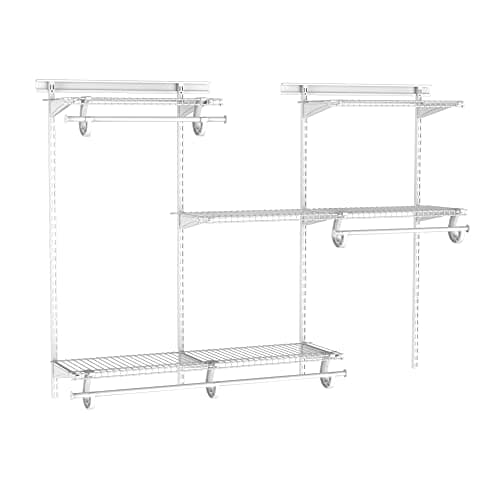
Rubbermaid Configurations Custom Closet KitTelescoping shelves that expand to fill a range of closet widths, so an awkward opening does not force you to cut metal.
ClosetMaid ShelfTrack Adjustable Closet Organizer KitAn adjustable hang-track system that lets you move every shelf later, which is the thing you will actually want to do.
Easy Track Basic Starter Closet KitA rail-hung laminate system whose manufacturer publishes a whole-closet load figure and the stud condition attached to it, sold in home centers rather than by one retailer.
ClosetMaid SuperSlide Ventilated Shelf Kit with Closet RodThe continuous-slide version: the rod runs the full length with no bracket interrupting it, so hangers never stop halfway.
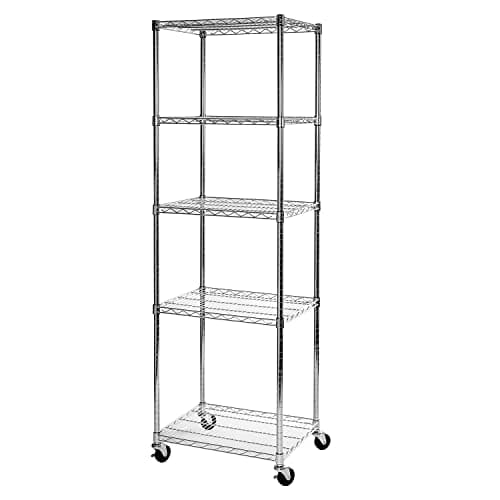
Seville Classics UltraDurable 5-Tier NSF Steel Wire ShelvingA freestanding NSF-rated rack with the highest published per-shelf load in this entire set, and no drilling at all.
Scores are our own, from the published rubric on the methodology page. They are editorial judgments about published specifications, not test results — we have not handled these units.
01
Fitting an odd width without cutting
Rubbermaid Configurations Custom Closet Kit
Telescoping shelves that expand to fill a range of closet widths, so an awkward opening does not force you to cut metal.
Telescoping shelves expand across a width range rather than one fixed size
Mounts to
A single hang rail spanning the closet, screwed into studs
What the rating depends on
Rubbermaid's rail guidance is that the rail begins and ends on a stud, with anchors every 8 in between. At 24 in stud spacing the maximum rated capacity is not achievable.Source: Rubbermaid FastTrack Rail and Shelving Installation Guide
Per-kit published load
Not published by the manufacturer in a form we could verify for the Configurations kits specifically.
What it gets right
Expanding shelves absorb a width that does not match a standard kit
One rail carries the whole system, so there is one line to level rather than several
Comes as a kit — rod, shelves and hardware in one box
What it does not
A telescoping shelf is two overlapping pieces, which is less rigid than one solid run
The rail concentrates everything on one line of fixings; a bad rail install compromises the lot
Who it is for
Someone with a non-standard opening who would rather set a width dial than take a hacksaw to a shelf.
Skip this if
Your studs are on 24 in centers. Rubbermaid's own guidance is that maximum rated capacity is not achievable at that spacing, and a closet full of winter coats is exactly where that matters.
12 in and 16 inSource: ClosetMaid published product specifications
Maximum standard spacing
24 in apart, and no more than 4 in from the end of the shelfSource: ClosetMaid ShelfTrack Installation Tips
Published load
About 83 lb per bracket, up to 1,000 lb across a full systemSource: ClosetMaid Wire Shelving Specifications, rev 6/12
What the rating depends on
At least 3 screws into studs in the hang track and 3 in the middle standards. Fewer than that and the published figure does not apply.Source: ClosetMaid ShelfTrack Installation Tips
Adjustable after install
Yes — shelves move on the standards without re-drilling
What it gets right
Shelf heights change later without new holes in the wall
The hang track spreads load across studs rather than into single anchors
Widely stocked, so a replacement bracket is easy to find years from now
What it does not
The visible track and standards are not a design feature; some people hate the look
Rated capacity is entirely dependent on hitting studs, which older homes make harder
Who it is for
Anyone with a standard 24-inch-deep reach-in who expects the contents to change — a growing child's closet, a first apartment, a closet you are not sure about yet.
Skip this if
Your closet wall is masonry or plaster over brick. The published load figures assume wood studs, and anchor-only installs do not reach them.
03
A whole closet in an afternoon
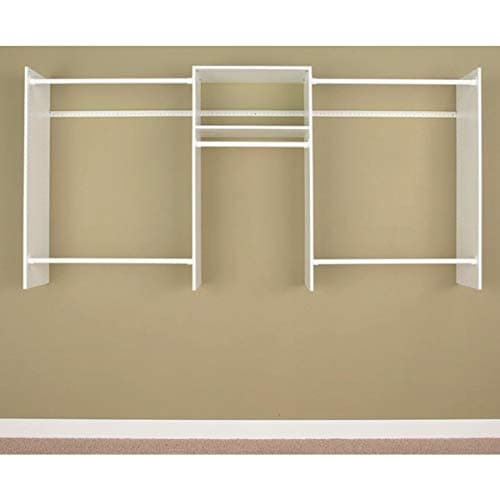
Easy Track Basic Starter Closet Kit
A rail-hung laminate system whose manufacturer publishes a whole-closet load figure and the stud condition attached to it, sold in home centers rather than by one retailer.
Up to 1,200 lb for an 8 ft closet, with the rail properly mounted into the studs along the back wallSource: Easy Track published FAQ
Material depth
14 in — a single depth across the closet rangeSource: Easy Track published FAQ
Published rail height
Hang the rail 76 in from the floor, putting the top of the product at 84 in. Adjustable by a couple of inchesSource: Easy Track published installation guidance
Closet widths
Kits sized for a 4 ft to 8 ft opening
Fit method
Cut to fit. A hacksaw for the rail and rods, a circular saw for the shelvesSource: Easy Track published installation guidance
Substrate
Sold by retailers as a wood closet system. Easy Track does not publish a substrate spec we could verify
What it gets right
Publishes a whole-closet load figure with the stud condition stated, which most laminate systems do not
Sold in home centers and online, so it is a same-day purchase rather than an order
One rail carries the system, so there is a single level line to get right
What it does not
One depth only, at 14 in — there is no narrow option for a shallow closet
The 1,200 lb figure is a whole-closet number, so it does not tell you what one shelf will take
Cutting is expected rather than optional, and the shelves want a circular saw
Who it is for
A standard reach-in or walk-in of 4 to 8 ft where you want a laminate finish today rather than a delivery date.
Skip this if
Your closet is shallower than about 20 in, or a sliding door panel eats the opening. The range is 14 in deep and there is no narrower version to fall back on.
04
Hangers that actually slide
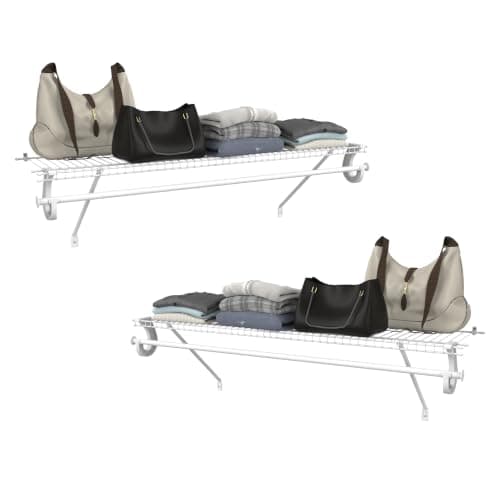
ClosetMaid SuperSlide Ventilated Shelf Kit with Closet Rod
The continuous-slide version: the rod runs the full length with no bracket interrupting it, so hangers never stop halfway.
12 in and 16 inSource: ClosetMaid published product specifications
Rod support spacing
One support every 36 in of hang rod, and one at each end of the shelf and rodSource: ClosetMaid published product specifications
Difference from Shelf & Rod
SuperSlide is the continuous-slide line; Shelf & Rod is the fixed-rod economy line. Hangers pass supports on SuperSlide and stop at them on Shelf & Rod.Source: ClosetMaid published product specifications
Material
Vinyl-coated steel wire
What it gets right
Hangers slide the full run, which is the single biggest daily difference in a closet
Fixed-mount shelf is more rigid than an adjustable track for the same money
Depth choice of 12 or 16 in covers both a shallow and a standard reach-in
What it does not
Fixed height — moving it later means new holes
The 16 in shelf needs a genuine 24 in of closet depth to leave door clearance
Who it is for
A closet whose job is settled: an adult wardrobe in a house you are staying in, where hanging space is the whole requirement.
Skip this if
You expect to reconfigure. This is a fixed installation and re-siting it leaves a wall to patch.
Leveling feet or 4 in casters depending on modelSource: Seville Classics UltraDurable product specification
Wall fixing
None required — the unit is freestanding
What it gets right
The published per-shelf figure is an order of magnitude above wall-mounted closet shelving
No holes, which makes it the default answer in a rental
Shelf heights adjust on the posts in one-inch increments
What it does not
It is a commercial rack and looks like one
Wire shelf gaps let small containers tip; it wants bins on top of it
Who it is for
A pantry, a utility room, a garage, or any rental where drilling into the wall is not on the table.
Skip this if
You are putting it in a bedroom closet under 24 in deep. The 18 in and 24 in depths are pantry and garage dimensions, and they will foul the door.
The cutting question, honestly
Cutting is the step that stops people, and the three systems that need it need it differently.
Wire shelf (ClosetMaid). A bolt cutter for the rails and a hacksaw for a square finish, then a file. It is a real job but a forgiving one — a slightly rough cut end takes an end cap and disappears. The method is on cutting wire shelving.
Laminate shelf (Easy Track). A circular saw, and laminate chips if you cut it with the wrong blade or in the wrong direction. This is the least forgiving cut in the category because the result is visible.
No cut (Rubbermaid Configurations). Telescoping shelves expand across a width range. You give up a little rigidity where the halves overlap, and you gain not owning a saw.
If you do not own a circular saw and do not want to, that single fact removes Easy Track from your shortlist more decisively than any specification does.
How long each actually takes
A realistic estimate for a first-timer doing a single reach-in closet, including measuring and tidying up:
Freestanding rack — under an hour, no wall contact, no decisions that cannot be undone.
Rubbermaid Configurations — an afternoon. One rail to level, no cutting, components hook on.
ClosetMaid ShelfTrack — an afternoon plus the cutting. The hang track is the step that decides everything downstream.
Easy Track — most of a day, and a chunk of that is cutting laminate carefully.
The step people underestimate is never the drilling. It is the measuring and marking before it, which is also where the mistakes that cost money get made. The full sequence is on installing wire shelving, and if the closet is an empty alcove start with building a simple closet.
When DIY is the wrong call
Masonry or plaster over brick. Published ratings assume wood studs. Freestanding instead.
A closet you are unsure about. Buy adjustable, so changing your mind later does not mean new holes.
Anything structural or electrical. Moving a wall or adding a light is past what a kit covers.
What we are not telling you
We have not installed any of these systems. Every cutting requirement, stud condition and mounting height above is the manufacturer's own published instruction, cited at the foot of this page.
The time estimates are our own reasoning about the number of steps involved rather than measured installs, and they are labeled as estimates rather than dressed up as data. The method is on how we pick.
FAQ
Questions people ask about this
What is the easiest closet system to install yourself?
Rubbermaid Configurations, for two reasons: the shelves telescope to width so there is no cutting, and everything hangs from a single rail so there is one level line to get right rather than several. A freestanding rack is easier still, because it never touches the wall.
Do you need to cut a DIY closet system?
It depends which one. ClosetMaid wire shelving is cut to the opening with a bolt cutter and hacksaw; Easy Track expects a hacksaw for the rail and a circular saw for laminate shelves; Rubbermaid Configurations telescopes instead and needs no cutting at all.
What tools do you need to install a closet system?
At minimum a stud finder, tape measure, level, pencil and drill. Add a bolt cutter and hacksaw for wire shelving, or a circular saw for laminate. The stud finder is the one people skip and the one that decides whether the published load rating applies.
How long does it take to install a closet system?
For a first-timer on a single reach-in: under an hour for a freestanding rack, an afternoon for Rubbermaid Configurations, an afternoon plus cutting for ClosetMaid, and most of a day for Easy Track. Measuring and marking takes longer than the drilling.
Can you install a closet system without hitting studs?
You can fit one, but the manufacturers' published load ratings all assume screws into studs and no longer describe your installation without them. If the wall will not cooperate, a freestanding rack publishes a far higher per-shelf figure and needs no wall at all.
Is a DIY closet system worth it versus a fitted one?
For most closets yes, because the structural job is the same and the price difference is large. What a fitted installation buys is design work, exact fit and someone else taking responsibility for the result — which is a real service, just not a structural upgrade.
Rubbermaid, FastTrack Rail and Shelving Installation GuideRail load rating, stud-count requirement per rail length, and anchor spacing between studs.
Easy Track, published installation guidanceThe 76 in rail height and the resulting 84 in top-of-product height, the tool list, and the hacksaw and circular-saw cutting requirements.
What is not a source hereWe have not handled these products. Nothing on this page is a test result, and no figure comes from a retailer listing, another publisher, or memory.