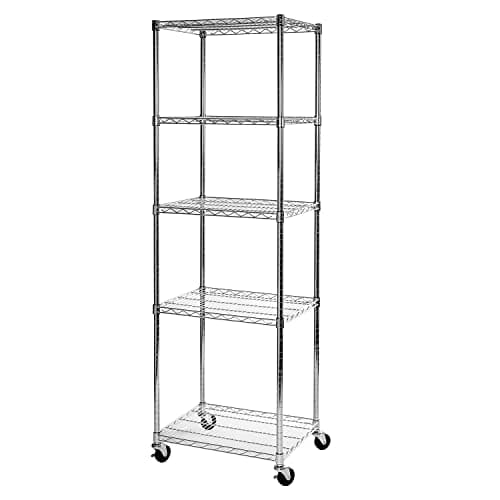
Pantry shelves want to be 12 to 16 inches deep, and 12 inches is the best depth for cans and boxed goods. Vertically, canned goods need about 7 inches of spacing, and mixed groceries sit in the 7 to 10 inch and 12 to 14 inch bands. Get those two numbers right and the rest of a pantry is easy. Get them wrong and no container set will rescue it.
Depth decides what you can reach. Spacing decides how much of the height you waste. Everything else — which rack, which bins, which containers — is downstream of both.
A standard food can is about 3 inches across. At 12 inches of depth you get four rows and, with a tiered rack raising the back ones, you can read every label. At 16 inches you get five and the fifth is invisible. Past that you are storing food behind food, which is the exact mechanism by which pantries lose things and tins expire.
This is why a commercial wire rack — genuinely the strongest shelving in this hub — is a slightly awkward fit for a pantry. Commercial racks come in 18 and 24 inch depths because they are designed for a commercial kitchen you walk around, not a cupboard you reach into. In a walk-in pantry that depth is fine. In a cupboard it is a liability, and the shallower consumer units are the better buy despite publishing lower load figures.
A pantry holds the heaviest things in the house: tinned food, bottled drinks, bulk flour, small appliances. Wall-mounted shelving transmits all of that into screws in drywall, and every manufacturer conditions its published rating on hitting studs.
A freestanding rack transmits it straight down through four posts into the floor. There is no condition to satisfy, which is why a commercial NSF rack publishes up to 800 lb per shelf and up to 4,000 lb per unit — roughly ten times the per-bracket figure of a wall-mounted closet system, at a fraction of the price of a fitted one. That comparison, with every published figure in one table, is on shelf span and weight.
- Above short items. A 4 to 5 inch can under a 12 inch shelf gap wastes seven inches of air. Reset the shelf if it is adjustable, or hang an under-shelf basket if it is not.
- Behind the front row. On anything deeper than about 16 inches, the back is effectively unreachable without hardware. Organizing deep pantry shelves covers the four fixes.
- The door. An entire surface doing nothing, if it is a solid hinged door with clearance behind it. Moving spices there frees a whole shelf — see over-the-door pantry racks.
02
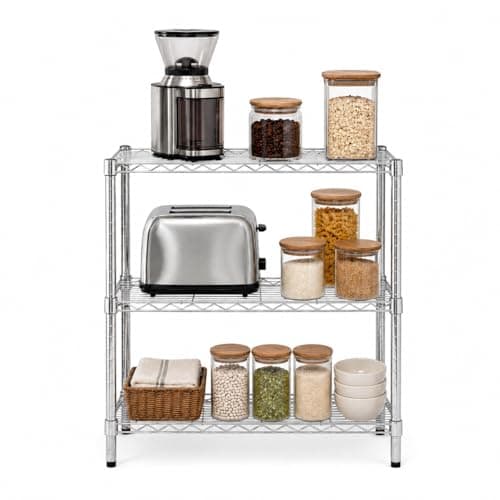
A narrow pantry alcove
Honey-Can-Do Adjustable Steel Pantry Shelving Unit
Narrower and shallower than a commercial rack, which is exactly what a cupboard-sized pantry needs.
- Score
- 7.5
- Value
- 8.5
- Load
- 6.5
- Fit range
- 8.5
- Published data
- 6.0
Published specifications
- Mounting
- Freestanding
- Depth
- Sold in shallower depths than commercial racks, closer to the 12 to 16 in pantry band
- Published load
- Stated per shelf on the listing
What it gets right
- Depth is closer to the 12 to 16 in band that actually suits food storage
- Narrow footprint fits an alcove a commercial rack cannot
- Assembles without tools on most models
What it does not
- Lighter gauge than a commercial rack, and it shows when loaded
- Fewer size options than the big wire-shelving ranges
Who it is for
A cupboard, an alcove, or a narrow gap being pressed into service as a pantry.
Skip this if
Your pantry is a full closet. In that space a deeper, stronger rack is a better use of the footprint.
03
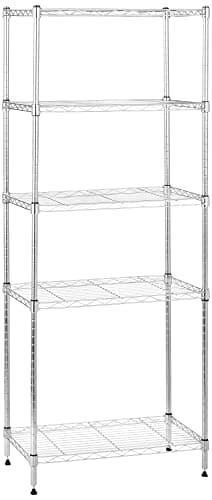
A cheap pantry rack
Amazon Basics 5-Shelf Adjustable Storage Unit
The commodity version of a wire rack: adjustable posts, no drilling, and a price that makes it the default first pantry.
- Score
- 7.5
- Value
- 9.5
- Load
- 6.0
- Adjustability
- 8.0
- Published data
- 5.5
Published specifications
- Mounting
- Freestanding; no wall fixing
- Adjustability
- Shelves reposition on the posts in increments
- Published load
- Stated per shelf on the listing, and materially below the NSF commercial figures
- Depth
- Sold in pantry-appropriate depths; measure the alcove before ordering
What it gets right
- Cheapest route to five adjustable shelves
- No fixings, so it works in a rental
- Shelf heights move as your storage changes
What it does not
- Published load is well below the commercial NSF racks
- Thinner posts flex more when the rack is tall and loaded high
Who it is for
A first pantry, a utility cupboard, or a light-duty store.
Skip this if
You are storing dense goods — tinned food, bottled drinks, bulk flour. Buy the NSF-rated rack instead; the published per-shelf figures are not close.
04
No
imageDoor-mounted storage that holds weight
Simple Houseware Over-the-Door Wire Storage Rack
Rigid wire baskets on a door bracket, which is what you want when the fabric-pocket version keeps sagging.
- Score
- 8.0
- Capacity
- 8.5
- Rigidity
- 8.5
- Fit
- 6.5
- Value
- 8.5
Published specifications
- Mounting
- Over-door brackets, with screw-fix option on most models
- Door requirement
- A solid hinged door with clearance behind it when closed
- Construction
- Coated steel wire baskets, rigid rather than fabric
- Published load per basket
- Not published by the manufacturer in a form we could verify for most over-door wire racks; check the specific listing.
What it gets right
- Rigid baskets hold tins and bottles that would tear fabric pockets
- Screw-fix option converts it from a renter product to a permanent one
- Wire lets you see the contents from the side
What it does not
- Needs real clearance behind the door; tight frames will not close
- The over-door brackets scuff the top edge of the door
Who it is for
A pantry or closet door with a couple of inches of clearance behind it.
Skip this if
Your door is bifold or sliding, or there is a wall within a few inches of the open door. Both make this unusable.
05
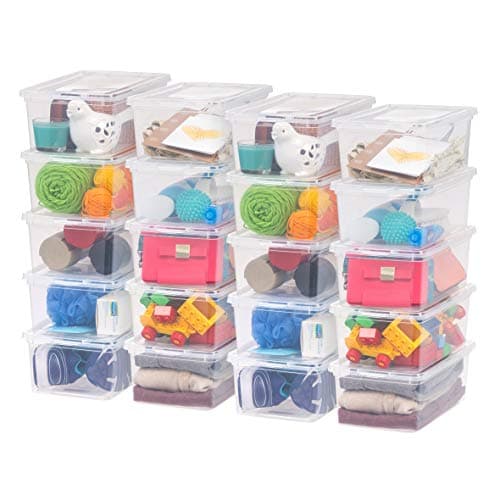
Stacking on a deep shelf
IRIS USA Stackable Storage Bins with Lids
Rigid stackable boxes in sizes that actually match a 12 to 16 inch shelf, rather than a garage shelf.
- Score
- 8.3
- Stackability
- 9.0
- Visibility
- 8.5
- Fit
- 7.5
- Value
- 8.0
Published specifications
- Construction
- Rigid polypropylene with a latching or friction lid depending on model
- Stackability
- Designed to stack loaded
- Published dimensions
- Stated per size on the listing; check against your shelf depth
What it gets right
- Stacks properly under load
- Sizes that suit a shelf rather than a garage floor
- Clear bodies mean no labeling required
What it does not
- Rigid boxes waste corner space in an irregular pantry
- Lids are a separate thing to lose
Who it is for
Deep pantry shelves where things get lost at the back.
Skip this if
Your pantry shelf spacing is under about 8 inches. Stacking is the reason to buy these, and there is no stacking headroom in a tight spacing.
Every rack in this hub is wire, because wire ventilates and publishes higher load figures for the money. The price of that is that packets tip and small items fall through the gaps. Budget for bins at the same time as the rack rather than discovering the problem when it is loaded.
Shelf liners are the other answer, and they undo the ventilation you bought wire for. Use them under the things that actually tip, not across every shelf.
Everything above assumes a cupboard with parallel walls. An under-stairs pantry does not have one, and shelving it to a single height is how most of it goes to waste — measure the headroom at three points and treat them as three zones. The method is on shelving an under-stairs pantry.
Three additions to this hub come from the same two figures. A freestanding cabinet is the answer where there is nothing to shelve - best freestanding pantry cabinets ranks them on what they publish, which is mostly not much. Where a shelf is too deep to reach, best pull-out cabinet organizers brings the back of it forward. And where the gap above a shelf is wasted, best pantry shelf risers compares the published heights against the spacing bands above.
Two cheap upgrades to shelving you already own have their own pages now. Best shelf liners covers the sizing rule that decides fit - liner width against the shelf's inner width, not its nominal size - and which liners publish a thickness for wire shelving.
A walk-in pantry is a different problem from a cupboard: there is more wall than you can use, and the limit is what each wall will carry. Shelving a walk-in pantry compares the published loads, which run from 40 lb to 250 lb a shelf on shelves of similar size, and sets out when a freestanding unit beats a wall-mounted one outright.
We have not assembled or loaded any of these racks. The load figures are the manufacturers' own, cited to the documents they came from; the depth and spacing bands come from published pantry dimension data; and every price comes live from Amazon when you look at it. Where a figure is not published, we say so rather than estimating. The method is on how we pick.