University guidance puts potatoes at 32 to 40 degrees and 95 percent humidity. Your kitchen is not that, so buy a bin for the two things it can control.
By Scooter M.Published October 3, 2026Content updated October 3, 2026Prices verified October 3, 2026How we pick
Bin & Basket earns a commission when you buy through our links, at no extra cost to you. We are an Amazon Associate. We accept no free products, no sponsored placements and no paid inclusion, and commission rate plays no part in what we recommend. Full disclosure.
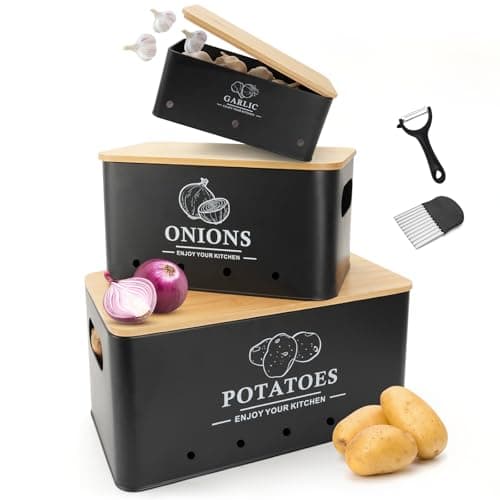
Buy opaque for potatoes and open for onions, and accept that no kitchen bin controls temperature. University of Minnesota Extension puts potato storage at 32 to 40 F and 95 percent relative humidity, in the dark. A container on your counter delivers none of the cold and none of the humidity - what it can do is block light and move air. The ZICOTO metal set does that best and publishes a weight capacity for each bin. The Dekosilave set adds a third lidded container so garlic is separated too. The bamboo and wire options give more airflow and far less darkness.
That gap between what potatoes want and what a kitchen offers is the whole subject, and most of this category pretends it does not exist.
What the storage guidance actually says
The published figures are unambiguous and they are not achievable on a counter.
Published storage guidance against a kitchen container
Condition
Published guidance
What a kitchen bin delivers
Temperature
32-40 F for storage potatoes
Room temperature, typically 65-72 F
Temperature, frying potatoes
40-50 F, to avoid cold-induced sweetening
Room temperature
Humidity
About 95 percent relative humidity
Whatever the kitchen is, usually far drier
Light
Dark
Controllable - this is what you are buying
Air movement
Ventilated storage
Controllable - this is the other thing you are buying
Temperature and humidity guidance from University of Minnesota Extension's potato growing and storage page. The right-hand column is our description of a normal kitchen, not a figure from that source.
So a counter bin is not a root cellar and no listing should imply it is. What it legitimately does is keep light off potatoes - which is what turns them green and starts them sprouting - and let air move so onions do not sit in their own moisture. Judged on those two jobs, the category divides cleanly.
Opaque against ventilated, and why you may want both
Metal with vent holes is the best compromise for potatoes: no light at all, with holes for air. The ZICOTO and Dekosilave sets are both this.
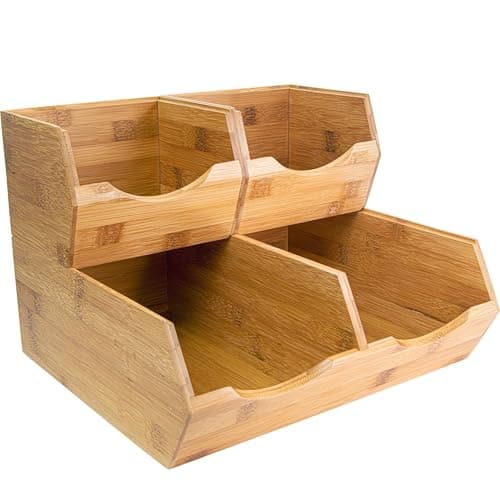
Bamboo with slats looks the best and lets in light through the gaps. Fine for onions and garlic, poor for potatoes.
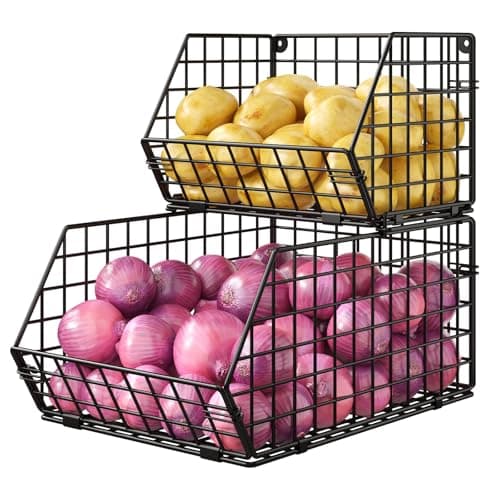
Open wire is the most ventilated and the least protective. It suits onions, shallots and citrus, and it is the wrong home for a potato.
Sealed plastic with no vents is the one format to avoid outright. Root vegetables respire and give off moisture, and a sealed tub turns that into rot.
Most kitchens are best served by two containers rather than one: something opaque for potatoes and something open for onions. Three of the four products here are sold as sets for exactly that reason.
Keep them apart
Potatoes and onions are routinely sold in divided bins and routinely stored in the same one. The practical reason to separate them is that both give off moisture and gases as they age, and a potato sitting against a softening onion is the first one to go. Every multi-bin set on this page is built around the separation, which tells you the manufacturers agree even where their listings do not explain why.
Garlic is the third case and the easiest to get wrong: it wants to be dry and airy, it does not want to be in a lidded tub with damp potatoes, and it keeps for months when it is simply left in a small open container. The Dekosilave set gives it a container of its own, which is the tidiest answer here.
How this page is ranked
Light exclusion for potatoes, because that is the one spoilage mechanism a container genuinely prevents.
Airflow, because the other mechanism is moisture sitting against the skin.
Separation. Two or three containers beats one divided box, since the crops want different conditions.
Published figures. One set publishes a weight capacity per bin; the rest publish none, which is the category norm and not a good one.
Cleanability. Soil and sprouts come off metal with a rinse and soak into bamboo.
#
Product
Best for
Score
Price
01
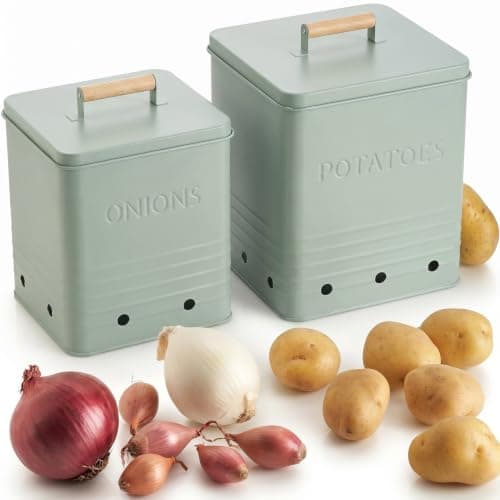
ZICOTO Metal Potato and Onion Storage Set of 2Opaque powder-coated metal with vent holes and a published weight capacity for each bin, which is the combination potatoes actually need on a counter.
Dekosilave Metal Potato, Onion and Garlic Storage Set of 3Three sizes of lidded metal container with vent holes and bamboo lids, which separates the three crops that should not share a container.
HOMESTEAD Stackable Bamboo Pantry Bins, 3-PackOne large bin and two small ones that stack into a single column, which is how a small kitchen stores potatoes, onions and garlic without three separate footprints.
X-cosrack 2-Tier Stackable Wire Produce BasketsOpen wire on two tiers, which gives produce the most air of anything here - and the least protection from the light that spoils potatoes.
Scores are our own, from the published rubric on the methodology page. They are editorial judgments about published specifications, not test results — we have not handled these units.
01
Darkness, which is the point
ZICOTO Metal Potato and Onion Storage Set of 2
Opaque powder-coated metal with vent holes and a published weight capacity for each bin, which is the combination potatoes actually need on a counter.
13 x 7.1 x 5.9 inSource: Retailer catalog listing, retrieved 3 October 2026
Set
3 rectangular containers in different sizesSource: Retailer catalog listing, retrieved 3 October 2026
Lids
Bamboo, stated at 1.5 cm thickSource: Retailer catalog listing, retrieved 3 October 2026
Ventilation
Small vent holes for air circulation, per the listingSource: Retailer catalog listing, retrieved 3 October 2026
Published capacity in weight
Not published by the manufacturer in a form we could verify
What it gets right
Lidded and opaque, so light is excluded while the vents still let air move
Three containers means garlic is not sitting in with the onions
Rectangular, so they use a shelf or counter corner better than round baskets
What it does not
No weight capacity published for any container in the set
A solid lid plus small vents is less airflow than an open basket, and damp produce needs air
The bamboo lids will stain where damp vegetables touch them
Who it is for
A pantry shelf where potatoes, onions and garlic each need their own dark container.
Skip this if
You want to see what you have at a glance. These are opaque by design, which is good for the potatoes and bad for your memory.
03
Stacking three crops in one footprint
HOMESTEAD Stackable Bamboo Pantry Bins, 3-Pack
One large bin and two small ones that stack into a single column, which is how a small kitchen stores potatoes, onions and garlic without three separate footprints.
About 14.4 x 10 x 7.5 inSource: Retailer catalog listing, retrieved 3 October 2026
Layout
Two tiers, stackable, separating two cropsSource: Retailer catalog listing, retrieved 3 October 2026
Construction
Open wire basketSource: Retailer catalog listing, retrieved 3 October 2026
Published capacity in weight
Not published by the manufacturer in a form we could verify
What it gets right
Open wire is the most ventilated format here, and damp onions rot in still air
Two tiers in one footprint, so a counter corner holds two crops
You can see what is going soft before it spoils the rest
What it does not
No light protection at all, which is the wrong trade for potatoes specifically
Wire marks soft produce where it rests, over a week or two
No weight capacity published, and a loaded upper tier sits on the lower one
Who it is for
Onions, shallots and citrus, where airflow matters more than darkness.
Skip this if
Potatoes are what you are storing. Use something opaque and keep the wire for onions and citrus.
How much to buy, and how much to store
The ZICOTO listing is the only one here that states capacity in weight: about 9 to 10 lb in the potato bin and 6 to 7 lb in the onion bin. That is useful because it maps onto how people actually shop - a 5 lb bag of potatoes and a few loose onions is a normal week, and those bins take roughly two weeks' worth.
Buying beyond that is where storage conditions start to matter. A 25 lb sack will not keep on a kitchen counter, whatever container you decant it into, because the limiting factor is temperature rather than the bin. If you buy in bulk, the honest answer is a cool basement, a garage that does not freeze, or buying less at a time.
Where to put the bin
Not above the oven or beside the hob. Heat is the one thing worse than light here, and the cupboard above a cooker is the warmest storage in the kitchen.
Not in direct sun on a counter, which defeats an opaque bin by warming it anyway.
A low cupboard on an exterior wall is usually the coolest spot in a kitchen, which makes it the best of the available compromises.
Not the refrigerator, for potatoes - the extension guidance notes that potatoes for frying should be kept at 40-50 F to avoid cold-induced sweetening, which is what makes refrigerated potatoes brown oddly when cooked.
What else belongs in these bins, and what does not
Once there is a vented bin on the counter it tends to collect everything, and a few things genuinely should not go in it.
Good in an opaque vented bin: potatoes, sweet potatoes and winter squash - things that keep for weeks and dislike light.
Good in an open basket: onions, shallots, garlic and citrus, all of which prefer air moving around them to darkness.
Keep separate: garlic, which wants to be dry and does badly shut in with damp potatoes.
Not in any of these: tomatoes, which lose flavor below about room temperature and bruise under anything stacked on them, and anything already soft.
Not in the bin at all: opened bags of anything. A paper sack of potatoes in a sealed cupboard is the arrangement these bins are meant to replace.
The simplest rule that keeps a mixed bin working: one crop per container. Every multi-bin set on this page exists because of it, and it is also why the two-tier wire basket is a better buy than one large basket of the same volume.
The weekly check, and what each sign means
Produce storage fails quietly and then all at once, because one spoiling item accelerates the ones touching it. A thirty-second look each week is worth more than any upgrade in container.
Green patches on a potato mean light has been reaching it. Move the bin somewhere darker or switch to an opaque one; the greening itself is a storage signal, not just a cosmetic one.
Sprouting means it has been warm. Sprouts can be rubbed off and the potato used, but it is telling you the storage spot is too warm for keeping stock long.
A soft or weeping onion should come out immediately, along with anything touching it. This is the single most common cause of a whole bin turning.
Condensation inside a lidded bin means too little airflow for how damp the contents are. Prop the lid or move to an open basket until it dries out.
A musty smell with nothing visibly wrong usually means something at the bottom. Empty the bin rather than rearranging the top of it.
Material, and what actually cleans up
Root vegetables bring soil, moisture and the occasional casualty into the container, which makes cleanability a more practical criterion here than in any other pantry category.
Powder-coated metal rinses and dries, and that is the whole argument for it. The coating is the weak point: once it chips, the steel underneath will mark, so avoid scouring it.
Bare wire is the easiest of all to clean and the hardest to clean thoroughly, because everything collects where the wires cross.
Bamboo and wood absorb. A liquefying onion in a bamboo bin leaves a stain and a smell that outlast the onion by months, and no amount of washing fully removes it. Wood is the best-looking and the worst-behaving material here.
Fabric bins, which are common in this category and not represented on this page, are the worst of both: absorbent and hard to dry.
A liner is the usual workaround for a wooden bin, and it is a bad one here - a plastic liner in a vented bamboo bin removes the ventilation that was the reason to buy a vented bin. A sheet of kitchen paper changed weekly does the same job without sealing the base, and it also makes the weekly check easier because you can see what has leaked.
If the bin will live somewhere you cannot easily take it to a sink, buy metal. That single practical consideration decides this purchase more often than aesthetics do.
It is worth saying plainly that the cheapest improvement here is not a container at all. Buying smaller quantities more often beats any bin, because the limiting factor in a warm kitchen is time rather than storage. A good bin buys you a week or two of margin on a sensible quantity; it cannot rescue a sack bought on offer and stored beside a radiator.
A note on sweet potatoes, which are frequently stored in the same bin and should not be: they prefer warmer conditions than ordinary potatoes and turn hard and off-flavored if kept cold. In a warm kitchen that works in their favor, so if you store both, give the sweet potatoes the spot nearest the room and the regular potatoes the coolest, darkest container you have.
What we are not telling you
We have not stored produce in any of these containers or measured how long anything lasted in them. Every dimension, capacity and material here is published by the seller or listed in the retailer catalog, retrieved on 3 October 2026. The temperature and humidity figures are University of Minnesota Extension's, cited below and not ours.
Only one product on this page publishes a weight capacity. Nothing in this category publishes an airflow rate, a light transmission figure or any shelf-life claim we could check, and we have not tested one. The advice to separate crops is the reasoning behind the sets rather than a controlled comparison. Prices are live from the retailer at the moment you look. The method is on how we pick.
FAQ
Questions people ask about this
How should potatoes be stored?
Dark, cool and ventilated. University of Minnesota Extension puts ideal storage at 32 to 40 F with about 95 percent relative humidity, which no kitchen counter achieves. In a normal kitchen, the two things you control are light and airflow - so an opaque, vented container in the coolest cupboard you have.
Should potatoes and onions be stored together?
Store them separately. Both give off moisture as they age, and a potato resting against a softening onion is the first to spoil. Every multi-bin set in this category is built around keeping them apart, which is why two small containers beat one large divided one.
Why do potatoes turn green?
Light. Exposure causes greening at the skin, which is why dark storage is the one condition a kitchen container can genuinely deliver. It is also why an open wire basket, which is excellent for onions, is the wrong home for potatoes.
Can you keep potatoes in the fridge?
It is not ideal for potatoes you intend to fry. Extension guidance notes that frying potatoes should be held at 40 to 50 F to avoid cold-induced sweetening, which causes discoloration when cooked. A cool cupboard is the better compromise in most homes.
What is the best container for onions?
Something open. Onions want air more than darkness, so a wire basket or a slatted bamboo bin suits them, and a sealed tub is the worst option because they release moisture as they age. Keep them out of the same container as potatoes.
How long do potatoes last in a kitchen bin?
No listing in this category publishes a figure and we have not tested one, so the honest answer is that it depends mostly on your kitchen's temperature rather than the bin. What a good bin does is remove light and allow airflow, and what you should do is check the contents weekly and remove anything soft or sprouting.
Sources
Where these figures come from
University of Minnesota Extension, Growing potatoesStorage guidance for potatoes: best stored in dark, cold, moist conditions at 32-40 F and 95 percent relative humidity, and at 40-50 F for potatoes destined for frying to avoid cold-induced sweetening.
Product figures, as listed in the retailer catalog (3 October 2026)Dimensions, capacities, published loads, materials and any stated fit requirement for every product added in this expansion, taken from the Amazon catalog and the sellers' own listing text through the Creators API on 3 October 2026. These are listing figures rather than manufacturer specification sheets, and each row is labeled that way. Coverage and clearance figures derived from them are our own arithmetic and are labeled as ours.
Availability check, 3 October 2026Every product added in this expansion was resolved through the Amazon Creators catalog on that date and carried a New buy-box offer at the time of writing. Products without a current offer were excluded before the pages were written.
What is not a source hereWe have not handled these products. Nothing on this page is a test result, and no figure comes from a retailer listing, another publisher, or memory.