The test is not how it looks when you install it. It is whether it is still in position after a month of the drawer being shut hard.
By Scooter M.Published September 1, 2026Content updated September 1, 2026Prices shown live on AmazonHow we pick
Bin & Basket earns a commission when you buy through our links, at no extra cost to you. We are an Amazon Associate. We accept no free products, no sponsored placements and no paid inclusion, and commission rate plays no part in what we recommend. Full disclosure.
Use spring dividers for a drawer of folded clothing, interlocking rigid trays for small hard objects, and fabric cubes for a shallow drawer of rolled items. The failure mode differs in each case: dividers slip under sideways pressure from packed clothing, loose cubes slide around a half-empty drawer, and rigid trays leave gaps if your drawer is not a clean multiple of their footprint.
Almost every review of these products describes the day they were installed. The useful question is what happens after a month, and the answer depends on which of those three failure modes applies to your drawer.
#
Product
Best for
Score
Price
01
No imagemDesign Expandable Drawer DividersSpring-loaded dividers that split a drawer into sections without measuring or cutting anything.
No imagemDesign Interlocking Drawer Organizer TraysRigid trays in modular sizes that lock together, so the layout stops moving every time the drawer closes.
Simple Houseware Fabric Drawer Organizer CubesOpen-top fabric cubes that hold folded items upright so you see the whole drawer instead of the top layer.
Scores are our own, from the published rubric on the methodology page. They are editorial judgments about published specifications, not test results — we have not handled these units.
01
No image
A drawer that has become a pile
mDesign Expandable Drawer Dividers
Spring-loaded dividers that split a drawer into sections without measuring or cutting anything.
Spring tension against the drawer sides across a stated width range
Drawer requirement
Two parallel, rigid sides. Soft-sided or curved drawers defeat the tension.
Published width range
Stated per model on the listing
What it gets right
No cutting and no fixings
Moves when the contents change
Cheap enough to do every drawer at once
What it does not
Tension slips under sideways pressure from packed clothing
The dividers themselves take a slice of the drawer
Who it is for
Underwear, socks, accessories — anything currently living as an undifferentiated heap.
Skip this if
Your drawers are wider than the divider's stated range. Beyond that range they do not grip and they will fall over the first time you close the drawer hard.
02
No image
A drawer of small things
mDesign Interlocking Drawer Organizer Trays
Rigid trays in modular sizes that lock together, so the layout stops moving every time the drawer closes.
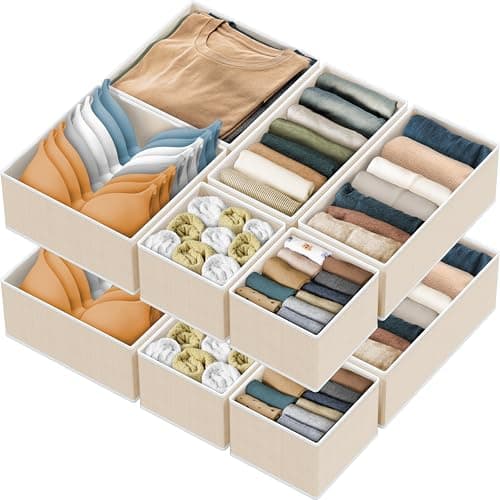
Soft fabric cubes, usually sold as a mixed-size set
Fit method
Placed loose in the drawer; no fixing and no tension
Published dimensions
Per-cube dimensions are stated on each listing and vary by set
What it gets right
Holds folded items vertically so nothing is buried
Mixed sizes fit an awkward drawer footprint better than fixed dividers
Lifts out to empty the drawer
What it does not
Cubes slide around a half-empty drawer
Soft sides give if you overfill them
Who it is for
Shallow drawers holding small folded items.
Skip this if
The drawer is deep. In a deep drawer, cubes leave dead air above the contents — a divider system that uses full height is better.
Matching the organizer to the drawer
What suits which drawer
Drawer
Contents
Use
Why not the others
Shallow, wide
Underwear, socks, t-shirts
Spring dividers
Trays waste depth; cubes slide when the drawer is not full
Deep
Jumpers, folded knits
Full-height dividers
Cubes leave dead air above the contents
Shallow, narrow
Jewelry, watches, small tools
Interlocking trays
Dividers cannot subdivide finely enough
Any, mixed contents
A bit of everything
Cubes in mixed sizes
Fixed dividers cannot absorb an irregular mix
Soft-sided or curved
Anything
Cubes only
Spring tension has nothing rigid to grip
Spring dividers need two parallel rigid drawer sides to work at all — that is their one hard requirement.
Everything here assumes you already have drawers. If you do not, the floor under your hanging clothes is where they go, and the units that fit it are on best closet drawer towers. What belongs in a drawer rather than on a shelf in the first place is settled on drawers vs shelves.
Why things move, and what to do about it
Spring dividers slip when packed clothing pushes sideways against them. Fill the sections evenly and do not over-pack; a section stuffed tight is pushing on the divider constantly.
Loose cubes slide when the drawer is not full. Fill the drawer front to back, or use fewer, larger cubes so there is nowhere to slide to.
Rigid trays stay put because they interlock with each other, which is their main advantage. The cost is that they only tile cleanly if the drawer's dimensions cooperate.
Everything moves in a soft-sided drawer. If the drawer sides flex, tension products are out and only loose cubes work.
A drawer given over to jewelry needs trays rather than dividers, because rings and chains behave differently from socks. The tray sets, and the hanging alternatives, are on best jewelry organizers for a closet.
Measuring before you buy
Measure the drawer's internal width at the front and at the back. Older drawers are not square, and a spring divider sized to the wider figure will not seat.
Measure the internal depth front to back, not the front panel.
Measure the usable height — the height under the drawer above, not the height of the drawer box.
Check the divider's stated range against the smaller of your two width measurements.
Buy one drawer's worth first. Doing an entire chest of drawers on an untested measurement is how these end up in a cupboard.
Two drawer problems have pages of their own now. Ties and belts rolled into fabric trays need a 13.39 in clear run, compared against the rod and wall alternatives on best tie and belt racks. In the kitchen, tea bags and coffee pods need between 2.5 and 3.8 in of drawer height, on best tea bag and coffee pod organizers.
FAQ
Questions people ask about this
What are the best drawer organizers?
Spring dividers for a drawer of folded clothing, interlocking rigid trays for small hard objects like jewelry and watches, and fabric cubes for a shallow drawer of rolled or mixed items. Match the type to the contents rather than buying one system for every drawer.
Do expandable drawer dividers stay in place?
They stay if the drawer has two parallel rigid sides and the sections are not over-packed. They slip when packed clothing pushes sideways against them, and they do not work at all in a soft-sided or curved drawer where the tension has nothing to grip.
How do you organize a deep drawer?
Full-height dividers and vertical folding — file items on edge rather than stacking them flat. Fabric cubes in a deep drawer leave dead air above the contents, which is the space you were trying to use.
What size drawer organizer do I need?
Measure the internal width at the front and the back, take the smaller figure, and check it against the divider's stated range. Also measure the usable height under the drawer above, not the height of the drawer box itself.
Are fabric or plastic drawer organizers better?
Plastic trays for small hard objects, because they interlock and stay put and wipe clean. Fabric cubes for soft folded items in a shallow drawer, because they fit an awkward footprint better than a rigid grid.
Sources
Where these figures come from
What is not a source hereWe have not handled these products. Nothing on this page is a test result, and no figure comes from a retailer listing, another publisher, or memory.