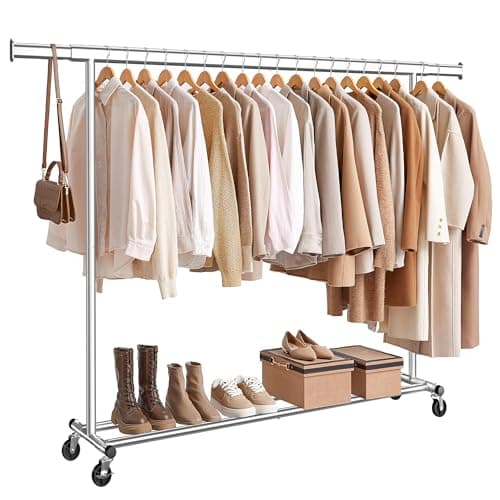
Racks do not bow because the tube is cheap. They bow because the rod spans the whole width with nothing under the middle.
By Scooter M.Published September 14, 2026Content updated September 14, 2026Prices verified September 14, 2026How we pick
Bin & Basket earns a commission when you buy through our links, at no extra cost to you. We are an Amazon Associate. We accept no free products, no sponsored placements and no paid inclusion, and commission rate plays no part in what we recommend. Full disclosure.
For most homes the SONGMICS rolling rack is the right buy: it states a 330 lb capacity, it rolls, and it costs a fraction of the commercial racks. If the rack is genuinely working — heavy coats, a market stall, a rack that has to last years — the Simple Houseware Z-base states 500 lb and uses the shape shops actually use. And if the problem is quantity of shirts rather than weight, a double-rod rack doubles capacity on the same footprint.
The thing that separates these is not steel thickness. It is whether the seller publishes a capacity at all, and how far the rod has to span between its end frames.
The span problem, which explains almost every bad review
A garment rack is a closet rod with legs, and it has exactly the same failure mode. ClosetMaid specifies one rod support every 36 inches of hang rod, plus one at each end. A 63 inch rack has its only supports at the two ends — a 63 inch unsupported span, nearly double what a fixed closet rod is allowed.
That is why wide racks bow in the middle and narrow ones do not, at the same steel gauge and the same load. It is geometry rather than quality, and it means the honest way to compare two racks is width-adjusted: a 63 inch rack carrying the same weight as a 36 inch one is working much harder. The full span arithmetic is on best closet rods and the published figures across the category are on shelf span and weight.
If you can, buy narrower and buy two. Two 36 inch racks hold the same clothes with half the span each, and they fit more layouts.
If you must go wide, go commercial gauge. The Z-base racks are wide and heavy specifically because they are designed for the span.
Do not fill the middle. Where you put the heaviest coats on the rod changes the sag more than the total weight does.
How this page is ranked
Does the seller publish a load capacity at all? Most do not. A stated figure is not a manufacturer spec sheet, but it is far better than nothing and it is the first filter.
Base shape. A Z-base resists sideways racking and lets racks nest; four separate legs do neither. This is why every shop uses the same shape.
Unsupported rod span, as above.
Rod height against your longest garment. A rack that is 60 inches tall overall gives you less than that in hanging drop, and a maxi dress or a long coat will touch the floor.
Wheels or feet. Wheels are convenience and a failure mode; feet are steadier and stay put.
What each rack publishes
Seller-published figures for the racks on this page
Rack
Published capacity
Base / wheels
Rod configuration
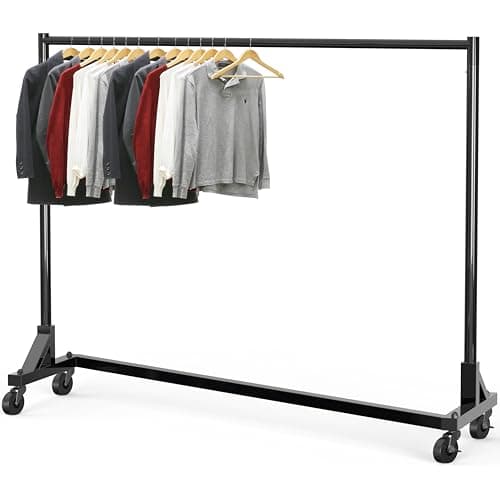
Simple Houseware Z-Base 63 in
500 lb, seller-stated
Z-base, casters
Single rod, 63 in unsupported span
SONGMICS Rolling
330 lb, seller-stated
Four legs, casters
Single rod, plus a lower shelf
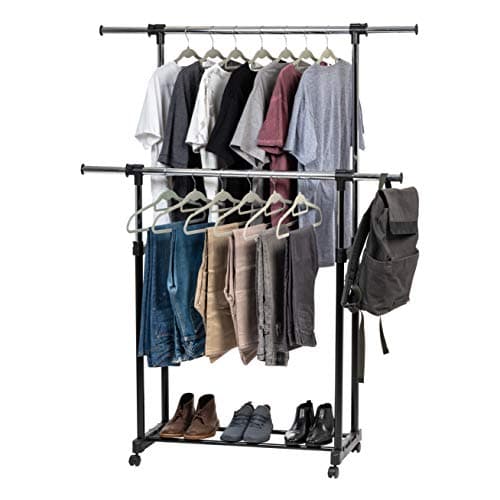
IRIS USA Double-Rod
Not published
Four legs, adjustable
Two rods, height adjustable, extendable width
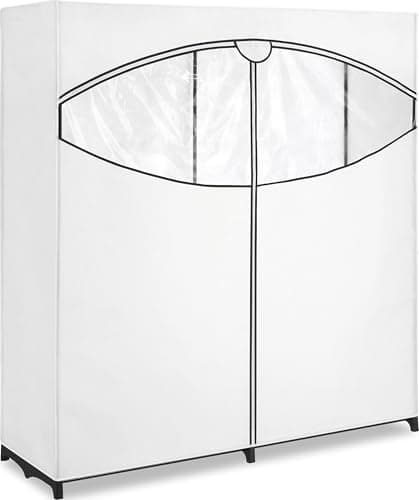
Whitmor Covered Closet 60 in
Not published
Four legs
Single rod, zip-on fabric cover
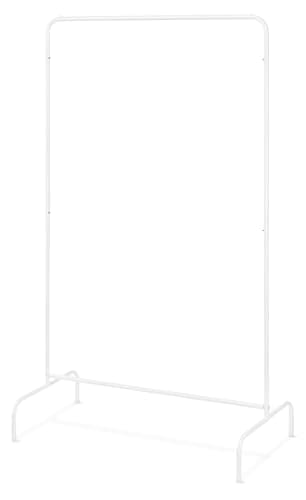
Whitmor Freestanding
Not published
Four legs
Single rod, most models with a lower shelf
Capacities here are the figures sellers state on the listing, not manufacturer specification sheets - a weaker class of source than the installation manuals we cite for fixed closet systems, and labeled as such. Where no figure is stated, the row says so rather than carrying an estimate.
#
Product
Best for
Score
Price
01
SONGMICS Rolling Clothes Rack, 330 lbPublishes a capacity, rolls, and costs a fraction of the commercial racks - which makes it the sensible default for a domestic wardrobe.
Simple Houseware Industrial Grade Z-Base Garment Rack, 63 inThe commercial shape, and the only rack here whose seller states a capacity high enough that the rod is no longer the thing you worry about.
IRIS USA Portable Double-Rod Height-Adjustable Clothes RackTwo rods on one footprint, which roughly doubles capacity for anything that hangs short - and does nothing at all for coats.
Whitmor 60 in Extra-Wide Clothes Closet with CoverA rack with a zip-on cover, which is the difference between open storage and something that keeps dust off the shoulders.
Scores are our own, from the published rubric on the methodology page. They are editorial judgments about published specifications, not test results — we have not handled these units.
01
A stated figure at a sensible price
SONGMICS Rolling Clothes Rack, 330 lb
Publishes a capacity, rolls, and costs a fraction of the commercial racks - which makes it the sensible default for a domestic wardrobe.
500 lb, as stated by the sellerSource: Seller-stated capacity on the product listing
Width
63 in
Base
Z-base - two Z-shaped end frames rather than four legs
Wheels
Casters fitted
Rod supports between the ends
Not published by the manufacturer in a form we could verify - the rod spans the full 63 in width
What it gets right
500 lb is a seller-stated figure well past anything a domestic wardrobe applies
The Z-base is why shops use this shape: it resists racking sideways and lets two racks nest
Heavy enough gauge that the rod does not visibly bow under a full load
What it does not
63 in of rod with no intermediate support is a long unsupported span, and span is what makes rods sag
Commercial looks - this is shop-floor furniture and it does not pretend otherwise
Heavy and bulky to move even on casters, and awkward to store when not in use
Who it is for
Heavy coats, a market stall, a wardrobe overflow that has to last, or anywhere the rack is genuinely working.
Skip this if
The rack is going in a bedroom you care about the look of. This is the right answer for a utility room, a fitting area or a renovation, and the wrong one for a made-up bedroom.
03
Shirts, where two rods beat one
IRIS USA Portable Double-Rod Height-Adjustable Clothes Rack
Two rods on one footprint, which roughly doubles capacity for anything that hangs short - and does nothing at all for coats.
Steel tube frame with a single hang rod, most models with a lower shelf
Published load
Not published by the manufacturer in a form we could verify consistently across the range; check the specific model listing.
What it gets right
Works in a room with no closet at all
Moves without leaving a mark
Cheap enough to be a stopgap rather than a commitment
What it does not
Tube frames flex; a fully loaded rack leans
Nothing is behind a door, so the room reads as a wardrobe
Who it is for
A bedroom with no closet, an overflow season change, or a temporary set-up during a renovation.
Skip this if
You need the clothes out of sight. This is open hanging storage and it always looks like it.
Rod height is the measurement people forget
Racks are sold on overall height, and what you actually need is hanging drop — the distance from the rod down to the floor, minus clearance.
A shirt occupies roughly 38 inches on the hanger, a suit jacket a little more, and a long coat or a maxi dress can want 60 inches or more. A rack with an overall height of 60 inches gives you well under that once the frame is accounted for, which is why long garments end up brushing the floor on a rack that looked tall enough in the listing. The garment-length figures are on reach-in closet dimensions.
Wheels, and when they are the wrong choice
Casters look like a pure upgrade and they are a trade.
For: you can move a loaded rack to clean behind it, reconfigure a room, or wheel it out of the way. On a hard floor that is genuinely useful.
Against: a rack on casters moves when you slide a hanger along the rod, which is every time you use it. Locking casters solve this and only if you actually lock them.
Against: on carpet, casters sink and steer badly, and a fixed-foot rack is steadier.
Against: wheels raise the rod height slightly, which cuts into your hanging drop.
The honest rule: buy wheels if the rack will genuinely move, feet if it will not. A rack that lives in one corner of a spare room does not need them.
Covered racks, and the moisture trade
A zip-on cover turns an open rail into something closer to a wardrobe, and it solves the real problem with open hanging storage: dust settling on shoulders.
What it introduces is still air. A covered rack in a damp or poorly ventilated room is a small closet with no airflow, and that is exactly the mechanism behind a musty smell — set out on why your closet smells musty. Fabric covers are better than sealed plastic here because they breathe, but they do not ventilate.
So: cover it if the room is dry and the rack is on show. Leave it open if the room is damp, or if the clothes are wool and going to sit for a season — in which case the storage answer is on best off-season clothes storage.
When a rack is the wrong answer
You have a closet and it is badly used. A rack adds a second rail to a room that already has one. Slim hangers and a second rod inside the closet are cheaper and less visible — the order is on best budget closet organizers.
You want the clothes out of sight. Open hanging storage always looks like open hanging storage, and a cover only partly fixes that.
You can fix to the wall. A wall-mounted system carries load into studs and takes no floor at all, at a similar price. The comparison is on best wire closet shelving.
The floor is the constraint. A rack takes its full footprint permanently, where a wall system takes none.
Where a rack genuinely wins is the case the wall cannot serve: a rented room you may not drill, a bedroom with no closet at all, or a temporary set-up during a renovation. That case is covered in full on renter-friendly closet organizers.
What we are not telling you
We have not loaded any of these racks. The capacities quoted are the figures sellers state on the listing, which is a weaker class of source than the installation manuals we cite for ClosetMaid, Rubbermaid and Elfa — and we have labeled them that way rather than presenting them as verified specifications. Where no figure is stated, the row says so.
The span reasoning is not a rack-specific finding either: it is ClosetMaid's published rod-support spacing applied to a rack's geometry, and you can check that arithmetic yourself. Every price on this page is live from the retailer at the moment you look. The method is on how we pick.
FAQ
Questions people ask about this
What is the best garment rack?
For most homes, a rolling rack with a stated capacity — SONGMICS states 330 lb, which is far beyond what a domestic rail of clothes weighs. For a rack that is genuinely working, a commercial Z-base states 500 lb and uses the shape shops use because it resists racking sideways.
Why do garment racks sag in the middle?
Because the rod spans the entire width with supports only at the two ends. ClosetMaid specifies a rod support every 36 inches for fixed closet rods, so a 63 inch rack is running nearly double that unsupported span. It is geometry, not steel quality — which is why two narrow racks beat one wide one.
How much weight can a garment rack hold?
It varies enormously and most sellers do not say. Where a figure is stated it ranges from about 330 lb on a domestic rolling rack to 500 lb on a commercial Z-base. Treat these as seller-stated rather than as manufacturer specifications, and note that where a rack publishes nothing you are guessing.
How tall should a garment rack be?
Tall enough for your longest garment plus clearance. Measure hook to hem on your longest coat — a shirt needs about 38 inches, a long coat or maxi dress can want 60 or more, and a rack sold as 60 inches tall gives you noticeably less hanging drop than that once the frame is accounted for.
Are rolling garment racks better than fixed ones?
Only if the rack will actually move. Casters let you shift a loaded rack to clean behind it, and they also mean it rolls away when you slide a hanger along the rod unless you lock them. On carpet they sink and steer badly, and they eat slightly into your hanging drop.
Should a garment rack have a cover?
Cover it if the room is dry and the rack is on show, because a cover keeps dust off shoulders. Leave it open if the room is damp or badly ventilated — a covered rack is a small closet with still air, which is how a musty smell starts. Fabric breathes; sealed plastic does not.
Is a garment rack better than a closet system?
Only where the wall is not an option. A wall-mounted system carries load into studs, takes no floor and costs about the same. A rack wins in a rental you may not drill, a bedroom with no closet, or a temporary set-up — and it always takes its full footprint permanently.
Sources
Where these figures come from
Garment rack load figures, as published by the sellerUnlike the closet systems on this site, garment racks are sold without manufacturer spec sheets. Where a capacity appears here it is the figure the seller states on the listing itself - useful, and a weaker class of source than an installation manual. Where no figure is stated, the row says so.
Availability check, 14 September 2026Every rack on this page was resolved through the Amazon Creators catalog on that date and carried a New buy-box offer at the time of writing.
What is not a source hereWe have not handled these products. Nothing on this page is a test result, and no figure comes from a retailer listing, another publisher, or memory.