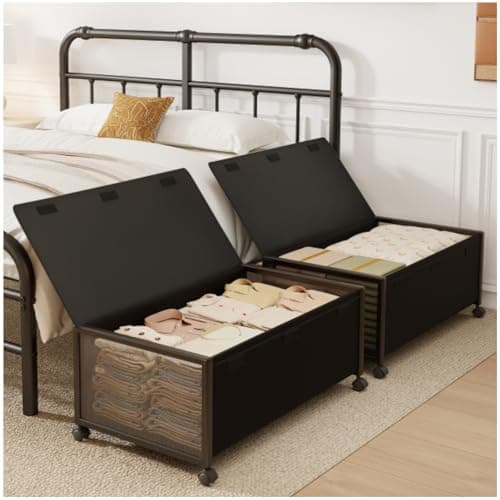
Every one of these fits under some bed. The only question worth asking is how many inches you have between the floor and the frame.
By Scooter M.Published September 21, 2026Content updated September 21, 2026Prices verified September 21, 2026How we pick
Bin & Basket earns a commission when you buy through our links, at no extra cost to you. We are an Amazon Associate. We accept no free products, no sponsored placements and no paid inclusion, and commission rate plays no part in what we recommend. Full disclosure.
Measure from the floor to the underside of your bed frame before you buy anything, because that number eliminates most of this category. With 7 inches or more, the Yecaye rolling containers are the pick: they state the clearance they need, they state a 66 lb load, and they roll rather than drag. Under 7 inches, the Lifewit shoe organizer has a stated 4.3 inch profile and almost nothing else will go in. If you want to see the contents, the 66 quart clear box is 7 inches tall with a latching lid. And if your bed is on risers, the Fokyfok is 12 inches tall and states 80 lb.
Under-bed space is the largest unused volume in most bedrooms and the most commonly bought-wrong, because listings sell capacity in quarts and the constraint is inches of clearance.
The clearance measurement, and what to subtract from it
Measure floor to frame at the lowest point, not at the corner. Then take that figure and subtract, because the listed height of a container is not the space it needs:
Wheels are included in some heights and not others. The Yecaye publishes 6.69 in with the wheels fitted and separately states it needs over 7 in of clearance - which tells you the seller expects an inch of working room.
A lid needs room to open, unless you pull the box fully clear of the bed every time. Latching boxes want the extra inch.
Carpet compresses, then recovers. A box that slides in on a flattened pile catches on the way out.
Bed frames have center supports. A 39.5 in long box may not pass a central leg, so measure the clear run as well as the height.
Published height and load for the under-bed options here
Container
Height
Footprint
Stated load
Wheels
Lifewit shoe organizer
4.3 in profile
30 x 23 in
Not published
No
Yecaye rolling container
6.69 in with wheels, needs over 7 in
30.71 x 16.93 in
66 lb
Yes, 4
66 qt clear box
7 in
39.5 x 20.25 in
Not published
Yes
Sterilite 56 qt wheeled box
Not published here
Not published here
Not published
Yes
Amazon Basics fabric bags
6 in
42 x 18 in
Not published
No
Fokyfok tall container
12 in
31 x 17 in
80 lb
Yes
Heights, footprints and loads as published by the sellers on their listings, retrieved 21 September 2026. Loads are seller-stated with no test method given. Only one listing states the bed clearance it requires, which is the figure the whole category should publish.
How this page is ranked
Published height, with wheels included. This is the pass-or-fail figure and it is the first thing on every card here.
Whether the listing states the clearance it needs. One does. That is the difference between a specification and a photograph.
Stated load, treated as a seller claim. Two of these publish one; the rest do not.
Wheels or no wheels, because dragging a loaded fabric box across carpet is how under-bed storage stops being used.
Rigid or soft. Rigid protects and stacks; soft compresses into a low clearance and folds away when empty.
#
Product
Best for
Score
Price
01
Yecaye Under-Bed Storage with Wheels, 2-PackThe only under-bed container here whose listing states the clearance it needs - more than 7 inches - which is the one number that decides whether it slides under your bed at all.
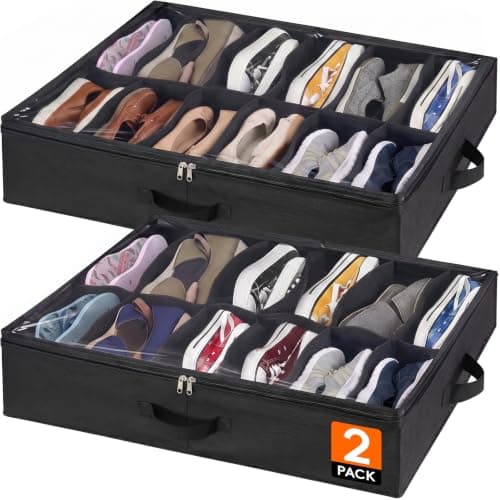
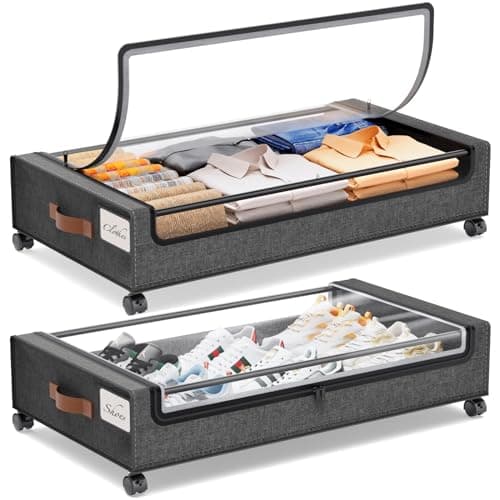
Lifewit Under-Bed Shoe Organizer, 4.3 in Profile, 2-PackAt a stated 4.3 inch profile it goes under beds that reject every rigid bin, and 12 cells per unit means shoes stop stacking on each other.
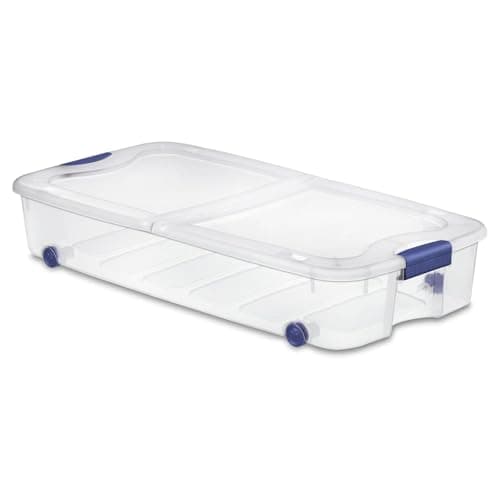
Generic 66 Quart Clear Under-Bed Container with WheelsRigid, clear and latched at 66 quarts, which is the honest answer when the fabric bins keep collapsing and you cannot remember what is in them.
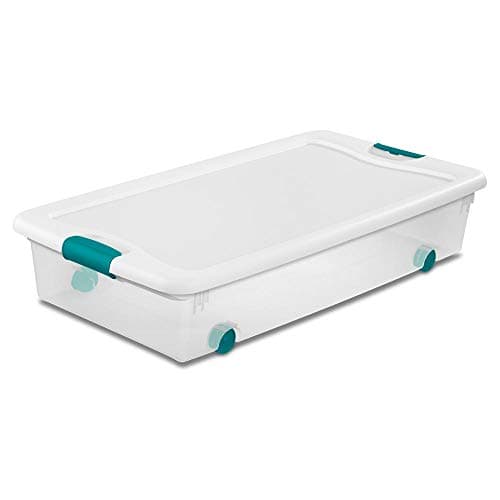
Sterilite 56 Qt Wheeled Latching Storage BoxRigid, wheeled and latching - the combination that makes under-bed storage something you actually open rather than something you forget.
Fokyfok 12 in Tall Under-Bed Storage Containers, 2-PackTwelve inches tall and a stated 80 lb, which is built for a bed that has been raised deliberately rather than a standard frame.
Scores are our own, from the published rubric on the methodology page. They are editorial judgments about published specifications, not test results — we have not handled these units.
01
The clearance figure is published
Yecaye Under-Bed Storage with Wheels, 2-Pack
The only under-bed container here whose listing states the clearance it needs - more than 7 inches - which is the one number that decides whether it slides under your bed at all.
31 in L x 17 in W x 12 in HSource: Retailer catalog listing, retrieved 21 September 2026
Published load
80 lb, as stated by the seller - the highest hereSource: Seller-stated capacity on the product listing
Construction
Iron pipe frame with platesSource: Retailer catalog listing, retrieved 21 September 2026
Wheels
360-degree rolling wheelsSource: Retailer catalog listing, retrieved 21 September 2026
Pack
2 unitsSource: Retailer catalog listing, retrieved 21 September 2026
What it gets right
The highest stated load here at 80 lb, on a metal rather than fabric frame
12 in of height is roughly double the usual under-bed box, so bulky bedding goes in uncompressed
Wheels on a heavy container are the difference between using it and never opening it
What it does not
12 in of clearance rules out most standard bed frames - this needs risers or a tall platform
The most expensive under-bed option here for the same footprint as cheaper bins
Metal frames with fabric panels still sag at the panel, not the frame
Who it is for
A bed already on risers, a platform bed, or a loft frame with real space beneath it.
Skip this if
Your bed sits at a normal height. Measure first; 12 in of clear space under a frame is uncommon.
Rigid, fabric or bag
Three constructions, and the choice follows your clearance more than your contents.
Rigid plastic keeps dust out, stacks in a closet when it comes out from under the bed, and protects what is inside from a vacuum cleaner. It also needs the most clearance and cracks at the latch if dragged loaded.
Fabric over a frame rolls, holds shape while it has something in it, and sags when half empty. The Yecaye is the example here, and the 300D fabric over a metal frame is why it can state 66 lb.
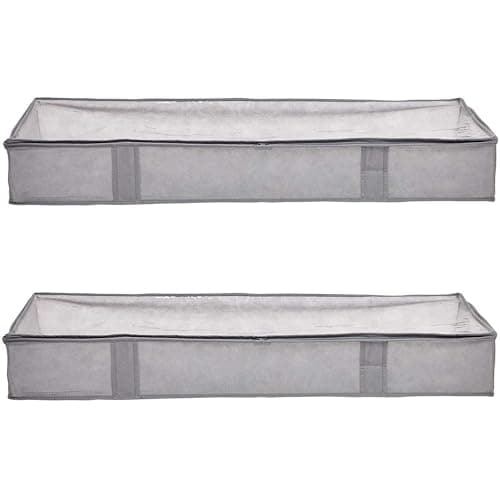
Plain zip bags compress to whatever is inside them, which is how they fit a low frame, and they fold flat when the winter bedding comes back out. They protect against dust and nothing else.
For clothes specifically - which is what most under-bed space ends up holding - the fiber question matters more than the container. Wool wants to breathe and vacuum bags are the wrong answer for it; that reasoning is set out on best off-season clothes storage, which is the page to read if you are storing a wardrobe rather than using up a gap.
Shoes are a different problem
A shoe organizer is not a box with dividers in it: the cells are sized so one pair sits flat without stacking, which is why a 4.3 inch profile works. The Lifewit states 12 cells per unit and the seller notes that thick-soled shoes take one shoe per cell rather than a pair - an unusually honest bit of listing copy, and worth believing.
What it does not do is protect. Cardboard-stiffened fabric sides under a bed, where dust gathers and damp collects against an exterior wall, is a short-term arrangement for shoes you wear rather than long-term storage for shoes you value. The closet-side options are on best closet shoe racks.
Acceptable with a sealed box: off-season clothes in cotton or synthetics, checked occasionally.
Bad: anything you need weekly, because you will stop pulling the box out by week three.
Bad: paper, photographs and documents against an exterior wall, where a cold floor and warm room air meet.
Bad: wool knitwear in a sealed bag for a whole season. It wants air, and the clothes moth risk is real.
Dust and damp, the two things under a bed
Under a bed is a still-air space at floor level, which is where household dust settles and where the coldest air in a heated room sits. Both matter for anything stored there over a season.
Dust falls, so lids matter more than sides. An open-topped bin under a bed collects a visible layer within weeks. A latching lid or a zipped bag is the difference between storing clothes and storing dusty clothes.
Cold floors plus warm room air is how condensation happens, particularly against an exterior wall. That is an argument for breathable fabric over sealed plastic for textiles, and for keeping paper and photographs out entirely.
Vacuuming under a bed stops happening once containers live there. If the room has carpet, pull the containers out twice a year, which is also when you should be checking what is inside them.
Wool is the exception to sealing. Sealed, undisturbed and dark is exactly the environment clothes moths want. Wool wants air and periodic disturbance.
Bed risers, and when they are the better purchase
If the clearance measurement rules out everything you want, there is a second lever: raise the bed rather than flatten the container.
Risers add a few inches under each leg and turn a frame that takes nothing into one that takes a 12 inch container - which is the case the Fokyfok here is built for. The trade is that the bed gets higher to climb into, the mattress sits further from a low window, and a frame on risers is less stable laterally than one on its own feet. On a divan or a platform bed with a solid base there is nothing to raise in the first place.
The honest comparison is: risers plus a tall container hold far more than a low container alone, and they change how the bed feels to use. Measure first and decide whether the extra volume is worth it before buying either.
A rotation that keeps the space useful
Under-bed storage fails in a specific way: it works for one season, then becomes the place things go to be forgotten. The fix is a routine rather than a product.
Label the end of the container, not the top. The end is the only part you can see without pulling it out.
One category per container. Mixed containers are why people stop opening them.
Swap twice a year, when the clocks change. Winter bedding comes out, summer bedding goes in, and both containers get checked while they are open.
If a container is untouched at the second swap, its contents are storage rather than clothing. That is the moment to decide whether it should exist at all.
Measuring, step by step
This is the whole purchase, and it takes about two minutes with a tape measure.
Floor to the underside of the frame, at the lowest point along the side you will load from. On a bed with a valance, measure the frame rather than the fabric.
Subtract an inch for a lid that opens, wheels that need to roll over a carpet edge, and the general reality that a box scraping its way in will stop being used.
Measure the clear run between the legs. This is the figure people skip, and it is why a 39.5 in box arrives and does not pass the center support.
Measure the depth from the side of the bed to the middle. A container deeper than your arm's reach has a back third you will never use.
Check both sides. Many beds sit against a wall, so everything has to load from one side, which halves the practical capacity of the space.
Those five numbers rule almost every product in or out before you look at a single listing, which is the right order to do this in. Capacity in quarts is a comparison between containers that already fit - it is never the thing that decides whether one fits.
One honest caveat: bed frames vary enormously, from platform beds with 3 inches of clearance to iron frames with 14. There is no standard to design around, which is exactly why the listings that publish a required clearance are more useful than the ones that publish a volume.
Renting, and moving with it
Under-bed storage is the one category in this hub that needs no fixings, no wall and no permission, which makes it the default answer in a rented room where a closet system is out of the question.
It also has to move when you do. Fabric bags fold flat into nothing and travel inside a suitcase; rigid boxes do not fold and take van space whether full or empty; wheeled containers are the most useful in place and the most awkward in a move. If you expect to move within a year or two, that argues for bags and lightweight fabric containers over the rigid boxes, even though the rigid ones protect their contents better while they are under the bed.
What we are not telling you
We have not loaded, rolled or measured any of these containers. Heights, footprints and loads are the figures sellers publish on their listings, retrieved on 21 September 2026, and where a listing publishes no load the table and the card say so instead of estimating one.
The clearance advice is arithmetic and not a test: a container's listed height plus room to open a lid has to be less than the gap under your frame, and a wheel adds to the height rather than the capacity. Prices are live from the retailer at the moment you look. The method is on how we pick.
FAQ
Questions people ask about this
How much clearance do I need for under-bed storage?
More than the container's listed height, because a lid needs room to open and carpet compresses. The Yecaye is 6.69 inches tall with its wheels and its seller states it needs over 7 inches of clearance, which is a good rule of thumb for the gap between the listed height and the space required.
What fits under a bed with low clearance?
Under about 6 inches, a fabric bag or a purpose-made shoe organizer. The Lifewit states a 4.3 inch profile, which is the lowest here, and plain zip bags compress to whatever is inside them. Rigid boxes with wheels generally need 7 inches or more.
Are under-bed storage containers with wheels better?
For anything heavy, yes. A loaded fabric box dragged across carpet is the reason people stop using the space under their bed. Wheels add to the height though, so check whether the listed height includes them - the Yecaye's 6.69 inches does.
How much weight can under-bed storage hold?
Only two of these publish a figure: 66 lb for the Yecaye and 80 lb for the Fokyfok, both seller-stated with no test method. The rest publish nothing, so treat unrated fabric containers as suitable for bedding and clothes rather than books or tools.
Is it bad to store clothes under the bed?
Not if the container seals and the room is dry. The risks are dust, damp against an exterior wall, and moths in natural fibers left undisturbed for a season. Wool in particular wants air rather than a sealed bag - the fiber-by-fiber guidance is on our off-season clothes storage page.
What size under-bed storage box should I buy?
Height first, from your clearance. Then check the length against the clear run between your bed's legs - a 39.5 inch box will not pass a central support on many frames. Capacity in quarts is the last thing to look at, not the first.
Sources
Where these figures come from
Product figures, as listed in the retailer catalog (21 September 2026)Dimensions, capacities, counts, materials and any stated load for every product added in this expansion, taken from the Amazon catalog and the sellers' own listing text through the Creators API on 21 September 2026. These are listing figures rather than manufacturer specification sheets, and each row is labeled that way. Where a listing states a load or a clearance requirement, it is quoted as the seller's figure. Where nothing is published, the row says so instead of carrying an estimate.
Garment rack load figures, as published by the sellerUnlike the closet systems on this site, garment racks are sold without manufacturer spec sheets. Where a capacity appears here it is the figure the seller states on the listing itself - useful, and a weaker class of source than an installation manual. Where no figure is stated, the row says so.
Availability check, 21 September 2026Every product added in this expansion was resolved through the Amazon Creators catalog on that date and carried a New buy-box offer at the time of writing. Products without a current offer were excluded before the pages were written.
What is not a source hereWe have not handled these products. Nothing on this page is a test result, and no figure comes from a retailer listing, another publisher, or memory.