Twelve changes, ordered by how much space each one genuinely gives back rather than by how good it looks in a photograph.
By Scooter M.Published September 1, 2026Content updated September 1, 2026Prices shown live on AmazonHow we pick
Bin & Basket earns a commission when you buy through our links, at no extra cost to you. We are an Amazon Associate. We accept no free products, no sponsored placements and no paid inclusion, and commission rate plays no part in what we recommend. Full disclosure.
The three highest-return changes in a closet are, in order: switch to slim hangers, add a second rod across part of the width, and put a stackable rack on the floor. All three are cheap, none requires a new system, and between them they usually recover more space than the closet was short of. Everything below them on this list is a smaller gain.
Most closet ideas lists are sorted by photogenic. This one is sorted by space recovered per pound spent, which produces a different and much shorter list at the top.
Ranked by what each one costs against what it returns, the same list becomes a shopping order - that version is on best budget closet organizers.
The changes, ranked
What each change gives back
#
Change
Space recovered
Effort
01
Switch to slim flocked hangers
Often 30 to 50 percent more garments on the same rod
An hour
02
Double hang across part of the width
About 38 in of new hanging drop
An afternoon
03
Stackable rack on the closet floor
Three to four levels where there was one heap
Ten minutes
04
Second shelf above the existing shelf
One full shelf of flat storage
An afternoon
05
Over-door organizer, solid hinged doors only
A whole surface that was doing nothing
Two minutes
06
Bins on the shelves
No new space, but the existing space becomes usable
Ten minutes
07
Fold knits instead of hanging them
Rod length, plus the garments last longer
An hour
08
Move out-of-season clothing
Roughly half the rod, twice a year
An hour
09
Add light
No space, but you use what you have
Ten minutes
10
Hanging fabric tower on the rod
Folded storage, at the cost of rod length
Two minutes
11
Under-shelf basket on a thick-free shelf
The dead air under a shelf
Two minutes
12
Replace a sagging rod and add a mid-support
No new space, but the rod stops dropping
An hour
Ordered by space recovered per pound spent. Rows 1 to 3 account for most of the total in most closets.
#
Product
Best for
Score
Price
01
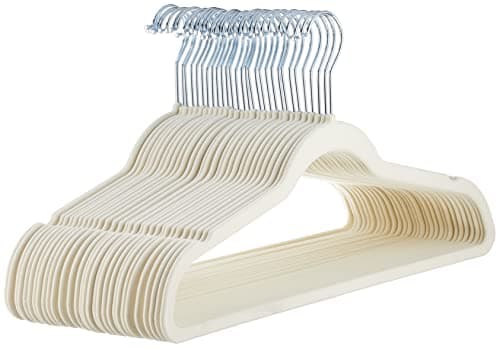
Amazon Basics Velvet Slim Non-Slip HangersA slim flocked hanger is the cheapest way to add hanging capacity to a closet you cannot make wider.
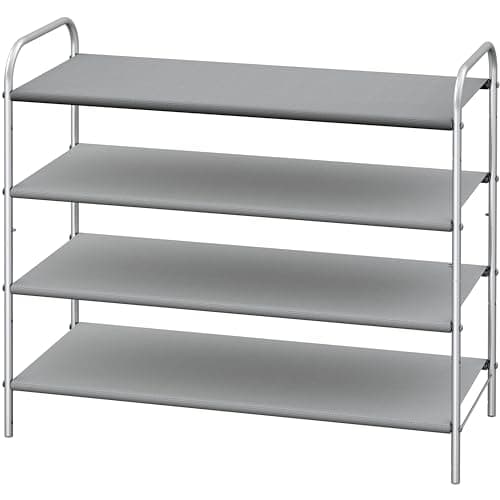
Simple Houseware 4-Tier Stackable Shoe RackA stackable metal frame that turns closet floor into four usable levels, and stacks further if the closet is tall.
No imagemDesign Fabric Storage Bins with HandlesSoft-sided bins that turn an untidy shelf into labeled blocks, and collapse flat when you stop needing them.
Scores are our own, from the published rubric on the methodology page. They are editorial judgments about published specifications, not test results — we have not handled these units.
01
Getting more onto the same rod
Amazon Basics Velvet Slim Non-Slip Hangers
A slim flocked hanger is the cheapest way to add hanging capacity to a closet you cannot make wider.
Slim flocked plastic, materially thinner than a molded plastic hanger
Grip
Flocking holds wide necklines and satin that slide off smooth plastic
Capacity effect
Rod capacity is a function of hanger thickness — thinner hangers, more garments per foot
Published per-hanger load
Not published by the manufacturer in a form we could verify for flocked hangers as a class.
What it gets right
The single highest-impact cheap change in a crowded closet
Nothing slides off, which is the daily annoyance flocking actually fixes
A uniform hanger set makes a closet look organized on its own
What it does not
The plastic core snaps under a heavy winter coat
Flocking sheds onto dark clothing when new
Who it is for
Anyone whose closet is full because the hangers are thick, which is most people who think they have a space problem.
Skip this if
You are hanging tailoring or heavy coats. Slim hangers crease shoulders and the plastic core is not built for the weight — use wooden suit hangers for those.
02
A closet floor with shoes on it
Simple Houseware 4-Tier Stackable Shoe Rack
A stackable metal frame that turns closet floor into four usable levels, and stacks further if the closet is tall.
Soft fabric with a reinforced base and cut-out or sewn handles
Shelf depth fit
Sized for standard 12 to 16 in shelving; measure before ordering
Stackability
Not stackable when full — the sides carry no load
Published dimensions
Per-size dimensions are published on each listing; they vary by model
What it gets right
Cheap, light and quiet on a wire shelf
Handles make a high shelf actually usable
Fold flat when not in use
What it does not
Sides collapse inward when half empty
Nothing stacks on top of a fabric bin
Who it is for
Shelf storage for soft goods — linens, accessories, off-season clothing.
Skip this if
You need to stack. Fabric sides carry no load; a rigid clear box is the answer if things must go on top of each other.
01. Slim hangers, which are almost always the answer
A slim flocked hanger is about a quarter of an inch thick against roughly half an inch for a molded plastic one. Forty shirts occupy about 10 inches of rod on slim hangers and about 20 on the plastic ones you inherited. The clothes are identical; the rod is half as full.
Do this before buying anything structural. It is cheap, reversible and immediate, and it tells you whether your problem was capacity or hanger thickness — which is a distinction most people never make. Full detail on best hangers by garment.
02. Double hang, but only across part of the width
A shirt or a folded trouser occupies about 38 inches from hook to hem. A single rod at 66 inches leaves roughly three feet of unused air beneath it, and a second rod recovers that. What you must not do is convert the whole width — that leaves nowhere for a dress or a coat.
Two thirds double hung, one third full height, is the arrangement that suits most wardrobes. The rod heights and the ceiling heights that allow it are on reach-in closet dimensions.
03. The floor, which is nearly always a heap
Under a double-hang lower rod there is about 40 inches of clear vertical space, and it is usually holding one layer of shoes. A stackable tier rack turns it into three or four levels, needs no fixings, and lifts out when you want to clean. Shoe racks covers the choice, including why boots need different treatment.
One place where hooks beat every hanging idea here is the closet by the front door, where everything is used daily and in a hurry - that case is on organizing a coat closet.
The ideas that do not work as well as they look
Matching boxes on every shelf. They photograph beautifully and they hide what is inside. If you cannot see it you will not use it — clear boxes or labels, always.
Hanging organizers in a small closet. They add folded storage by consuming rod length, which in a small closet is the scarcest thing you have.
Tension rods for a second hanging level. No manufacturer publishes a load-versus-span figure and they come down under real clothing. See renter-friendly organizers.
Vacuum bags for everyday clothing. Fine for genuine long-term storage; miserable for anything you need this month.
Color-sorting. It looks wonderful and it makes finding a specific garment harder, because you search by item, not by color.
FAQ
Questions people ask about this
What is the best way to organize a closet?
In order of return: switch to slim hangers, add a second rod across part of the width, and put a stackable rack on the closet floor. Those three are cheap and account for most of the space available in a typical closet.
How do you get more hanging space in a closet?
Slim hangers first, which often gains 30 to 50 percent on the same rod. Then double hang across part of the width, which adds about 38 inches of new hanging drop. Then move anything knitted to a drawer, because it should not be hanging anyway.
Should you double hang the whole closet?
No. That leaves nowhere for a dress or a long coat. Double hang across roughly two thirds of the width and keep the remaining third as a single full-height section.
What closet organization ideas are not worth doing?
Opaque matching boxes, which hide what is inside; hanging organizers in a small closet, which consume the rod length you are short of; and tension rods used as a second hanging level, which have no published load-versus-span figure and come down under real clothing.
How often should you reorganize a closet?
Twice a year is enough, aligned with moving out-of-season clothing. That single habit recovers roughly half the rod each time and forces the sort that everything else depends on.
What is not a source hereWe have not handled these products. Nothing on this page is a test result, and no figure comes from a retailer listing, another publisher, or memory.