Depth past about 16 inches stops being storage and starts being a place things expire. Here is how to get it back.
By Scooter M.Published September 1, 2026Content updated September 1, 2026Prices shown live on AmazonHow we pick
Bin & Basket earns a commission when you buy through our links, at no extra cost to you. We are an Amazon Associate. We accept no free products, no sponsored placements and no paid inclusion, and commission rate plays no part in what we recommend. Full disclosure.
Depth stops being useful at roughly 16 inches, because past that you are storing food behind food. The fix is not to reorganize but to add hardware that brings the back row forward: pull-out bins, gravity can dispensers, tiered racks that raise the rear, or simply treating the back half as long-term storage with a rule about what may go there.
This is a structural problem and it has structural answers. No amount of tidying makes a 24 inch shelf behave like a 12 inch one, and the recommendation to keep pantry shelves at 12 to 16 inches exists precisely because of it — see pantry shelf depth and spacing.
#
Product
Best for
Score
Price
01
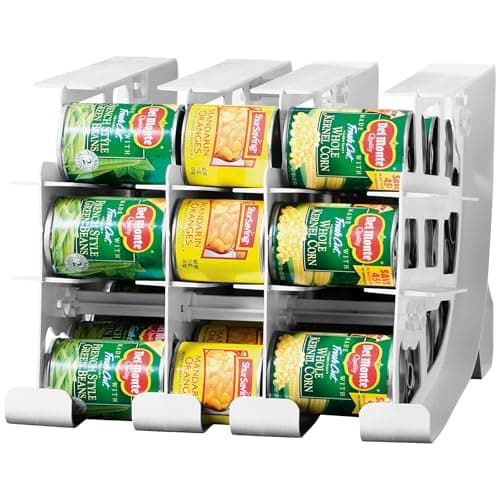
FIFO First-In-First-Out Can DispenserCans roll to the front as you take one, which enforces rotation instead of asking you to remember it.
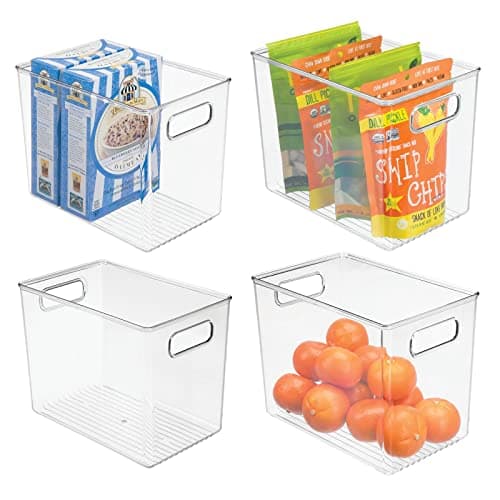
mDesign Clear Plastic Pantry Bins with HandlesOpen-top clear bins that turn the pile of half-open packets into a category you can pull out in one movement.
Scores are our own, from the published rubric on the methodology page. They are editorial judgments about published specifications, not test results — we have not handled these units.
01
Rotating stock so nothing expires
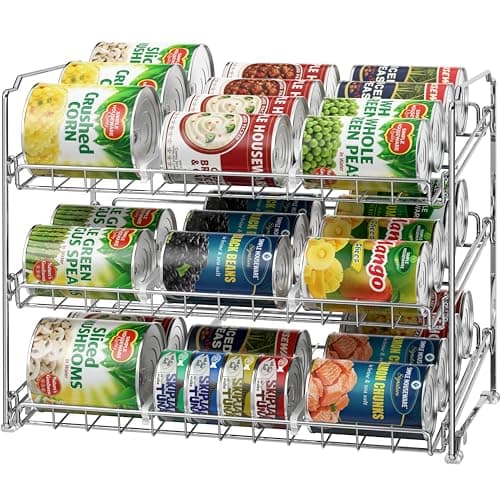
FIFO First-In-First-Out Can Dispenser
Cans roll to the front as you take one, which enforces rotation instead of asking you to remember it.
Tiered steps, so back rows sit higher than front rows
Shelf spacing needed
More than a flat row of tins: the top step raises the rear cans
Why it works
Standard cans are 4 to 5 in tall, and pantry shelves are commonly spaced 7 in for canned goods, which leaves the headroom a tiered rack needsSource: Dimensions.com pantry storage heights
Published capacity
Stated per model on the listing
What it gets right
Every label is readable without unloading the shelf
Uses the vertical headroom a flat row of tins wastes
Freestanding — lift it out to clean the shelf
What it does not
Only works for uniform can heights; tall tins foul the step above
Takes more shelf depth than stacking tins flat
Who it is for
Anyone whose tinned food lives three rows deep on a shelf.
Skip this if
Your shelf spacing is 6 inches or less. A tiered rack needs headroom above a 4 to 5 in can, and a tight spacing removes it.
03
Stacking on a deep shelf
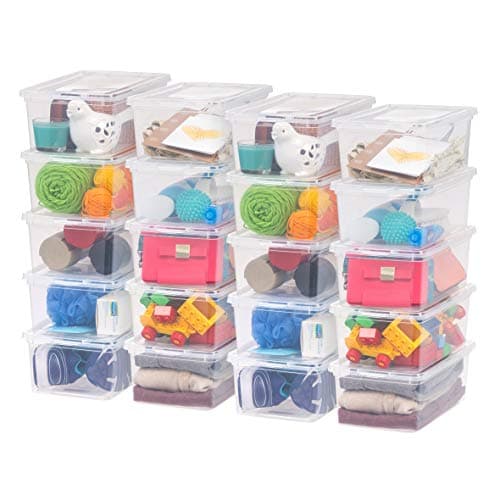
IRIS USA Stackable Storage Bins with Lids
Rigid stackable boxes in sizes that actually match a 12 to 16 inch shelf, rather than a garage shelf.
Sold in depths that suit the 12 to 16 in pantry band; check the specific size
Stackability
Not designed to stack loaded — the open top is the point
Published dimensions
Stated per size on the listing
What it gets right
Pull the whole category out rather than reaching past things
Rigid, so it holds shape when half empty
Clear, so you do not need labels to find something
What it does not
Open tops do not keep anything airtight
Rigid bins waste the space between them
Who it is for
Snacks, packets, baking supplies — loose items that belong together.
Skip this if
You are trying to solve a pest or freshness problem. Open bins do nothing for either — that is what airtight containers are for.
The four fixes, in order of effectiveness
Deep-shelf hardware compared
Fix
How it works
Best for
Limit
Pull-out bins
The bin comes out, so the back of the bin is as accessible as the front
Packets, snacks, baking supplies
You still reach past the bin's own front row
Gravity can dispenser
Cans roll forward as you take one; load at the back
A lot of one can size
Handles one diameter; wants real depth to be worth it
Tiered rack
Raises the back rows so labels are readable over the front
Cans and jars
Needs vertical headroom above; a tier costs spacing
Two-zone rule
Front half is current stock, back half is backstock with a written rule
Everything, at no cost
Requires discipline, which is the thing in shortest supply
Ordered by how much of the back row each one actually recovers in ordinary use.
A turntable is the fifth fix and it is a special case, which is why it is not in the table. It brings the back row forward better than anything else here, but only on a shelf deep enough to take the diameter, and you pay for it with the four corners of the square it occupies — around 38 to 44 percent of the footprint. The published diameters and that arithmetic are on best lazy susans for a pantry.
The two-zone rule, which costs nothing
If you buy no hardware at all, this is the version that works. Declare the front half of every deep shelf as current stock and the back half as backstock. The only rule is that nothing goes in the back that is not a duplicate of something in the front.
That single rule means you never lose a unique item to the back of a shelf, because there is nothing unique back there. When the front item runs out, the back one comes forward. It is a manual first-in-first-out system and it is the reason a gravity dispenser is worth buying — it enforces exactly this without you thinking about it.
Under-stairs cupboards are the most common place to meet this problem, because they are typically deeper than they are tall at the short end. That space needs zoning before it needs bins — see shelving an under-stairs pantry.
Bin sizing for a deep shelf
Measure the shelf depth, front edge to back wall.
Subtract about an inch so the bin sits fully on the shelf.
Choose a bin close to the full depth, not a shallow one. A shallow bin on a deep shelf recreates the problem behind it.
Pick a bin with a handle at the front. The whole mechanism is that the bin comes out; a bin you cannot grip is a bin you reach into.
Do not stack on a pull-out bin. Anything on top must come off before the bin comes out, which defeats it.
Where the shelf is fixed and deep, hardware solves what arrangement cannot: a slide-out tray brings the back of the cabinet to you. The fit figures, including the minimum cabinet each one needs, are on best pull-out cabinet organizers.
Deep shelves that are also tall
A shelf that is both deep and generously spaced wastes space in two directions at once. Stackable rigid boxes handle both: they use the height, they use the depth, and because they are transparent you can see the contents from the front without pulling them out.
The one thing to avoid is stacking soft-sided bins, which collapse under load — the structural comparison is on best closet storage bins and it applies identically in a pantry.
A water bottle lying on its side is the clearest example of this failure - it rolls to the back, takes the full depth of the shelf and hides everything behind it. The racks that stand them upright are on best water bottle organizers.
FAQ
Questions people ask about this
How do you organize deep pantry shelves?
Add hardware that brings the back forward: pull-out bins, a gravity can dispenser, or a tiered rack that raises the rear rows. If you buy nothing, adopt the two-zone rule — the back half holds only duplicates of what is in the front half.
How deep is too deep for a pantry shelf?
Past about 16 inches, because you start storing food behind food. 12 inches is the recommended depth for cans and boxed goods precisely because you can still see and reach every row.
What do you put on the back of a deep pantry shelf?
Only duplicates of what is at the front, or genuine long-term backstock. Nothing unique should live where you cannot see it, because the item you cannot see is the one you buy again and then find expired.
Are pull-out pantry bins worth it?
On a deep shelf, yes — the bin comes out so its back is as reachable as its front. Choose one close to the full shelf depth, with a front handle, and do not stack anything on top of it.
Do gravity can dispensers work on shallow shelves?
Not usefully. They need real depth to hold a worthwhile run of cans, so on a 12 inch shelf you get a track two cans long, which is not worth the hardware. They also handle only one can diameter reliably.
What is not a source hereWe have not handled these products. Nothing on this page is a test result, and no figure comes from a retailer listing, another publisher, or memory.