01
Wire vs wood shelving
Two materials that fail in different ways. Wire deflects and recovers nothing; wood sags at the middle of a span and holds fine at the ends.
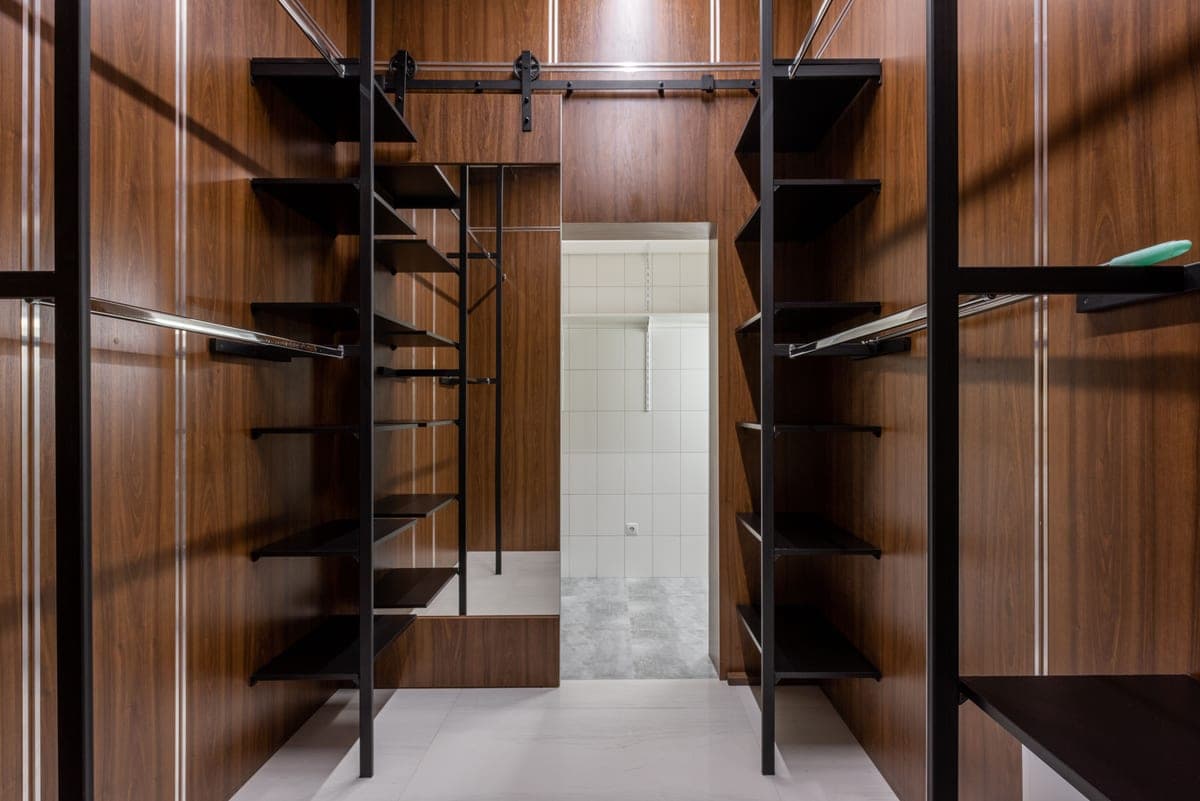
Wire shelving is stronger for its weight, cheaper, and ventilated; wood looks better, holds small items without them tipping, and can be cut to any shape. The published load figures favor wire: ClosetMaid rates its wire systems at about 83 lb per bracket and up to 1,000 lb per system, and the Maximum Load line at up to 600 lb per 6 ft shelf. Wood shelving in a closet is usually a melamine-faced particle board, which has no published closet load rating at all and sags at mid-span under sustained weight.
The choice is less about strength than about what you are storing and how the closet is used. Both fail; they just fail differently, and the failure mode should decide it.
The comparison, attribute by attribute
| Attribute | Wire | Wood / melamine |
|---|---|---|
| Published load rating | Yes — about 83 lb per bracket, up to 1,000 lb per system; Maximum Load line up to 600 lb per 6 ft shelf | Rarely published for closet shelving |
| Failure mode | Permanent deflection across an unsupported span; does not recover | Sag at mid-span; particle board can also delaminate at the edge |
| Ventilation | Full airflow, which matters for linens and shoes | None; damp items stay damp |
| Small items | Tip and fall through the gaps; needs bins | Sits flat; no bins required |
| Cutting | Bolt cutter and hacksaw; ends must be filed | Circular saw; edge needs banding to look finished |
| Cleaning | Dust falls through, which is a mixed blessing | Wipes clean |
| Appearance | Utility. Visible in an open closet | Reads as joinery |
| Cost | Lower, and stocked everywhere | Higher, especially with edge banding and finishing |
| Rental suitability | Kits are cheap and replaceable | Cut boards are a commitment |
Wire figures per ClosetMaid Wire Shelving Specifications rev 6/12 and ShelfTrack Installation Tips. The absence of a published wood figure is itself the finding — closet-grade melamine shelving is generally sold without one.
That ventilation argument matters most in a closet that already smells, where dead air is half the cause - the rest of the diagnosis is on why your closet smells musty.
The ventilation argument, which is real
Wire shelving is ventilated, and in a closet that is not a marketing point. Folded linens and towels put away slightly damp will hold that dampness against a solid shelf. Shoes stored on a solid shelf in a closed closet do the same. It is the reason linen closets are so often wire and stay fresher than the wardrobes next to them.
It is also the reason wire is standard in pantries, where airflow around dry goods matters — see pantry shelving. The counterargument is equally real: things fall through wire, and small items tip. The fix is bins, which adds cost and removes the ventilation you bought the wire for.
How each one actually sags
A wire shelf deflects between its supports and, under sustained load, takes a permanent set. It does not recover when you unload it. This is entirely a span problem, which is why ClosetMaid's 24 inch maximum standard spacing exists and why the same document limits end overhang to 4 inches.
Melamine-faced particle board sags in the middle of a span too, but it also has a second failure mode: the facing delaminates at a cut or wet edge, and once water gets into the core the board swells and never goes back. In a closet that is rare. In a pantry, near a kitchen, it is not.
Whichever material you land on, the shelf is only half the storage question — what belongs on a shelf rather than in a drawer is set out on drawers vs shelves.
Inside a single brand the same choice comes with a documentation gap attached: ClosetMaid wire vs wood compares ClosetMaid's own wire and wood ranges, where only one half publishes a load figure at all.
The hybrid answer most closets end up with
In practice, the closets that work tend to be wire for the structural runs and wood-fronted towers for the drawers and folded storage. That is exactly what ClosetMaid Selectives is: laminate towers designed to sit alongside the same manufacturer's wire runs.
It is also why the systems comparison on ClosetMaid vs Rubbermaid vs Elfa matters more than the material question. Every one of those manufacturers sells both, and the interoperability of their parts is a bigger constraint than wire versus wood.
FAQ
Questions people ask about this
Is wire or wood shelving better for a closet?
Wire is stronger for its weight, cheaper and ventilated, and it comes with published load ratings. Wood looks better and holds small items flat without bins. For a hanging run carrying weight, wire. For a visible shelf holding folded items, wood.
Does wire shelving sag more than wood?
Both sag over an unsupported span. Wire deflects and takes a permanent set that does not recover; melamine-faced board sags at mid-span and can additionally delaminate at a wet or cut edge. Wire has published spacing limits to work to; closet-grade wood generally does not.
Can you put wood shelves on wire shelving brackets?
Physically sometimes, but the bracket geometry is designed to hook and clip a wire shelf rather than support a flat board. The published load figures assume the manufacturer's own shelf on its own bracket, and they stop applying the moment you substitute.
Why do pantries use wire shelving?
Airflow around dry goods, plus the higher published load ratings for the same money. The cost is that small items tip and fall through, which is why pantry wire shelving nearly always ends up with bins on it.
Is melamine shelving strong enough for a closet?
For folded clothing over a short span, generally yes. The problem is that closet-grade melamine shelving is usually sold without a published load rating, so you are working without the figure you would have with wire. Keep the spans short and treat any wet edge as a failure point.
Sources
Where these figures come from
- ClosetMaid, Wire Shelving Specifications (rev 6/12)Depth options, bracket and standard load figures for the ClosetMaid wire ranges.
- ClosetMaid, ShelfTrack Installation TipsStandard spacing, end clearance and the screw-into-stud requirement the load rating depends on.
- What is not a source hereWe have not handled these products. Nothing on this page is a test result, and no figure comes from a retailer listing, another publisher, or memory.