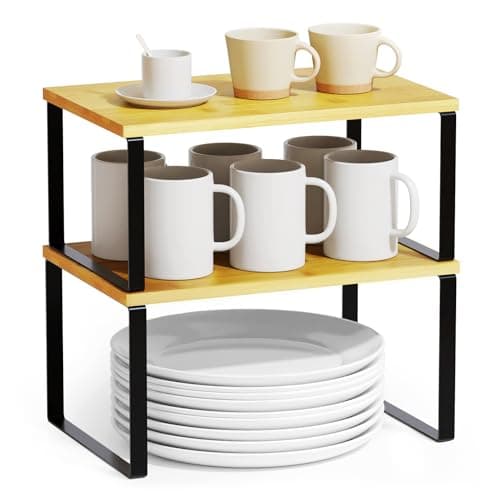
A riser only pays for itself if the shelf gap is taller than the riser plus what stands on it. The stated loads in this category vary by nearly four times.
By Scooter M.Published September 21, 2026Content updated September 21, 2026Prices verified September 21, 2026How we pick
Bin & Basket earns a commission when you buy through our links, at no extra cost to you. We are an Amazon Associate. We accept no free products, no sponsored placements and no paid inclusion, and commission rate plays no part in what we recommend. Full disclosure.
Start with your shelf gap, not the riser. For the 7 to 10 inch gap most canned-goods shelves have, the SpaceAid pair is the only riser here that fits, at a published 5.3 and 6.1 inches tall. For a roughly 10 inch gap with weight on it, the Across-Star states 80 lb. For a tall pantry shelf or a countertop, the Cidaziya states 110 lb and three set heights. The X-cosrack adjusts in height as well as width, and the Lipper is the bamboo one you would leave on show.
A riser is the cheapest storage upgrade in a pantry and the easiest one to buy wrong, because the listing sells you the width and you are constrained by the height.
The arithmetic, in one line
Shelf gap must exceed the riser height plus the tallest thing you will stand on top of it. That is the whole calculation, and it is why a 9.8 inch riser is useless on a shelf with a 10 inch gap: you have gained a platform with half an inch of air above it.
Our pantry shelf depth and spacing guide puts canned goods in a 7 inch band and taller boxed goods in a 12 to 14 inch band. Set against that, most of this category is sized for the taller band and sold to people with the shorter one.
Published height, span and stated load
Riser
Height
Span
Stated load
Fits a 7-10 in gap?
SpaceAid 2-pack
5.3 in and 6.1 in
11.7 in fixed
Not published
Yes
Lipper bamboo
6 1/4 in
15 5/8 in fixed
Not published
Yes
Across-Star 2-pack
9.8 in
15.7 to 25.6 in
80 lb, seller-stated
Only at the top of the band
X-cosrack 2-pack
Adjustable, up to 9.8 in
15.5 to 25.5 in
30 lb, seller-stated
Only at the top of the band
Cidaziya expandable
11.6, 14 or 16.3 in
18.2 to 28.9 in
110 lb, seller-stated
No
Heights and spans as published by the sellers, retrieved 21 September 2026. Loads are seller-stated with no test standard given, and two of these racks are near-identical in construction while stating 30 lb and 80 lb respectively.
The load figures do not add up, and you should know that
Three racks on this page state a load: 30 lb, 80 lb and 110 lb. The 30 lb and 80 lb racks are the same shape, the same materials and nearly the same span - one of them is simply more conservative, or more optimistic, than the other. Neither states a test method.
This is the same problem we document on garment racks, where seller-stated capacities sit alongside manufacturer specifications and look identical to a shopper. Our position is the same here: a stated figure is better than silence, it is not a specification, and where a rack publishes nothing the card says so rather than inventing a number.
How this page is ranked
Published height first. A riser that does not fit the gap is not a cheaper riser, it is a returned one.
Whether the height or width adjusts, because one adjustable product covers shelves a fixed one cannot.
Stated load, treated as the seller's claim rather than a specification, and weighted down accordingly.
Span against a standard shelf. Expandable racks cover 15 to 29 inches; fixed racks need several units to do the same job.
Depth against a 12 to 16 inch pantry shelf. Most of these are 8 to 10 inches deep and leave the back of the shelf unused.
#
Product
Best for
Score
Price
01
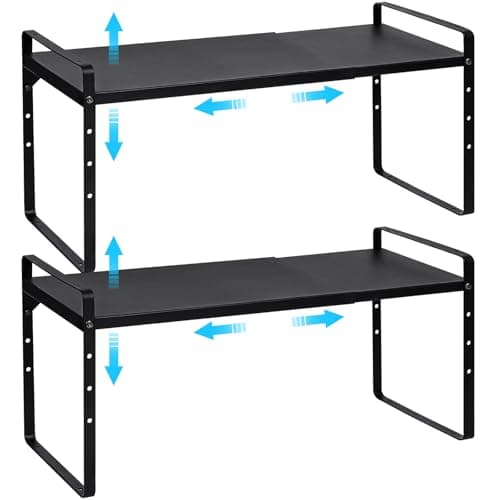
SpaceAid Cabinet Shelf Organizers, 2-PackThe only riser here that fits under a low shelf: 5.3 and 6.1 inches tall, published individually, which is the band a canned-goods shelf actually has.
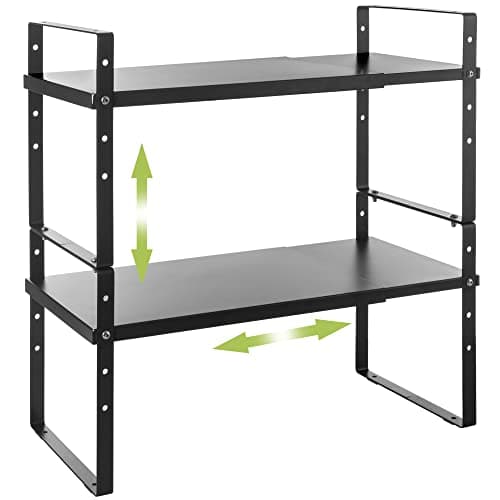
Across-Star Expandable Cabinet Shelf Organizer, 2-PackEighty pounds stated in a 9.8-inch-tall frame, which is the combination most pantry shelves actually need and most risers in this price bracket do not publish.
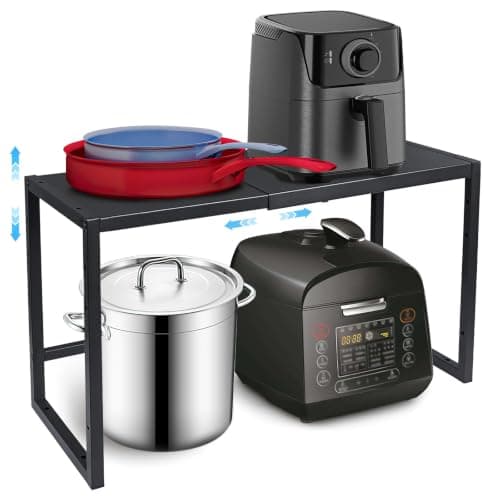
Cidaziya Expandable Metal Shelf, 110 lb StatedStates 110 lb and three set heights - 11.6, 14 and 16.3 inches - which makes it the only riser here you can plan a heavy shelf around.
X-cosrack Expandable Cabinet Shelf, Adjustable Height, 2-PackExpands to 25.5 inches and adjusts in height as well, so one pair covers a deep pantry shelf and a shallow cabinet without buying twice.
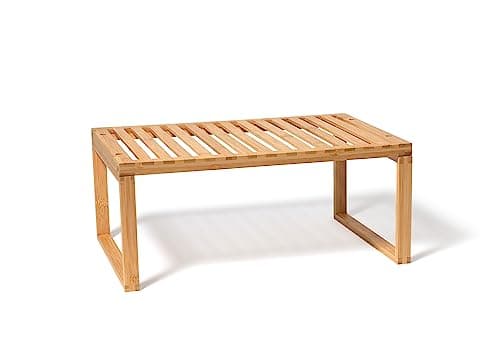
Lipper International Bamboo Cabinet ShelfBamboo rather than coated steel, with a slatted top that lets you use the space under it - the one riser here you would leave on a countertop on show.
Scores are our own, from the published rubric on the methodology page. They are editorial judgments about published specifications, not test results — we have not handled these units.
01
A tight shelf gap
SpaceAid Cabinet Shelf Organizers, 2-Pack
The only riser here that fits under a low shelf: 5.3 and 6.1 inches tall, published individually, which is the band a canned-goods shelf actually has.
Eighty pounds stated in a 9.8-inch-tall frame, which is the combination most pantry shelves actually need and most risers in this price bracket do not publish.
15 5/8 in W x 10 in D x 6 1/4 in HSource: Retailer catalog listing, retrieved 21 September 2026
Top
Slatted, so small items sit on top and things slide underneathSource: Retailer catalog listing, retrieved 21 September 2026
Material
BambooSource: Retailer catalog listing, retrieved 21 September 2026
Published load rating
Not published by the manufacturer in a form we could verify
What it gets right
At 10 in deep it uses more of a 12 in pantry shelf than any metal riser here
6 1/4 in tall, so it fits the common low shelf gap
Bamboo looks like kitchen furniture rather than storage hardware, which matters on an open shelf
What it does not
No load rating, and wood gives less warning than steel before it fails
Fixed size, so it cannot be expanded to a wider shelf
Bamboo absorbs spills and odors in a way a wipe-clean steel rack does not
Who it is for
An open pantry shelf, a countertop or a coffee station where the riser is visible.
Skip this if
The shelf is hidden behind a door. You are paying for an appearance you will not see.
Depth: where every riser here falls short
Pantry shelves are usefully 12 to 16 inches deep. The risers on this page are 7.3 to 11.8 inches deep. That difference is not a defect, but it does mean a riser leaves a strip of shelf at the back doing nothing - or, worse, invites you to push things behind it where they are invisible.
The Lipper is the deepest at 10 inches and the Cidaziya at 11.8, and both are the ones to choose if the shelf is deep and you hate wasted space. On a 16 inch shelf, the honest answer may be a riser at the front and a small under-shelf basket using the gap above.
When a riser is the wrong answer
Your shelves are adjustable. Move the shelf. It is free, it uses the full depth and it does not add a second thing to dust.
The gap is under about 6 inches. Nothing here fits, and a riser would simply block the shelf.
The problem is reach, not height. A deep shelf needs a pull-out organizer or a bin you can slide, not a platform at the front.
You are storing heavy cases. Two of these racks state no load at all, and the stated ones disagree with each other.
Steel or bamboo
Four of the five risers here are coated steel and one is bamboo, and the choice is less about strength than about where the shelf is and who sees it.
Coated steel is thin, strong for its weight, wipes clean, and holds nothing if a jar leaks onto it. It is the right answer behind a cupboard door, and it looks like storage hardware because it is.
Bamboo is thicker for the same strength, so it costs a little more of the gap it sits in, and it looks like kitchen furniture. On an open shelf or a countertop that matters. It also absorbs a spill rather than shedding it.
Neither publishes a deflection figure, so on the widest expandable settings you are judging the middle of the span by eye. If a rack visibly bows under what you have put on it, it is over its working load whatever the listing claims.
Stacking, and when it stops being sensible
Most of these are sold as stackable, and stacking is genuinely how a two-pack turns one shelf into three levels. It also multiplies every weakness in the design.
Check the gap against the combined height, not the single unit. Two 6 in risers stacked need over 12 in of shelf gap before anything goes on top of them.
Put the heavier rack underneath. These stack by sitting one frame on another, and a light frame carrying a loaded one is the arrangement that racks sideways.
Stop at two. A third level puts the top rack above most people's sightline into the shelf, which defeats the purpose, and the stack gets unstable as it is loaded unevenly.
Load from the back forward. A riser loaded only at the front pivots, and nothing here is fixed to the shelf.
What belongs on a riser, and what belongs under it
The riser creates two spaces where there was one, and they have different jobs. The rule that makes it work: the shorter items go up, the taller items stay below.
On top: tins, jars of spices, small tubs, anything uniform and short. The raised row is the one you can see from the door, so put the things you reach for there.
Underneath: boxes, bags, bottles - anything tall enough to fill the gap you just created. The mistake is to put tall things on the riser and short things under it, which wastes both levels.
Not on a riser at all: heavy cases and bulk sacks. Those belong on the shelf itself, or on the floor of the pantry, where the load path is short and nothing is rated by a seller's estimate.
Done well, a riser on a 12 to 16 inch pantry shelf gives back roughly the front half of a second shelf, which is why it is the cheapest storage upgrade in the category. Done badly, it is a metal frame with three jars on it and a pile of boxes wedged underneath.
Measuring, in the right order
Almost every returned riser in this category is a measuring failure rather than a product failure, and the measurements have to be taken in a particular order to be useful.
Measure the gap at its smallest. Shelf to the underside of the shelf above, at the lowest point - a shelf that sags in the middle gives you less clearance there than at the ends.
Measure your tallest regular item for that shelf. Not the tallest thing you own; the tallest thing that lives there routinely.
Subtract. Gap minus item height is the maximum riser height that leaves the top row usable. If that number is under about 5 in, no riser on this page will help.
Measure the shelf depth, and accept that an 8 to 10 in riser on a 14 in shelf leaves a strip behind it. Decide now whether that strip becomes a second row of tins or dead space.
Measure the width you want to span, then check it against the expandable range rather than the collapsed size quoted first in most titles.
One more check that costs nothing: look at whether your shelves are adjustable before buying anything at all. A pantry with adjustable shelving and a 16 inch gap does not need a riser, it needs the shelf moved down four inches - which uses the full depth, adds no hardware and costs nothing. Risers exist for fixed shelving, and for cabinets where the shelf positions are set by the carcass.
Deep corners and awkward shelves
The hardest part of any pantry is a corner shelf, where the usable depth changes across the width and a rectangular riser only fits part of it. Two of the sets here are sold as pairs specifically so they can be arranged side by side or in an L, which is the arrangement that works in a corner: one riser facing the door, one facing along the return, and the actual corner left for tall items that do not need a second level.
The same logic applies to a shelf interrupted by a bracket or a pipe. Two small risers either side of the obstruction use the shelf that an expandable rack, which needs a clear span, simply cannot. It is worth measuring the longest clear run on the shelf rather than the shelf's full width before choosing between a pair of small racks and one wide expandable one.
What we are not telling you
We have not loaded or measured any of these risers. Heights, spans and loads are the figures sellers publish on their listings, retrieved on 21 September 2026, and two of the five publish no load at all. Where that is the case the product card says so.
The gap arithmetic on this page is arithmetic, not a test: shelf gap minus riser height is what you have left, and you can check it with a tape measure faster than you can read this sentence. Prices are live from the retailer at the moment you look. The method is on how we pick.
FAQ
Questions people ask about this
What size shelf riser do I need?
Measure the vertical gap between your shelves, then subtract the height of the tallest item you want to stand on the riser. If the remainder is less than the riser's own height, go shorter. For a typical 7 to 10 inch canned-goods shelf that means a riser around 5 to 6 inches tall.
How much weight can a shelf riser hold?
The sellers here state 30 lb, 80 lb and 110 lb, and two state nothing at all. None gives a test method, and the 30 lb and 80 lb racks are near-identical in construction, so treat all of these as claims rather than specifications and keep heavy cases on the shelf itself.
Are shelf risers worth it in a pantry?
Where shelves are fixed and the gap is taller than what you store, yes - they turn dead air into a second row for a few dollars. Where your shelves adjust, moving the shelf is free, uses the full depth and achieves the same thing.
What is the difference between a shelf riser and a shelf organizer?
In this category the words are used interchangeably. What differs is whether the frame is fixed or expandable, and whether the height adjusts. Expandable racks span 15 to 29 inches, which suits a whole shelf; fixed units are smaller and cheaper and you buy several.
How deep should a pantry shelf riser be?
As deep as you can get, because pantry shelves are usefully 12 to 16 inches and most risers are 8 to 10. A shallow riser leaves a strip at the back of the shelf that either goes unused or becomes a place things disappear into.
Can you stack shelf risers?
Most of these are sold as stackable, and the two-packs are designed to sit on top of each other or side by side. Bear in mind that stacking multiplies the height requirement, so check the shelf gap against the combined height rather than the single unit.
Sources
Where these figures come from
Product figures, as listed in the retailer catalog (21 September 2026)Dimensions, capacities, counts, materials and any stated load for every product added in this expansion, taken from the Amazon catalog and the sellers' own listing text through the Creators API on 21 September 2026. These are listing figures rather than manufacturer specification sheets, and each row is labeled that way. Where a listing states a load or a clearance requirement, it is quoted as the seller's figure. Where nothing is published, the row says so instead of carrying an estimate.
Garment rack load figures, as published by the sellerUnlike the closet systems on this site, garment racks are sold without manufacturer spec sheets. Where a capacity appears here it is the figure the seller states on the listing itself - useful, and a weaker class of source than an installation manual. Where no figure is stated, the row says so.
Availability check, 21 September 2026Every product added in this expansion was resolved through the Amazon Creators catalog on that date and carried a New buy-box offer at the time of writing. Products without a current offer were excluded before the pages were written.
What is not a source hereWe have not handled these products. Nothing on this page is a test result, and no figure comes from a retailer listing, another publisher, or memory.