ShelfTrack publishes what most closet systems will not: a per-bracket load, a spacing limit and the fixing conditions those numbers assume. All three matter.
By Scooter M.Published September 21, 2026Content updated September 21, 2026Prices verified September 21, 2026How we pick
Bin & Basket earns a commission when you buy through our links, at no extra cost to you. We are an Amazon Associate. We accept no free products, no sponsored placements and no paid inclusion, and commission rate plays no part in what we recommend. Full disclosure.
ShelfTrack is the right buy for most reach-in closets, and its published load is conditional in a way the box does not shout about. ClosetMaid states roughly 83 lb per bracket and up to 1,000 lb across a full system, with standards no more than 24 inches apart and no more than 4 inches from the end of a shelf - and every one of those figures assumes the hang track and standards are screwed into studs. Hit the studs and it is a genuinely strong system that stays adjustable for life. Miss them and you own a different, weaker product.
That is a compliment, not a criticism. Almost nothing else in this category publishes a load figure at all, and a conditional number you can check beats a confident number with no conditions attached.
What ShelfTrack actually is
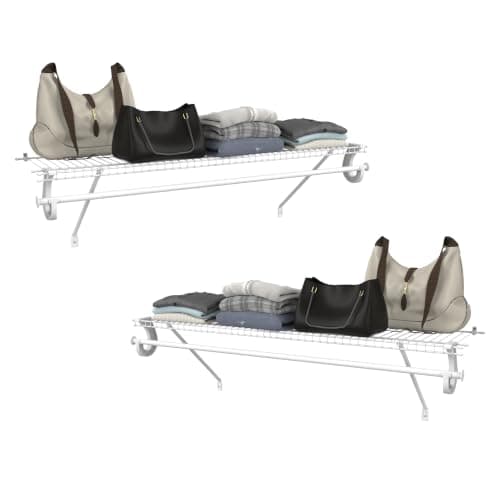
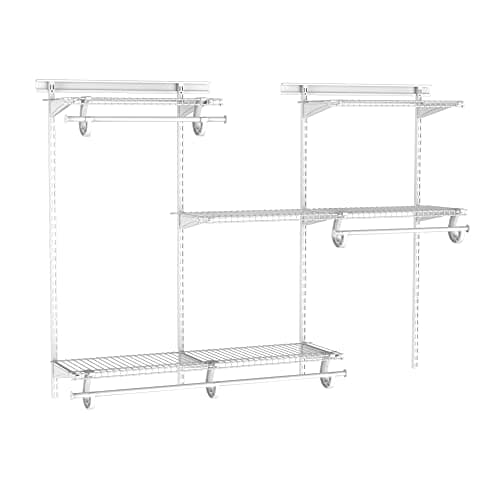
ShelfTrack is a track-and-standard system in four parts: a horizontal hang track screwed to the wall near the top of the closet, vertical standards that hook onto it, brackets that clip into the standards at any height, and ventilated wire shelf that drops onto the brackets.
The consequence of that design is the reason to buy it: the shelves move without new holes. A kit installed for a coat closet becomes a linen closet, then a kid's closet, then a pantry, and the wall is drilled once. A fixed shelf-and-rod system costs less and settles that question permanently on day one.
The published figures, and what each one assumes
ClosetMaid's published figures for its wire ranges
Figure
Published value
The condition attached
Load per bracket
About 83 lb
Screws into studs, per ClosetMaid's installation documents
Load per system
Up to 1,000 lb
Full system, correctly installed and spaced
Standard spacing
No more than 24 in apart
And no more than 4 in from the end of a shelf
Rod support spacing
Every 36 in of hang rod, plus each end
Applies to the hanging rod rather than the shelf
Shelf depths offered
12 in and 16 in
Depth chosen at purchase, not adjustable later
Adjustable after install
Yes, shelves move on the standards
The track and standards stay where they were drilled
Figures from ClosetMaid's own published wire shelving specifications and installation documents. The conditions are ClosetMaid's, not ours - they are printed in the same documents as the load ratings and are routinely ignored in reviews of this system.
The number to hold on to is 24 inches between standards. It is the figure that most often gets broken in a real installation, because standards want to land on studs and studs are also commonly 16 or 24 inches apart. When a stud falls awkwardly, the temptation is to stretch the spacing, and stretching it is exactly what the specification forbids.
The stud condition, in practice
Every load figure in that table is a figure for a system anchored to timber. Drywall anchors change the failure mode: the fixing pulls through the plasterboard before the bracket or shelf ever reaches its rated load, and it does so without warning, usually when the shelf is fully loaded.
This is not unique to ClosetMaid and it is worth seeing the comparison. Rubbermaid states outright that the maximum rated capacity of its FastTrack rail is not achievable at 24 inch stud spacing, which is the same admission from the other direction. Both brands are being straight with you; the difference is how carefully anyone reads it. The full comparison of published loads across brands is on shelf span and weight.
#
Product
Best for
Score
Price
01
ClosetMaid ShelfTrack Adjustable Closet Organizer KitAn adjustable hang-track system that lets you move every shelf later, which is the thing you will actually want to do.
ClosetMaid SuperSlide Ventilated Shelf Kit with Closet RodThe continuous-slide version: the rod runs the full length with no bracket interrupting it, so hangers never stop halfway.
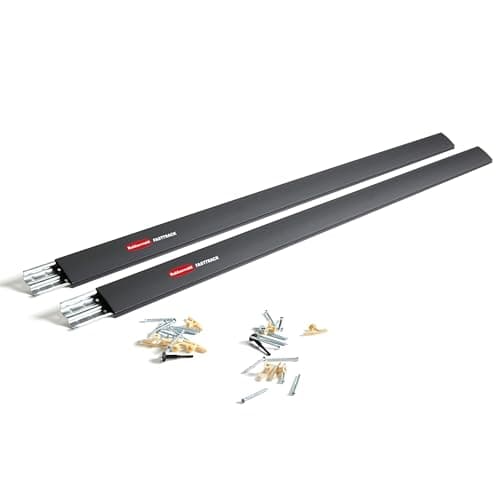
Rubbermaid FastTrack Closet Hang Rail SystemA rail-and-hook system built for weight: everything hangs off one heavily-fixed rail and unhooks without tools.
No imageClosetMaid Selectives Stackable Wood Organizer TowerLaminate towers that stack and stand on the floor, giving you drawers and cubbies without a wire aesthetic.
Scores are our own, from the published rubric on the methodology page. They are editorial judgments about published specifications, not test results — we have not handled these units.
12 in and 16 inSource: ClosetMaid published product specifications
Maximum standard spacing
24 in apart, and no more than 4 in from the end of the shelfSource: ClosetMaid ShelfTrack Installation Tips
Published load
About 83 lb per bracket, up to 1,000 lb across a full systemSource: ClosetMaid Wire Shelving Specifications, rev 6/12
What the rating depends on
At least 3 screws into studs in the hang track and 3 in the middle standards. Fewer than that and the published figure does not apply.Source: ClosetMaid ShelfTrack Installation Tips
Adjustable after install
Yes — shelves move on the standards without re-drilling
What it gets right
Shelf heights change later without new holes in the wall
The hang track spreads load across studs rather than into single anchors
Widely stocked, so a replacement bracket is easy to find years from now
What it does not
The visible track and standards are not a design feature; some people hate the look
Rated capacity is entirely dependent on hitting studs, which older homes make harder
Who it is for
Anyone with a standard 24-inch-deep reach-in who expects the contents to change — a growing child's closet, a first apartment, a closet you are not sure about yet.
Skip this if
Your closet wall is masonry or plaster over brick. The published load figures assume wood studs, and anchor-only installs do not reach them.
02
Hangers that actually slide
ClosetMaid SuperSlide Ventilated Shelf Kit with Closet Rod
The continuous-slide version: the rod runs the full length with no bracket interrupting it, so hangers never stop halfway.
12 in and 16 inSource: ClosetMaid published product specifications
Rod support spacing
One support every 36 in of hang rod, and one at each end of the shelf and rodSource: ClosetMaid published product specifications
Difference from Shelf & Rod
SuperSlide is the continuous-slide line; Shelf & Rod is the fixed-rod economy line. Hangers pass supports on SuperSlide and stop at them on Shelf & Rod.Source: ClosetMaid published product specifications
Material
Vinyl-coated steel wire
What it gets right
Hangers slide the full run, which is the single biggest daily difference in a closet
Fixed-mount shelf is more rigid than an adjustable track for the same money
Depth choice of 12 or 16 in covers both a shallow and a standard reach-in
What it does not
Fixed height — moving it later means new holes
The 16 in shelf needs a genuine 24 in of closet depth to leave door clearance
Who it is for
A closet whose job is settled: an adult wardrobe in a house you are staying in, where hanging space is the whole requirement.
Skip this if
You expect to reconfigure. This is a fixed installation and re-siting it leaves a wall to patch.
03
Heavy loads and future changes
Rubbermaid FastTrack Closet Hang Rail System
A rail-and-hook system built for weight: everything hangs off one heavily-fixed rail and unhooks without tools.
1,750 lb for the hang rail itselfSource: Rubbermaid FastTrack Rail and Shelving Installation Guide
Stud requirement
The rail must begin and end on a stud. A 48 in rail must hit 4 studs; an 84 in rail must hit 6.Source: Rubbermaid FastTrack Rail and Shelving Installation Guide
Between studs
Anchors every 8 in; two 2 in wood screws per screw locationSource: Rubbermaid FastTrack Rail and Shelving Installation Guide
Stud-spacing caveat
At 24 in stud centers, maximum rated capacity is not achievableSource: Rubbermaid FastTrack Rail and Shelving Installation Guide
What it gets right
The published rail rating is the highest figure any of these manufacturers puts in writing
Components unhook and move without touching the wall again
The same rail carries closet shelving and garage hooks, so parts are interchangeable
What it does not
The rail is visible and industrial-looking in a bedroom closet
Its whole rating is contingent on stud count, which you cannot change
Who it is for
A closet carrying real weight — a coat closet, a utility closet, or a walk-in that doubles as overflow storage.
Skip this if
You have a 48 in opening with only two studs behind it. Rubbermaid asks for four on that length, and the rating is meaningless without them.
Freestanding and stackable laminate tower, floor-supported
Wall fixing
Anti-tip attachment to the wall is required; it does not carry the load
Depth needed
Tower depth is nominal 14 in class, so a 24 in closet leaves door clearance
Published shelf load
Not published by the manufacturer in a form we could verify for the Selectives towers.
What it gets right
Looks like furniture rather than shelving, which matters in an open or doorless closet
Floor-supported, so wall construction stops being the limiting factor
Stacks and combines with hanging sections from the same range
What it does not
Laminate on particle board sags under sustained heavy load in a way steel does not
It eats floor area, which a small reach-in cannot spare
Who it is for
A walk-in or a wide reach-in where the closet is visible and you want folded storage and drawers, not just rods.
Skip this if
Your closet is under about 5 feet wide. A tower takes a fixed slice of that width and you will lose more hanging space than you gain in drawers.
Where it beats the alternatives
Against fixed shelf and rod. ShelfTrack costs more and moves later. If the closet's job will change - a nursery, a first home, a rented flat you will reconfigure - that flexibility is the whole value.
Against SuperSlide. SuperSlide's rod lets hangers slide the full run, which ShelfTrack's bracket-mounted rod does not do as smoothly. If the layout is settled and hanging is the main job, SuperSlide is the better buy and the line-by-line comparison sets out why.
Against Rubbermaid FastTrack. FastTrack publishes a much higher rail figure, 1,750 lb, and requires the rail to begin and end on a stud. Where the closet carries real weight and the studs cooperate, it is the stronger system - the head-to-head is on ClosetMaid vs Rubbermaid.
Against wood towers. ClosetMaid's own Selectives range looks like furniture and stands on the floor, which suits a walk-in that is on show. It publishes no load rating at all, which is the trade.
Installing it, honestly
The hang track goes up first and it has to be level, because everything else hangs off it and any error is multiplied across the run. That single step is where most bad ShelfTrack installations are decided, and it is the one worth borrowing a proper level for.
Wire shelf usually needs cutting to the opening, which is a bolt cutter and a file rather than a saw. The method is on cutting wire shelving.
The shelf has a front lip and a back wall clip, and the shelf only sits properly one way up. It is an easy thing to get wrong and an annoying one to discover at the end.
End caps and rod supports are extra on some kits. Check the parts list against the closet width rather than assuming the box contains a complete run.
Renters. This is a drilled, permanent installation in someone else's wall. The no-damage options are on renter-friendly closet organizers.
Masonry or plaster-on-brick walls. The published figures assume timber studs, and a masonry fixing is a different calculation with different hardware.
Anyone who wants a closet that looks like furniture. Ventilated wire is honest, practical and unmistakably wire.
Anyone storing folded knitwear directly on the shelf. The wire pattern embosses itself into the bottom item of a stack over a season - budget for a liner or use bins.
What is in the box, and what is not
A ShelfTrack kit is sold by closet width, and the part counts follow from that. What catches people out is the parts that are not included rather than the ones that are.
Usually included: hang track, standards, brackets, wire shelf, rod and the screws for the track.
Often not included: enough wall anchors for a closet whose studs do not cooperate, end caps for cut shelf, extra rod supports for a long run, and a second shelf if you want double hanging.
Never included: the bolt cutter you will need to cut wire shelf to width, and the level the whole installation depends on.
Worth buying at the same time: shelf liner if the shelf will hold folded knitwear, because ventilated wire embosses a stack left for a season.
Check the rod-support count against your closet width before you start. ClosetMaid specifies a support every 36 inches of hang rod plus one at each end, so a 72 inch closet needs more supports than a kit sized by shelf length alone may contain.
The complaints, and which ones are the system's fault
Wire shelving attracts a consistent set of criticisms. Some are real limitations of the product and some are installation errors being blamed on it, and it is worth separating them.
"It sagged." Usually a spacing error. Standards more than 24 in apart, or more than 4 in from the end of a shelf, is outside the specification the load rating assumes.
"It pulled out of the wall." Almost always a fixing error. The published figures assume screws into studs; drywall anchors alone fail at a fraction of them, and they fail suddenly.
"Things fall through it." A real limitation. Ventilated wire is open by design, and small items need bins rather than a different system.
"It marks my sweaters." Also real. The wire pattern presses into the bottom item of a stack over months, which is what liners are for.
"The hangers bunch at the brackets." Real, and it is the specific thing SuperSlide exists to fix - its rod lets hangers pass the full run.
Tools, time and skill
This is a genuinely DIY-able installation, which is most of its appeal against a fitted closet company, and it is not a no-tools job.
Needed: a stud finder, a long spirit level, a drill, a screwdriver and a bolt cutter for the shelf. A file to dress cut wire ends is worth having.
Time: a single reach-in closet is an afternoon for someone who has done it before and most of a day for someone who has not, with the hang track taking longer than expected because it must be dead level.
The hard part is not strength or skill, it is patience with the first 30 minutes. Everything hangs off the track, so an error there repeats along the whole run.
The reversible part: brackets and shelves move freely afterwards. Only the track and standards are drilled, which is exactly why the system is worth its premium over fixed shelf and rod.
What we are not telling you
We have not installed or load-tested a ShelfTrack system. Every figure on this page is ClosetMaid's own published specification, taken from its wire shelving documents and installation tips, and the conditions quoted alongside them are ClosetMaid's too. That is a stronger class of source than the seller-stated capacities we have to rely on elsewhere, and it is still the manufacturer's own number.
We have not compared shelf deflection between brands, and we have not measured what happens when the 24 inch spacing is exceeded - we simply report that the specification forbids it. Prices move, so every price here is live from the retailer at the moment you look. The method is on how we pick.
FAQ
Questions people ask about this
Is ClosetMaid ShelfTrack any good?
Yes, for most reach-in closets. It publishes about 83 lb per bracket and up to 1,000 lb per system, it stays adjustable after installation, and it is stocked everywhere so spare parts are a reasonable expectation. The catch is that every published figure assumes screws into studs.
How much weight can ShelfTrack hold?
ClosetMaid publishes about 83 lb per bracket and up to 1,000 lb across a full system, conditional on the hang track and standards being screwed into studs and on standards being no more than 24 inches apart. Installed into drywall anchors alone, those numbers do not apply.
How far apart should ShelfTrack standards be?
No more than 24 inches apart, and no more than 4 inches from the end of a shelf, per ClosetMaid's installation documents. If your studs do not fall within that, stretching the spacing is the wrong fix - the specification is what the load rating is based on.
ShelfTrack or SuperSlide?
ShelfTrack if the closet's job may change, because the shelves move without new holes. SuperSlide if the layout is settled and hanging is the priority, because its rod lets hangers slide the full length of the run rather than stopping at brackets.
ShelfTrack or Rubbermaid FastTrack?
FastTrack publishes a far higher rail figure - 1,750 lb - and requires the rail to start and finish on a stud. Where the closet carries serious weight and the studs cooperate, it is stronger. ShelfTrack is cheaper, more widely stocked and easier to adjust.
Can you install ShelfTrack without hitting studs?
You can physically hang it on drywall anchors, but ClosetMaid's published load ratings assume fixings into studs, so you would be installing an unrated system. The failure mode is the anchor pulling through the plasterboard under load, which happens without warning.
ClosetMaid published product specificationsSuperSlide and Shelf & Rod depth options and rod-support spacing.
Rubbermaid, FastTrack Rail and Shelving Installation GuideRail load rating, stud-count requirement per rail length, and anchor spacing between studs.
Availability check, 21 September 2026Every product added in this expansion was resolved through the Amazon Creators catalog on that date and carried a New buy-box offer at the time of writing. Products without a current offer were excluded before the pages were written.
What is not a source hereWe have not handled these products. Nothing on this page is a test result, and no figure comes from a retailer listing, another publisher, or memory.