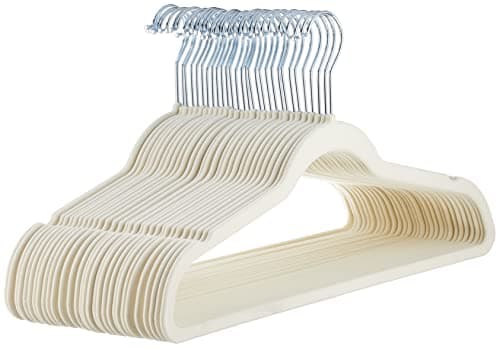
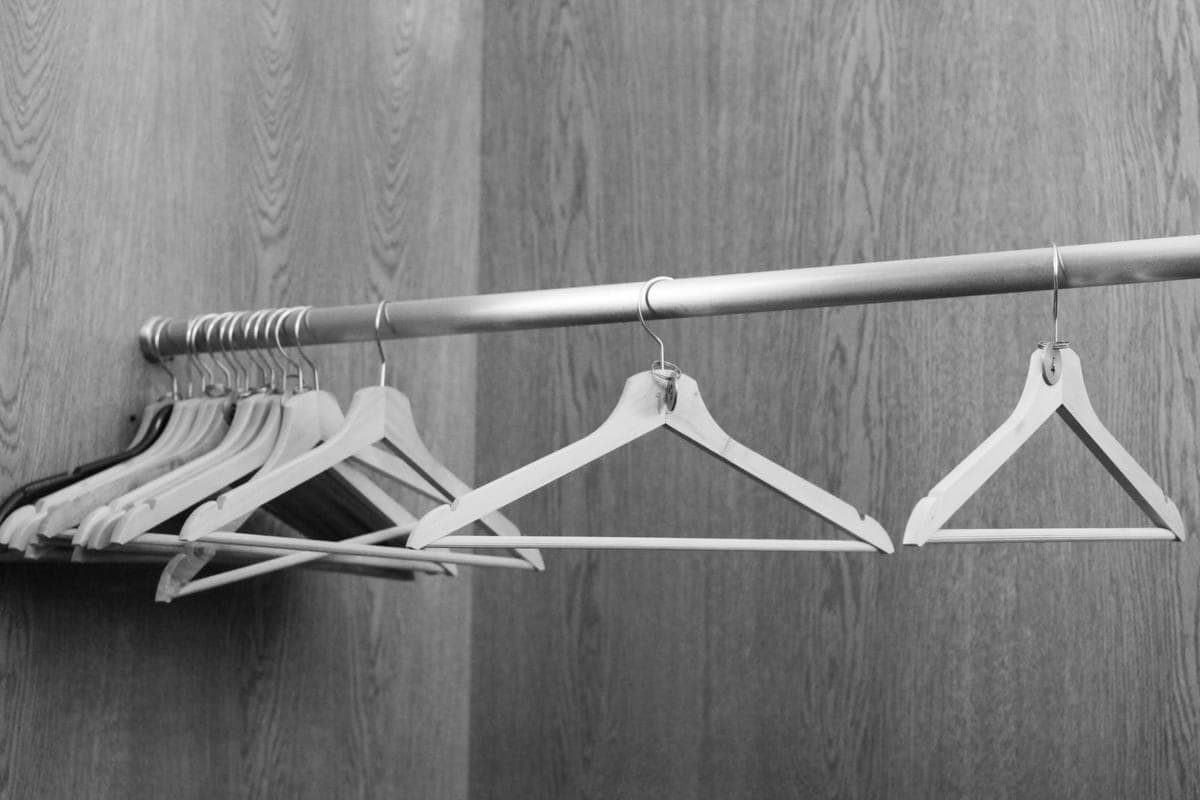
The highest-return purchase in this entire category is a set of slim flocked hangers. A slim hanger is about a quarter of an inch thick against roughly half an inch for the molded plastic ones most closets are full of, so the same forty shirts occupy about 10 inches of rod instead of 20. It costs very little, takes an hour, and it is reversible — which makes it the right thing to try before buying any structure at all.
That is not a throwaway tip. A large share of "my closet is too small" turns out to be "my hangers are too thick", and the only way to find out which you have is to try the cheap thing first.
Everything on this hub does one of five things. Working out which job you actually have is most of the decision:
- Hang more in the same width. Slim hangers first, then a second rod across part of the width. Best hangers and best closet rods.
- Use the floor. It is nearly always a heap of shoes and nearly always three or four usable levels. Best shoe racks.
- Make the shelves usable. Wire shelving lets small things tip and fall through; bins fix that. Best storage bins.
- See what is in there. Most closets have no light of their own, and a walk-in has none borrowed from the room either. Best closet lighting.
- Stop the drawer becoming a heap. Best drawer organizers.
Closet rods sag, and people replace them with thicker rods, and they sag again. The reason is span. ClosetMaid's own specification for its SuperSlide rod is one support every 36 inches of hang rod, plus one at each end of the shelf and rod. A six-foot rod supported only at its ends has a 72 inch unsupported span, which is double that figure.
So if your rod has bowed, add a mid-span support before you buy a new rod. It is cheaper, faster and usually the actual fix. If the rod has already taken a permanent set — and steel does not recover — you will need both. The full load picture, including what forty garments actually weigh, is on shelf span and weight.
Over-door organizers hook over the top edge of a door leaf. Bifold doors and sliding doors do not have one. That single fact rules out an entire product category for a large proportion of closets, and it is the most common reason these products get returned.
Three of the most common reasons a closet stops working are not storage shortages at all. Stacks that topple are fixed by shelf dividers rather than by more shelves. Holes in wool are clothes moths, and the traps most people buy first only monitor them. And a musty smell is a moisture problem, so a scented product treats the wrong thing entirely.
The other two questions this hub gets asked are where the other season should live, which is on off-season clothes storage, and how to make the closet by the front door survive daily use - organizing a coat closet.
Two categories here add storage without a single fixing, which matters if you rent. A hanging closet organizer hooks over the rod and converts rod length into shelves — a real trade, and worth checking which of the two you actually have spare. A drawer tower stands on the floor under the hanging and claims the two-foot band that usually holds shoes badly.
If the closet belongs to a child, the scale changes before anything else does: a child-width hanger and a rod they can reach are worth more than any product on this page, and both are set out on organizing a kids' closet.
Sliding doors have a second cost: the panel sits inside the opening, so your usable depth is less than the measurement to the frame, and only half the closet is open at a time. The workarounds, and the hardware fixes for a bifold that keeps jumping its track, are on closet door organizers.
02
A closet floor with shoes on it
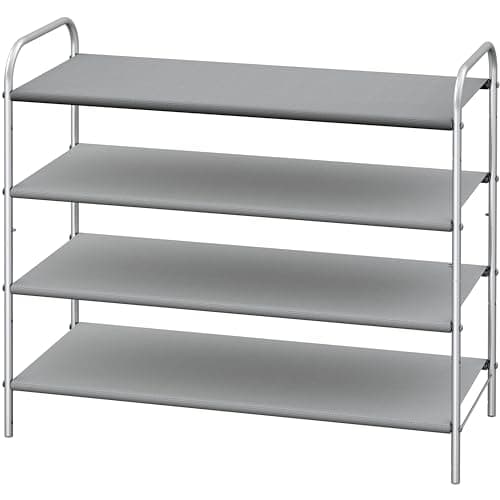
Simple Houseware 4-Tier Stackable Shoe Rack
A stackable metal frame that turns closet floor into four usable levels, and stacks further if the closet is tall.
- Score
- 8.4
- Space used
- 9.0
- Capacity
- 8.5
- Durability
- 7.0
- Value
- 9.0
Published specifications
- Type
- Stackable metal tier frame, freestanding
- Depth needed
- Sits within a standard 24 in closet depth with the door closing
- Stacking
- Units stack on each other to use full closet height
- Published load per tier
- Not published by the manufacturer in a form we could verify for stackable shoe racks in this class.
What it gets right
- Uses the height of the closet floor, which is usually wasted
- Freestanding, so no fixings and no wall dependency
- Stacks, so the same product scales from a small closet to a walk-in
What it does not
- Bare metal bars mark soft soles over time
- Tall stacks wobble if the floor is not flat
Who it is for
A reach-in or walk-in floor currently holding a pile of shoes.
Skip this if
Your shoes are mostly boots. Tier spacing on these racks is sized for shoes, and a knee boot does not fit under the next tier.
03
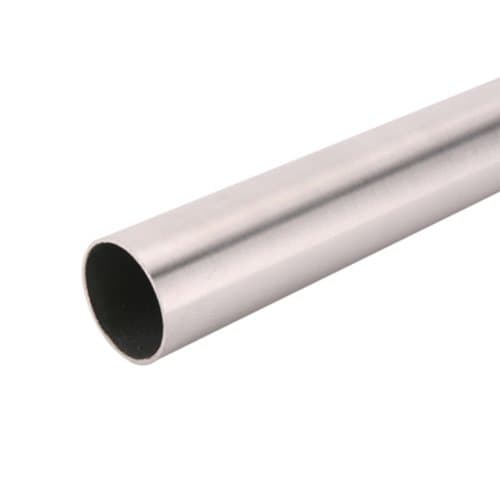
A span that has already sagged once
Knape & Vogt Heavy-Duty Steel Closet Rod
A plain steel rod in the standard 1-5/16 in diameter, sold in lengths you cut down — the boring answer to a bowed rod.
- Score
- 8.1
- Span performance
- 9.0
- Fit
- 8.0
- Value
- 9.0
- Finish
- 5.5
Published specifications
- Diameter
- 1-5/16 in, the standard US closet rod size that fits standard sockets
- Material
- Steel tube, which resists deflection far better than wood at the same diameter
- Support rule
- Add a center support if the span exceeds about 36 in — ClosetMaid's own SuperSlide guidance is a support every 36 in of hang rodSource: ClosetMaid published product specifications
- Published deflection figure
- Not published by the manufacturer in a form we could verify for closet rod stock.
What it gets right
- Standard diameter, so existing sockets and supports fit
- Cuts to length with a hacksaw or pipe cutter
- Steel outperforms a same-diameter wood dowel over a long span
What it does not
- Plain steel, no finish options to speak of
- You still have to buy or reuse the end sockets
Who it is for
Anyone replacing a wooden rod that has bowed, or building a run longer than about a meter.
Skip this if
Your sockets are an odd diameter. Measure the existing rod before ordering — 1-5/16 in is standard but 1 in and 1-1/4 in sockets exist.
04
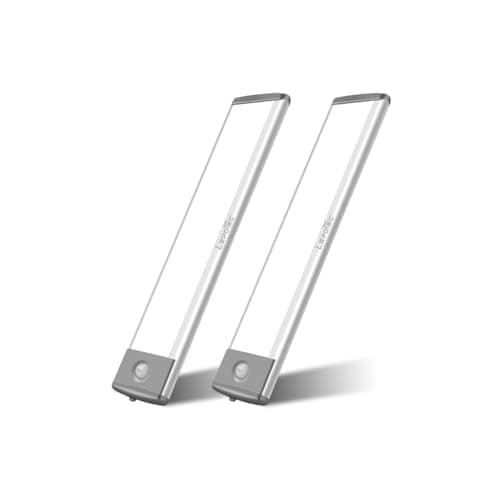
Hands-full closet entry
Lepotec Rechargeable Motion-Sensor LED Light Bar
A magnetic strip that switches itself on when you open the door, which is the behavior a closet light should have had all along.
- Score
- 8.3
- Installation
- 9.0
- Brightness
- 7.0
- Control
- 9.0
- Value
- 8.0
Published specifications
- Power
- USB rechargeable internal battery
- Trigger
- Motion sensor with an ambient-light cutoff, so it stays off in daylight
- Mounting
- Magnetic strip, so it lifts off to charge
- Published runtime
- Stated per model on the listing; depends heavily on trigger frequency
What it gets right
- Switches on automatically, which matters when your arms are full
- Lifts off its magnetic strip to recharge instead of needing new batteries
- The daylight cutoff stops it wasting charge
What it does not
- Sensor range is short; a deep walk-in needs more than one
- Recharging is a chore you will forget
Who it is for
A reach-in or a small walk-in you enter with both hands occupied.
Skip this if
The closet is a walk-in over about six feet deep. One bar lights the doorway and leaves the back dark; buy two or wire a real fixture.
05
No
imageShelf clutter
mDesign Fabric Storage Bins with Handles
Soft-sided bins that turn an untidy shelf into labeled blocks, and collapse flat when you stop needing them.
- Score
- 7.5
- Tidiness
- 8.5
- Access
- 8.5
- Stackability
- 2.0
- Value
- 9.0
Published specifications
- Construction
- Soft fabric with a reinforced base and cut-out or sewn handles
- Shelf depth fit
- Sized for standard 12 to 16 in shelving; measure before ordering
- Stackability
- Not stackable when full — the sides carry no load
- Published dimensions
- Per-size dimensions are published on each listing; they vary by model
What it gets right
- Cheap, light and quiet on a wire shelf
- Handles make a high shelf actually usable
- Fold flat when not in use
What it does not
- Sides collapse inward when half empty
- Nothing stacks on top of a fabric bin
Who it is for
Shelf storage for soft goods — linens, accessories, off-season clothing.
Skip this if
You need to stack. Fabric sides carry no load; a rigid clear box is the answer if things must go on top of each other.
06
No
imageA drawer that has become a pile
mDesign Expandable Drawer Dividers
Spring-loaded dividers that split a drawer into sections without measuring or cutting anything.
- Score
- 7.8
- Tidiness
- 8.5
- Fit
- 7.0
- Durability
- 6.5
- Value
- 9.0
Published specifications
- Fit method
- Spring tension against the drawer sides across a stated width range
- Drawer requirement
- Two parallel, rigid sides. Soft-sided or curved drawers defeat the tension.
- Published width range
- Stated per model on the listing
What it gets right
- No cutting and no fixings
- Moves when the contents change
- Cheap enough to do every drawer at once
What it does not
- Tension slips under sideways pressure from packed clothing
- The dividers themselves take a slice of the drawer
Who it is for
Underwear, socks, accessories — anything currently living as an undifferentiated heap.
Skip this if
Your drawers are wider than the divider's stated range. Beyond that range they do not grip and they will fall over the first time you close the drawer hard.
Three narrower problems have their own pages here. Best under-bed storage ranks containers on the one figure that decides them, the clearance under your frame. Best jewelry organizers for a closet sorts the category by which scarce thing it spends - a drawer, rod inches or a door. And best handbag and purse organizers ranks bag storage on what each format does to the bag.
Shoes get a second page for a specific reason: the boxes sold to store them are all about 13 in long and claim maximum sizes four apart, from a men's 9 to a men's 13. Best shoe storage boxes sets those claims against each other and against the single published interior figure in the category.
Hats are the accessory where the published numbers are easiest to check and least often checked: a cap box claiming 12 caps in 6.7 in of height is allowing about half an inch each, and a hat box claiming five 16-inch brims is 16.93 in across. Best hat storage for a closet divides every claim in the category into the seller's own dimensions.
Two more storage problems get their own pages. Best garment bags for storage ranks bags on length, gusset depth and whether the fabric breathes, and best wrapping paper storage settles the roll-length question the containers themselves disagree about by ten inches.
Three more problems get their own pages. Best tie and belt racks sorts the accessory category by what each format spends - wall, rod inches or drawer - and publishes the one projection figure in it. Best boot storage starts from the mismatch that decides it: a boot box is 4.5 in tall and a boot shaft is fourteen. And best broom and mop holders covers the utility closet, where one listing publishes 30 lb screwed against 8 lb adhesive for the same rack.
We have not handled these products. What we can do is compare what the manufacturers publish, do the fit arithmetic against the standard closet dimensions, and be explicit about the constraint that disqualifies each pick. Every product above carries a real "skip this if", because a list where everything wins is a list nobody should believe.
Every price comes live from Amazon at the moment you look. Nothing on this site has a price typed into a sentence, because a number written into a page is stale within weeks and wrong for years. The reasoning is on how we pick.