Larvae chew through thin cardboard and plastic bags. They cannot chew through rigid plastic, glass or metal. That single fact is the whole control strategy.
By Scooter M.Published September 1, 2026Content updated September 1, 2026Prices shown live on AmazonHow we pick
Bin & Basket earns a commission when you buy through our links, at no extra cost to you. We are an Amazon Associate. We accept no free products, no sponsored placements and no paid inclusion, and commission rate plays no part in what we recommend. Full disclosure.
Indianmeal moth larvae chew through thin cardboard and plastic bags, and cannot chew through rigid plastic, glass or metal. That is why decanting into sealed rigid containers is the control that works and a tidy pantry full of bags is not. A single female can lay up to about 400 eggs, which hatch in roughly a week, so an unaddressed infestation compounds fast.
This is the one page on this site where the reasoning genuinely matters more than the product, because half the products sold for this problem do nothing. The entomology below is sourced to university extension services, named at the foot of the page.
Identifying what you have
Pantry moth or clothes moth
Sign
Pantry moth (Indianmeal moth)
Clothes moth
Where you see them
Flying around the kitchen and pantry, often at dusk
In wardrobes and stored textiles; they avoid light
What is damaged
Dry goods: flour, cereal, grains, rice, pet food, dried fruit
Wool, cashmere, silk, natural fibers
What you find
Fine webbing in grain, larvae in packets, small caterpillars on walls and ceilings
Holes in knitwear, larval cases in folds
Flight behavior
Flies openly around the room
Flutters near the floor, hides from light
The fix
Rigid airtight storage plus a full pantry clear-out
Clean or freeze the garments, then seal the storage
Two different insects with two different treatments. Cedar deters clothes moths and does nothing for pantry moths.
#
Product
Best for
Score
Price
01
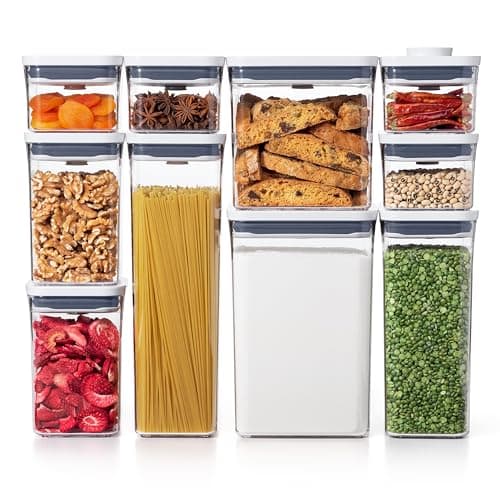
OXO Good Grips POP Container SetThe only set in this category whose manufacturer publishes an exact dimension for every single size, which is why it is first here.
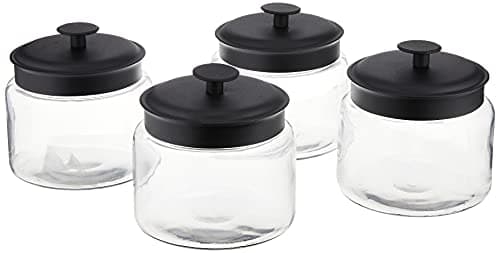
Anchor Hocking Glass Storage Jars with Sealing LidsGlass does not absorb oil or odor and does not scratch, which is the whole argument against plastic for some foods.
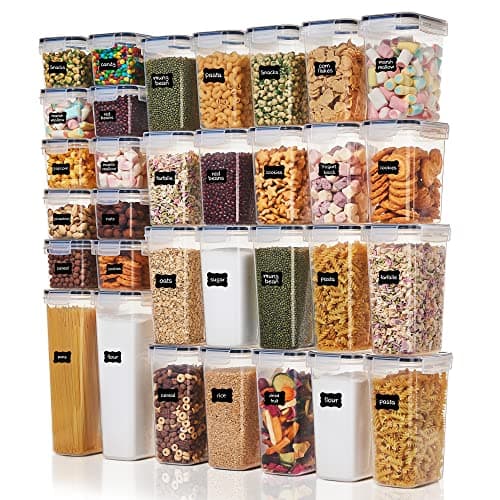
Vtopmart Airtight Food Storage Container SetA large multi-piece set at a price that lets you convert an entire pantry in one go, with a real gasket seal.
Scores are our own, from the published rubric on the methodology page. They are editorial judgments about published specifications, not test results — we have not handled these units.
01
Flour, sugar and cereal
OXO Good Grips POP Container Set
The only set in this category whose manufacturer publishes an exact dimension for every single size, which is why it is first here.
Mini Square Short 0.5 qt is 3.1 x 3.1 x 6.7 in; Small Square Medium 1.7 qt is 4.1 x 4.1 x 9.8 in; Rectangle Short 1.7 qt is 6.3 x 4.1 x 6.7 in; Small Square Tall 2.3 qt is 4.1 x 4.1 x 13 in; Rectangle Medium 2.7 qt is 6.5 x 4.3 x 9.5 inSource: OXO POP container product pages, oxo.com
Seal
Push-button lid; the button pops up to double as a handleSource: OXO POP container product pages, oxo.com
Shelf depth needed
Every size above fits within a 12 in pantry shelf on its longest footprint dimension
Shelf height needed
The 13 in Small Square Tall needs a spacing well above the 7 to 10 in common band
What it gets right
Published dimensions for every size, so you can plan a shelf before buying
One-handed opening, which matters when the other hand holds a measuring cup
Square footprints tessellate on a shelf; round canisters waste the corners
What it does not
The most expensive option in this category by a wide margin
The button mechanism traps flour and needs disassembly to clean properly
Who it is for
A pantry you are laying out deliberately, where knowing the exact footprint before you buy is worth the premium.
Skip this if
Your shelf spacing is 8 inches or less. The tall sizes are 9.5 to 13 in and simply will not stand up — check the table above against your own shelf before ordering.
02
Anything oily or strongly flavored
Anchor Hocking Glass Storage Jars with Sealing Lids
Glass does not absorb oil or odor and does not scratch, which is the whole argument against plastic for some foods.
2.8 L in the multi-piece setsSource: Vtopmart product listing
Per-piece dimensions
Not published by the manufacturer in a form we could verify — the manufacturer does not publish a per-piece dimension table for the multi-piece sets. Measure your shelf spacing and treat the tall canisters with caution.
What it gets right
Enough pieces to convert a whole pantry rather than a corner of it
The gasket seal is a genuine airtight seal, not a friction lid
Labels are included, which the cheaper sets skip
What it does not
No published per-piece dimension table, so shelf planning is guesswork
Lid latches are the failure point on this style of container
Who it is for
Converting a whole pantry to matching containers on a normal budget.
Skip this if
You need to know the exact footprint before you buy. The dimensions are not published per piece — if your shelf is tight, buy a set that publishes them.
The life cycle, and why speed matters
A single female can lay up to about 400 eggs, and those eggs hatch in roughly a week. The larvae pass through five to seven instars, and development takes anywhere from about 14 days to 90 or more depending on temperature — faster in a warm kitchen, much slower in cool, dry storage.
The practical consequence: the flying moth you can see is the least important part of the problem. By the time an adult is in the air it has probably already laid, and the eggs and larvae are in the food. Killing the adults you see changes almost nothing, which is why traps alone never resolve this.
Why packaging fails
Larvae chew through almost all thin packaging, including thin cardboard and plastic bags. What they cannot penetrate directly they get through anyway, via imperfect seals, loose folds and small manufacturing gaps. A resealable bag folded over is not a barrier to anything.
They cannot eat their way through hard plastic containers, glass or metal. So the barrier that works is rigid, with a lid that closes completely — a gasketed container, a screw-top jar, a metal tin. That is the specification, and it is why airtight containers are the product category that solves this rather than bins or baskets.
Clearing an infestation
Empty the pantry completely. Not the affected shelf — all of it. Larvae travel and pupate away from the food, frequently in a corner of a different shelf or where the wall meets the ceiling.
Inspect every dry good. Fine webbing in grain is the giveaway. Discard anything with webbing, larvae, or that you are unsure about. Check pet food and birdseed, which are a very common source and rarely checked.
Vacuum every surface, including the shelf edges, the corners and the underside of shelves. Empty the vacuum outside immediately.
Wash the shelves, then let them dry completely before restocking.
Restock into rigid sealed containers only. This is the step that stops it happening again; the previous four only reset it.
Freeze anything you are keeping but are unsure about. Several days in a domestic freezer kills eggs and larvae in dry goods.
Traps as a monitor, not a treatment. Pheromone traps catch adult males and tell you whether the problem is ongoing. They do not clear an infestation and should not be relied on to.
If the moths are around clothing rather than food, this is the wrong guide - they are a different insect eating a different thing, and the fix is on clothes moths in a closet.
What does not work
Traps alone. They catch adult males and are useful as a monitor. They do nothing about eggs and larvae in the food.
Cedar. That is a clothes-moth deterrent. It has no bearing on pantry moths — see closet deodorizers for what cedar actually does.
Bay leaves and other folk deterrents. No published evidence supports them as a control.
Clearing one shelf. Larvae pupate away from their food source; a partial clear-out reliably fails.
Keeping food in bags inside a sealed bin. The bin is not the barrier — the larvae are already inside the bag, and an open bin stops nothing.
A gasket-and-latch lid is the category of seal that keeps a moth out, and one widely sold range applies the same latch across its pantry, leftovers and glass lines - which set does which job is on the Rubbermaid Brilliance review.
FAQ
Questions people ask about this
Can pantry moths get into sealed containers?
Not into rigid containers with a properly closing lid. Larvae chew through thin cardboard and plastic bags, and get through imperfect seals and loose folds, but they cannot eat through hard plastic, glass or metal. Rigid plus a complete seal is the specification.
What causes pantry moths?
They almost always arrive in a bag of dry goods that was already infested — flour, dried fruit, birdseed or pet food are common sources. It is not a hygiene problem, which is why cleaning alone does not prevent recurrence.
How long does it take to get rid of pantry moths?
The clear-out is a day; the confirmation takes weeks. Development runs from about 14 days to 90 or more depending on temperature, so keep a pheromone trap up for a couple of months afterwards to confirm nothing survived.
Do pantry moth traps work?
As a monitor, yes — they catch adult males and tell you whether the problem is ongoing. As a treatment, no. The eggs and larvae are in the food, and by the time you see a flying adult it has probably already laid.
What is the difference between pantry moths and clothes moths?
Pantry moths fly openly around the kitchen and damage dry goods; clothes moths avoid light and damage wool and natural fibers. The treatments are entirely different — cedar deters clothes moths and does nothing whatsoever for pantry moths.
Should you throw everything out if you find pantry moths?
Everything with webbing, larvae, or that you are unsure about. Anything you keep should be frozen for several days, which kills eggs and larvae in dry goods, and then stored in a rigid sealed container.
What is not a source hereWe have not handled these products. Nothing on this page is a test result, and no figure comes from a retailer listing, another publisher, or memory.