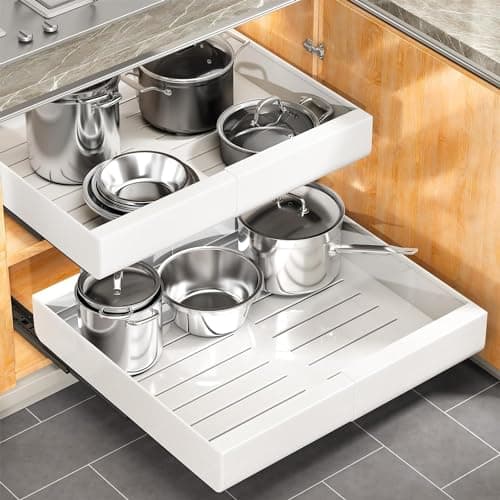
The tray is the easy part. The purchase is decided by the narrowest point of your cabinet opening, and whether your cabinets have a face frame.
By Scooter M.Published September 21, 2026Content updated September 21, 2026Prices verified September 21, 2026How we pick
Bin & Basket earns a commission when you buy through our links, at no extra cost to you. We are an Amazon Associate. We accept no free products, no sponsored placements and no paid inclusion, and commission rate plays no part in what we recommend. Full disclosure.
For most kitchens the Kitstorack is the right buy: it expands from 12 to 20 inches, it mounts with adhesive rather than screws, and its listing states the minimum cabinet it needs - wider than 13 inches and deeper than 21. If your cabinets have a face frame, pay more for the Seinloes, which ships the raising pads that clear the frame lip. For a narrow filler cabinet, the VEVOR is 8.5 inches wide and the only tray here with a published load. For a 30 inch sink base, the Fokyfok expands to 31.
Every one of these is a tray on rails. What separates them is whether they fit, and the listings that tell you that up front deserve the sale.
Measure the opening, not the cabinet
The number that matters is the narrowest clear width inside the cabinet opening, not the width of the cabinet box. On a face-frame cabinet - the traditional American construction - the frame overlaps the opening on both sides, so a 24 inch cabinet can present a 21 inch opening. Door hinges, a center stile, and pipes in a sink base all steal more.
Open the door fully and measure the clear width between the frame edges, at the narrowest point.
Measure the depth from the inside face of the frame to the back panel, not from the door front.
Measure the height of the opening, which decides whether a two-tier basket fits at all.
Look for obstructions - hinge hardware, a waste pipe, a garbage disposal - and subtract them before you shop.
Then compare against the minimums the sellers publish, which is the useful thing several of these listings do.
What each organizer needs, and what it gives you
Organizer
Tray size
Minimum cabinet stated
Tray height
Published load
Kitstorack expandable
21 in D x 12-20 in W
Over 13 in W, over 21 in D
2.8 in
Not published
Seinloes 2-pack
21 in D x 12.05-20.4 in W
Over 13 in W, over 21 in D
2.4 in
Not published
VEVOR two-tier basket
8.5 in W x 21 in D x 15.2 in H
10 in W x 22 in D x 19 in H
Two tiers
60 lb, seller-stated
Fokyfok wide expandable
23-31 in W x 17-24 in D
Not stated
3.3 in
Not published
Mustorn 2-pack
16.5 in D x 11.8 in W
Not stated
3.94 in
Not published
Figures as published by the sellers on their listings, retrieved 21 September 2026. Only one of the five states a load rating, and two state no minimum cabinet size at all - measure especially carefully before buying those.
Face frame or frameless, and why it stops the tray
A frameless cabinet presents a clean opening the full width of the box. A face-frame cabinet has a wooden frame across the front, and its bottom rail usually sits proud of the cabinet floor by a fraction of an inch. A tray mounted flat on the floor then has to climb that lip every time it slides out, which is why people describe these organizers as sticking or catching.
The fix is a raising pad, which lifts the rails above the lip. The Seinloes ships them, which is the reason it is on this page at a higher price than the single Kitstorack unit. If your cabinets are frameless, you do not need them and should not pay for them.
How this page is ranked
Does the listing state the cabinet it needs? Three of the five do. That figure prevents more returns than any feature.
Face-frame compatibility, because most older American kitchens are framed.
Tray height against what you store. These run 2.4 to 3.94 inches. Bottles need the deeper sides; baking trays do not.
Published load. Only the VEVOR states one. Everything else is a judgment call, and we say so on each card.
Mounting method. Adhesive keeps a rented kitchen intact; screws hold more but leave holes.
#
Product
Best for
Score
Price
01
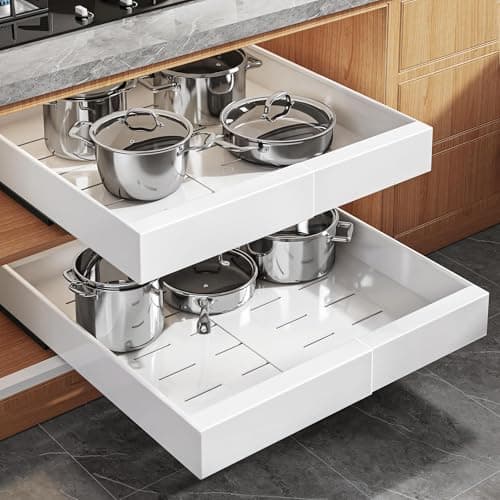
Kitstorack Expandable Pull-Out Cabinet Organizer, 21 in DeepExpands from 12 to 20 inches wide and mounts with adhesive rather than screws, and the listing states the minimum cabinet it needs. That last part is rarer than it should be.
Seinloes Expandable Pull-Out Organizer with Raising Pads, 2-PackThe pack that ships raising pads, which is the part most buyers of framed American cabinets discover too late: the frame lip blocks a flat-mounted tray.
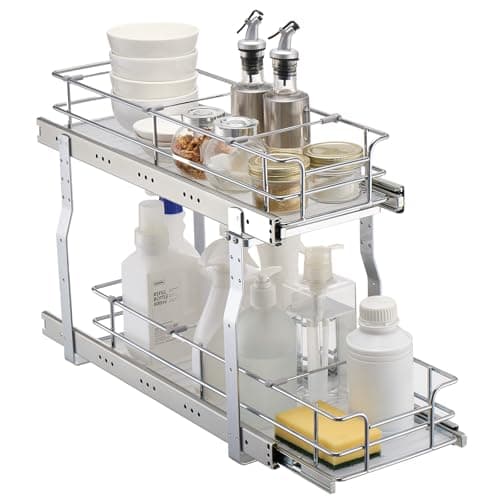
VEVOR Two-Tier Slide-Out Pantry Basket, 8.5 in WideThe only pull-out on this page with a stated load - 60 lb - and the only one built tall and narrow, which is what a filler cabinet next to an oven actually needs.
A narrow cabinet, and the only published load here
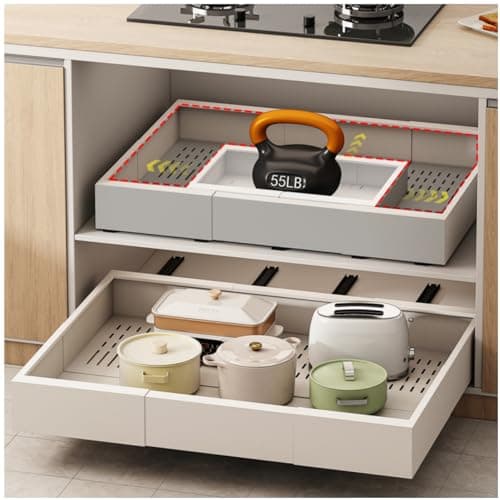
Fokyfok Expandable Pull-Out Organizer, 23 to 31 in WideThe only tray here that expands past 20 inches, and it expands in both directions, which is the answer for a 30-inch sink base or a pantry bottom.
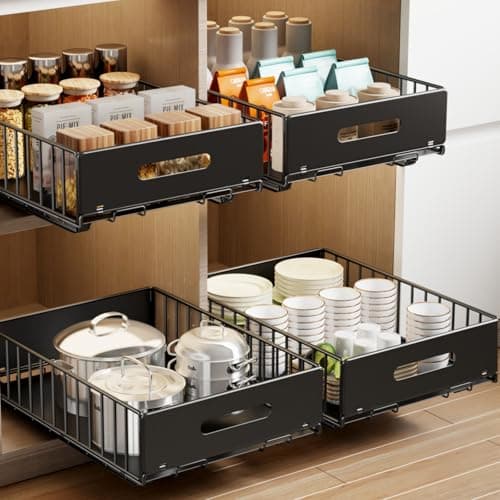
Mustorn Peel-and-Stick Pull-Out Drawers, 2-PackShorter and taller-sided than the expandable trays, which suits a cabinet that is not 21 inches deep - and most bathroom and island cabinets are not.
Scores are our own, from the published rubric on the methodology page. They are editorial judgments about published specifications, not test results — we have not handled these units.
01
Most cabinets, without drilling
Kitstorack Expandable Pull-Out Cabinet Organizer, 21 in Deep
Expands from 12 to 20 inches wide and mounts with adhesive rather than screws, and the listing states the minimum cabinet it needs. That last part is rarer than it should be.
21 in D x 12-20 in W x 2.8 in HSource: Retailer catalog listing, retrieved 21 September 2026
Minimum cabinet stated
Wider than 13 in and deeper than 21 inSource: Retailer catalog listing, retrieved 21 September 2026
Mounting
Adhesive. No drilling stated as requiredSource: Retailer catalog listing, retrieved 21 September 2026
Rails
Damping guide rail, seller-tested to 40,000 open and close cyclesSource: Retailer catalog listing, retrieved 21 September 2026
Weight
About 7.9 lbSource: Retailer catalog listing, retrieved 21 September 2026
Published load rating
Not published by the manufacturer in a form we could verify
What it gets right
The listing publishes the minimum cabinet width and depth, which is the figure that decides whether it fits
Adhesive mounting, so a rented kitchen keeps its cabinet intact
One unit rather than a multipack, so you can test a single cabinet before committing
What it does not
No load rating is published, so how much cookware it will carry is unstated
At 2.8 in tall the tray sides are shallow, and tall bottles will topple rather than be held
Adhesive mounting depends on a clean, flat cabinet floor - it is not a fix for a warped base
Who it is for
A standard base cabinet where things disappear at the back and you cannot drill.
Skip this if
Your cabinet is under 13 in wide or under 21 in deep. The listing rules that out itself.
02
Face-frame cabinets
Seinloes Expandable Pull-Out Organizer with Raising Pads, 2-Pack
The pack that ships raising pads, which is the part most buyers of framed American cabinets discover too late: the frame lip blocks a flat-mounted tray.
21 in D x 12.05-20.4 in W x 2.4 in HSource: Retailer catalog listing, retrieved 21 September 2026
Framed cabinets
Raising pads included, stated as compatible with framed and framelessSource: Retailer catalog listing, retrieved 21 September 2026
Minimum cabinet stated
Wider than 13 in and deeper than 21 inSource: Retailer catalog listing, retrieved 21 September 2026
Rails
Three-rail construction with dampingSource: Retailer catalog listing, retrieved 21 September 2026
Pack
2 unitsSource: Retailer catalog listing, retrieved 21 September 2026
Published load rating
Not published by the manufacturer in a form we could verify
What it gets right
Raising pads solve the face-frame lip, which is the single most common reason a pull-out will not slide
Two units per pack, so a pair of cabinets gets done at once
Three rails rather than two, per the listing
What it does not
At 2.4 in it has the lowest sides of any tray here
No load rating published, so heavy stand mixers are a guess
Two units is a commitment if you have only one cabinet worth converting
Who it is for
A traditional American kitchen with face-frame cabinets and a deep, dark bottom shelf.
Skip this if
Your cabinets are frameless. The pads are the reason to pay more, and you will not need them.
03
A narrow cabinet, and the only published load here
VEVOR Two-Tier Slide-Out Pantry Basket, 8.5 in Wide
The only pull-out on this page with a stated load - 60 lb - and the only one built tall and narrow, which is what a filler cabinet next to an oven actually needs.
16.5 in D x 11.8 in W x 3.94 in HSource: Retailer catalog listing, retrieved 21 September 2026
Mounting
Peel and stickSource: Retailer catalog listing, retrieved 21 September 2026
Construction
Carbon steel with a painted finishSource: Retailer catalog listing, retrieved 21 September 2026
Pack
2 unitsSource: Retailer catalog listing, retrieved 21 September 2026
Published load rating
Not published by the manufacturer in a form we could verify. The listing describes load-bearing capacity without a figure
What it gets right
16.5 in deep, so it fits the shallower cabinets the 21 in trays cannot
The deepest sides here at 3.94 in, which actually contains bottles rather than letting them roll
Carbon steel rather than coated wire, so there is a flat floor under the contents
What it does not
Fixed width at 11.8 in, so a wide cabinet keeps dead space at the sides
No load figure is published despite the heavy-duty description
Peel and stick is only as good as the surface under it, and it is not designed to be repositioned
Who it is for
A shallow cabinet, a bathroom vanity, or an island cupboard where the 21 in trays are too long.
Skip this if
Your cabinet is a standard 21 in deep base unit. An expandable tray will use the full depth and width.
Height is the constraint nobody checks
Flat trays are easy: 2.4 to 3.94 inches and they slide under almost anything. The two-tier basket is the one that catches people out, because the VEVOR needs 19 inches of interior height and a standard base cabinet with a drawer above it does not have that.
That is why the tall narrow basket suits a filler cabinet, a full-height pantry base or the cupboard beside a built-in oven, and why it is the wrong buy for the cupboard under your worktop drawer. The listing publishes the requirement; it is simply easy to skim past it.
What these will and will not carry
One product here publishes a load, at 60 lb. The rest describe themselves as heavy duty and give no figure, which is the same gap we document across garment racks and every other category where sellers replace specifications with adjectives.
Safe on any of them: packets, boxes, tins in a single layer, cleaning bottles, small appliances.
Only on the rated one: a stand mixer, a stack of cast iron, a full case of canned goods.
On none of them: anything you would not be happy to have slide forward at speed when the tray is pulled hard.
Adhesive or screws
Most of these mount with adhesive pads, which is genuinely useful in a rental and depends entirely on the cabinet floor being clean, dry and flat. A warped or laminated-peeling cabinet base is not a surface adhesive will hold to under repeated pulling.
If you own the kitchen and the tray will carry weight, screws into the cabinet floor are the stronger fixing. The same logic runs through everything we recommend: the fixing, not the product, is usually what fails. That argument in full is on shelf span and weight.
The sink base, which is its own problem
The cabinet people most want to fix is the one under the sink, and it is the hardest one to fit. A waste trap, a disposal unit, a water filter and two shut-off valves all live in that space, and none of them is where the tray wants to be.
Measure around the trap, not the cabinet. The usable rectangle is whatever is left in front of and beside the plumbing, and it is often 12 to 14 in deep rather than 21.
Two narrow trays usually beat one wide one. A pair either side of the trap uses the space a single expandable tray cannot reach.
Check the height of the shut-off valves, because a tray that clears the trap at floor level can still foul a valve as it slides forward.
Think about leaks. A slow drip onto a carbon steel tray leaves rust; the chrome-plated wire basket here handles damp better than a painted flat tray.
Fitting one, step by step
Empty the cabinet and clean the base thoroughly. Adhesive mounts fail on grease more often than on weight, and a kitchen cabinet floor is greasier than it looks.
Dry-fit first. Slide the tray in at its narrowest setting, open and close it, and check the door closes past the tray front before anything is stuck down.
Set the width against the opening, not the cabinet box. Expand the tray until it sits square with a few millimetres of clearance each side, and check it at the front of the runners as well as the back.
On a face-frame cabinet, fit the raising pads now. Trying to add them after the adhesive has cured means removing the whole assembly.
Press and wait. Adhesive pads want firm pressure and curing time before load - overnight is not excessive, and loading a tray the same hour is the most common installation mistake in this category.
What goes on a pull-out, and what should not
A slide-out tray changes how the back of a cabinet behaves, and it introduces one new failure mode: everything on it moves every time you pull it.
Ideal: pans and lids, bottles of oil and vinegar, cleaning supplies, tinned goods in a single layer, small appliances you use weekly.
Fine with care: dry goods in rigid containers, provided they cannot tip. Square containers that tessellate move less than round ones that roll.
Poor: anything tall and narrow on a shallow 2.4 in tray, which will topple on the first hard pull.
Never: anything you would not want to slide forward at speed. A tray that ends its travel abruptly throws its contents toward the door.
Loading matters for the runners as well. Weight over the rails rather than at the very front of the tray keeps the leverage on the mechanism lower, which is the same span-and-leverage reasoning that runs through shelf span and weight.
Cleaning, maintenance and renting
A slide-out tray adds a mechanism to a cabinet, and mechanisms need a little attention that a fixed shelf does not.
Crumbs and grit are what kill runners. A tray that grinds rather than glides usually needs the rails wiped rather than replaced, and it is a two-minute job if you do it before the grit scores the bearings.
Wipe the tray, not the rails, with anything wet. Water sitting in a runner is how a painted steel mechanism starts to rust, particularly in a sink base.
Check the adhesive pads twice a year if the tray is mounted that way. A pad starting to lift is obvious when the tray is empty and invisible when it is loaded.
Do not overload a tray to test it. The failure mode on an unrated tray is the runner deforming, and a deformed runner does not recover.
For renters, the adhesive-mounted trays are one of the few genuine kitchen upgrades available: nothing is drilled, the cabinet is unmodified, and the tray leaves with you. The removal question is worth thinking about before you fit it - adhesive pads that have cured for two years will take some persuading, and a hairdryer to soften the adhesive is the usual method. That is the same trade we describe across renter-friendly closet organizers: no-damage fittings are never quite no-trace fittings.
Corner cabinets and bifold doors
Two cabinet types defeat a standard tray and are worth identifying before you order. A blind corner cabinet has a section that runs back behind the neighboring cabinet face, and a straight-sliding tray can only ever reach the part of it directly behind the opening - the rest needs a purpose-built corner mechanism rather than anything on this page. A cabinet with bifold or folding doors gives an opening narrower than the cabinet at the hinge point, so measure with the doors fully folded back rather than with them removed.
In both cases the honest answer is often two narrow trays rather than one wide one, or a bin you lift out rather than a tray you slide. A tray that fits the opening but cannot reach the storage is worse than no tray, because it also takes up the height.
What we are not telling you
We have not installed or loaded any of these organizers. Every dimension, minimum and load figure here is published by the seller and was retrieved on 21 September 2026. Where a listing states no minimum cabinet size or no load, this page says so rather than filling the gap with a guess.
The face-frame reasoning is geometry rather than a measurement: a frame lip above the cabinet floor obstructs a tray mounted flat on it, and raising pads lift the rails clear. You can check that on your own cabinets with a ruler in about a minute. Prices are live from the retailer. The method is on how we pick.
FAQ
Questions people ask about this
What size pull-out organizer do I need?
Measure the clear width inside the cabinet opening at its narrowest point, the depth from the inside of the frame to the back panel, and the height of the opening. Then check those against the minimum the seller states: the expandable trays here need a cabinet over 13 inches wide and over 21 inches deep, and the two-tier basket needs 10 by 22 by 19 inches.
Will a pull-out organizer work in face-frame cabinets?
Only with raising pads, or with a model designed for it. A face frame usually leaves a lip above the cabinet floor, and a tray mounted flat has to climb that lip on every pull. The Seinloes pack ships raising pads for exactly this; frameless cabinets do not need them.
How much weight can a pull-out cabinet shelf hold?
Only one of the five here publishes a figure: the VEVOR two-tier basket, at a seller-stated 60 lb. The others describe themselves as heavy duty without a number. Treat unrated trays as suitable for packets, tins in a single layer and bottles, not for a stand mixer.
Do pull-out shelves need drilling?
Not usually. Most of these mount on adhesive pads, which suits a rental and needs a clean, flat, dry cabinet floor to hold. If you own the kitchen and the tray will carry real weight, screws into the cabinet base are the stronger fixing.
What is the difference between a pull-out shelf and a pull-out basket?
A flat tray is 2.4 to 3.94 inches deep and slides into almost any cabinet. A two-tier wire basket stores bottles upright and doubles your usable height, but it needs around 19 inches of interior cabinet height, which rules out a standard base cabinet with a drawer above it.
Are pull-out organizers better than buying a new pantry cabinet?
If the problem is the back of a cabinet you already own, yes, and by a wide margin on price. A new freestanding pantry cabinet solves a different problem, which is not having enough storage at all rather than not being able to reach it.
Sources
Where these figures come from
Product figures, as listed in the retailer catalog (21 September 2026)Dimensions, capacities, counts, materials and any stated load for every product added in this expansion, taken from the Amazon catalog and the sellers' own listing text through the Creators API on 21 September 2026. These are listing figures rather than manufacturer specification sheets, and each row is labeled that way. Where a listing states a load or a clearance requirement, it is quoted as the seller's figure. Where nothing is published, the row says so instead of carrying an estimate.
Garment rack load figures, as published by the sellerUnlike the closet systems on this site, garment racks are sold without manufacturer spec sheets. Where a capacity appears here it is the figure the seller states on the listing itself - useful, and a weaker class of source than an installation manual. Where no figure is stated, the row says so.
Availability check, 21 September 2026Every product added in this expansion was resolved through the Amazon Creators catalog on that date and carried a New buy-box offer at the time of writing. Products without a current offer were excluded before the pages were written.
What is not a source hereWe have not handled these products. Nothing on this page is a test result, and no figure comes from a retailer listing, another publisher, or memory.