Compression is brilliant for a duvet and quietly ruinous for a wool coat. Matching the container to the fiber is the whole job.
By Scooter M.Published September 13, 2026Content updated September 13, 2026Prices verified September 14, 2026How we pick
Bin & Basket earns a commission when you buy through our links, at no extra cost to you. We are an Amazon Associate. We accept no free products, no sponsored placements and no paid inclusion, and commission rate plays no part in what we recommend. Full disclosure.
Vacuum-compress bedding and synthetic-filled coats. Do not vacuum-compress wool, cashmere, leather or anything tailored. Compression is a volume trick that works by crushing loft, and loft is exactly what a duvet has spare and a wool coat does not. For the things you cannot compress, a rigid latching box under the bed is the right container — it protects against damp and crushing in a way a fabric bag does not.
That single rule decides most of this category. Everything after it is about where the box goes and how low your bed frame sits.
Match the container to the fiber
What to store in what
What you are storing
Container
Why
Duvets, pillows, synthetic-fill coats
Vacuum bag
Mostly air. Compression costs you nothing you cannot shake back out
Wool and cashmere knitwear
Rigid box, folded, not compressed
Compression flattens the loft that makes wool warm, and creases set over months
Tailored jackets and structured coats
Hanging, in a breathable garment bag
Shoulders and canvas are shaped; folding or crushing them is permanent
Leather and suede
Hanging, breathable, never sealed
Sealed plastic traps moisture against the hide and causes mildew
Cotton and linen bedding
Rigid box or vacuum bag
Tolerant of both; compression just creases it
Anything damp or unwashed
Nothing — clean it first
Storing soil and moisture is how you get both mildew and moths
This table is our editorial reasoning from how each fiber behaves, not a manufacturer specification, and it is labeled as such.
#
Product
Best for
Score
Price
01
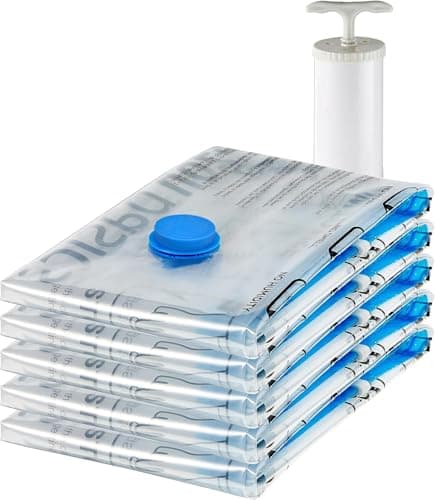
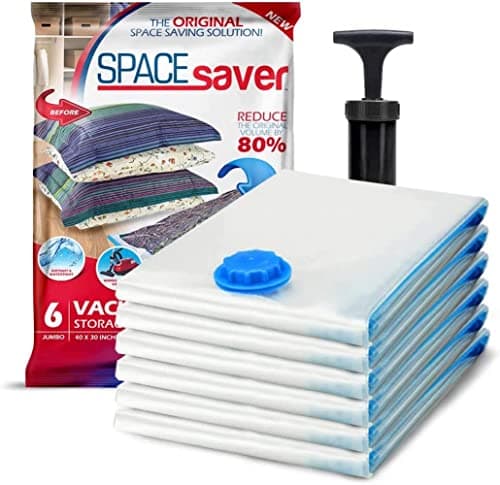
Spacesaver Vacuum Storage Bags with Hand Pump, JumboThe only product here that makes a duvet smaller rather than just moving it, and the hand pump means it works without a vacuum cleaner.
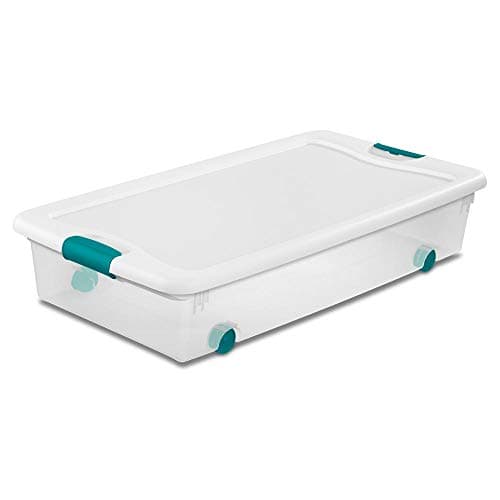
Sterilite 56 Qt Wheeled Latching Storage BoxRigid, wheeled and latching - the combination that makes under-bed storage something you actually open rather than something you forget.
Scores are our own, from the published rubric on the methodology page. They are editorial judgments about published specifications, not test results — we have not handled these units.
01
Bulk, when you have nowhere to put it
Spacesaver Vacuum Storage Bags with Hand Pump, Jumbo
The only product here that makes a duvet smaller rather than just moving it, and the hand pump means it works without a vacuum cleaner.
Transparent body, so no label is needed to find something
Published sizes
Sold by quart capacity; per-size dimensions appear on each listing
What it gets right
Stacks properly, which is the whole reason to buy rigid
Latches keep dust and insects out of stored textiles
You can see the contents without opening it
What it does not
Rigid boxes waste the space fabric bins would flex into
Latches crack with repeated cold-weather use in a garage
Who it is for
Seasonal storage, top-shelf archives, anything that goes up and stays up.
Skip this if
The boxes live on a high shelf you access weekly. Getting a latching lid off above head height is a two-handed job and it is genuinely annoying.
What vacuum bags are actually good at
Vacuum bags get criticized broadly and deserve it narrowly. What they do brilliantly is turn a duvet into something the size of a cushion, because a duvet is mostly trapped air and you can remove the air without harming the fill.
What they do badly is everything with structure. Wool fibers have a natural crimp that gives the fabric its warmth and its recovery; hold that crushed for six months and some of it does not come back. Tailoring is worse, because a jacket's shoulder is built from layers that are shaped rather than just folded.
Marginal: cotton knitwear and jeans, which will crease heavily but recover with a wash.
Bad: wool, cashmere, down (the fill clumps), tailoring, leather, anything with a structured shoulder.
Never: anything stored damp or unwashed, in any container.
One more failure mode worth knowing: a bag whose valve leaks re-inflates silently, and you discover months later that you have been storing a full-size duvet in a bag that was supposed to be flat. Check bags a week after sealing, once.
Under the bed is the space most people forget
Off-season storage has to go somewhere, and the closet you are trying to empty is the wrong answer. Under the bed is usually the largest unused volume in a bedroom.
Measure the clearance from floor to the underside of the frame. This one number decides everything.
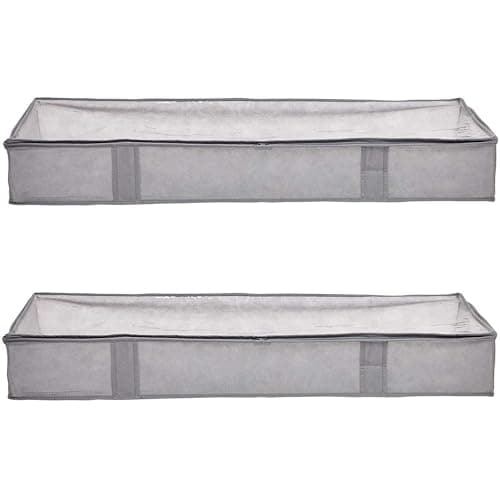
Under about 6 inches, only a fabric bag will go in, because it compresses to its contents.
Over about 6 inches, a rigid wheeled box is far better: it protects the contents and rolls out instead of dragging.
Check the bed has an open side. A divan with drawers on both sides has no clearance to roll anything out of.
If the answer is that there is no under-bed space at all, the next candidate is the top shelf of the closet in labeled boxes — which is what that shelf is genuinely good for, as set out on drawers vs shelves.
Rigid or fabric
Once you have ruled out compression, the remaining choice is between a rigid box and a fabric bag, and it is genuinely a trade rather than a ranking.
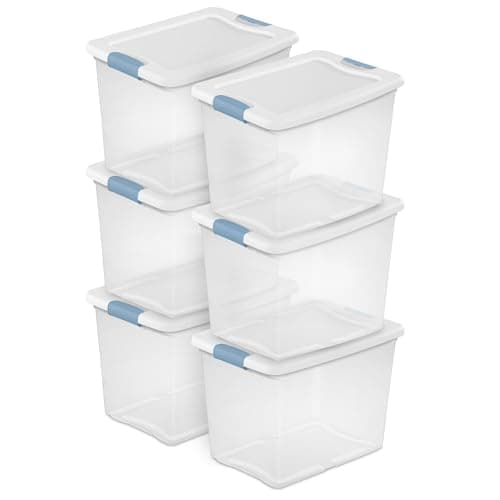
Rigid box. Protects against crushing and damp, stacks, latches, and rolls if it has wheels. Costs you the ability to squeeze it into an odd gap, and it takes up its full volume even when half empty.
Fabric bag. Goes under a low frame, folds flat out of season so it does not become storage that itself needs storing, and gives you very little protection. A half-full bag slumps and creases the contents.
Both, by location. Rigid where there is clearance and the contents matter; fabric where the gap is tight and the contents are robust.
What we are not telling you
We have not stored a season's clothes in any of these. Pack counts and stated capacities are the sellers' published figures. No manufacturer here publishes a compression ratio or a load rating we could verify, and every product says so rather than carrying a number we invented.
The fiber table is editorial reasoning about how wool, down and tailoring behave under compression, not a laboratory finding, and we would rather label it that way than imply a test we did not run. The method is on how we pick.
FAQ
Questions people ask about this
What is the best way to store off-season clothes?
Clean everything first, then match the container to the fiber. Vacuum bags for duvets, pillows and synthetic-fill coats; rigid latching boxes for wool and cashmere, folded but not compressed; breathable garment bags on a rail for tailoring and leather. Never store anything damp or unwashed.
Are vacuum storage bags bad for clothes?
For some fabrics, yes. Compression crushes the loft that makes wool and down work, and months of it means some of that recovery is lost. They are excellent for duvets, pillows and synthetic-fill coats, which are mostly air, and wrong for wool, cashmere, leather and tailoring.
How do you store sweaters without ruining them?
Fold rather than hang, so the shoulders are not stretched, and store in a rigid box rather than a vacuum bag so the knit is not crushed flat. Clean them first — larvae feed on body oils and food traces, not on clean wool alone.
What size under-bed storage do I need?
Measure the floor-to-frame clearance first, because that is the constraint. Under about 6 inches only a fabric bag will fit, since it compresses to its contents. Over 6 inches, a rigid wheeled box is better: it protects the contents and rolls out rather than dragging.
Should you store clothes in plastic or fabric?
Rigid plastic for anything that needs protection from damp or crushing, fabric where the gap is too tight for a box and the contents are robust. The one absolute is that leather and anything wool should never be sealed in airtight plastic, because trapped moisture causes mildew.
How long can clothes stay in vacuum bags?
A season is routine for compression-tolerant items. The practical limit is not time but fiber: robust synthetics and bedding are fine indefinitely, while anything with natural loft should come out and be allowed to recover rather than spending years flat.
Sources
Where these figures come from
Availability check, 13 September 2026Every product added for these pages was resolved through the Amazon Creators catalog on that date and carried a New buy-box offer at the time of writing. Products with no verifiable listing were not featured.
Where a figure is absentSeveral categories on these pages are dominated by sellers that publish a pack count and an overall size and nothing else - no load rating, no clearance height. Where that is the case the row says so rather than carrying an estimate.
What is not a source hereWe have not handled these products. Nothing on this page is a test result, and no figure comes from a retailer listing, another publisher, or memory.