Caps nest into each other and brims do not. Every capacity claim in this category depends on the first and ignores the second.
By Scooter M.Published September 26, 2026Content updated September 26, 2026Prices verified September 26, 2026How we pick
Bin & Basket earns a commission when you buy through our links, at no extra cost to you. We are an Amazon Associate. We accept no free products, no sponsored placements and no paid inclusion, and commission rate plays no part in what we recommend. Full disclosure.
Sort the collection into caps and brims first, because nothing stores both well. For baseball caps, the Perfect Curve CapRack holds up to 36 on a door face and is the one listing here that admits what it will not take - fitted caps. For wide-brim hats, the Bamneat box is the only one that publishes a brim width rather than just a hat count, and that figure is what you check your own hat against. If the caps need to be dust-free on a shelf, the AOODA boxes close and stack; if they need to be on show, the Mkono rails give each cap about 1.7 inches; and if you cannot drill, the NANATI hanger uses closet rod instead.
Every product here publishes a capacity. Divide that capacity into the dimensions the same listing publishes and you learn what the claim actually assumes, which is the useful part.
Two different problems wearing the same word
A baseball cap and a felt fedora are both hats and they fail in opposite ways. A cap is semi-soft: its crown collapses under weight and springs back, and its bill is the part that holds a shape. A structured brim hat is the reverse - the crown is rigid and the brim is the fragile part, and once a brim has taken a set it does not come back.
Caps nest. Stack one inside another and each adds roughly half an inch to the pile. That is why cap boxes claim double-digit capacities in seven inches of height.
Brims do not nest. Stack two wide-brim hats and the brim of the upper hat rests on the brim of the lower one, which is exactly the load a brim is worst at carrying.
Fitted caps are the exception among caps. A fitted crown is stiffer and does not compress, so every nesting claim on this page quietly assumes adjustable caps.
Soft hats - beanies, bucket hats, packable sun hats - have no shape to protect. Put them in a bin and stop thinking about it.
What the capacity claims work out to
Each of these figures is the seller's own claim divided into the seller's own dimensions. The arithmetic is ours; both inputs are theirs.
Published capacity against published size
Product
Published size
Claimed capacity
That works out to
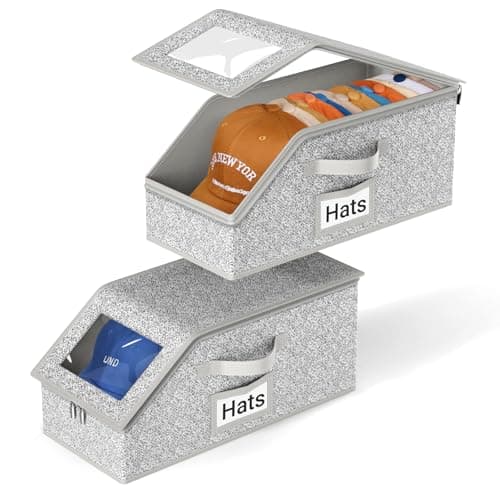
AOODA cap box
17 x 8.7 x 6.7 in
12 caps per box
About 0.56 in of height per cap
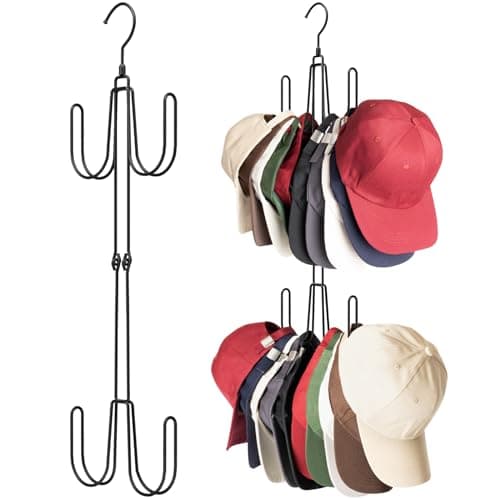
NANATI rod hanger
25.2 in tall, 4 hooks
10-15 hats
2.5 to 3.75 caps stacked on each 3.8 in hook
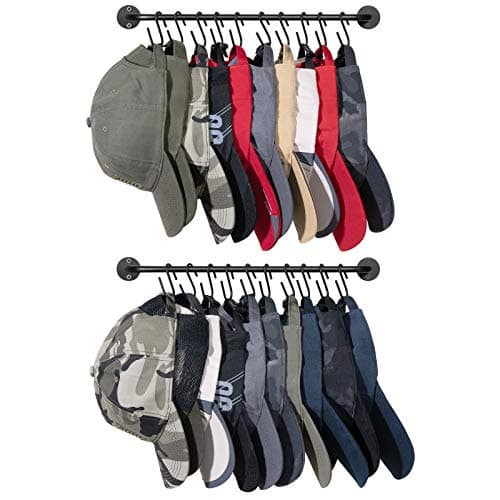
Mkono wall rails
Two 17 in rails
20 caps
About 1.7 in of rail per cap - the roomiest here
Perfect Curve CapRack
18 clips on 2 door straps
Up to 36 caps
2 caps per clip, one behind the other
Bamneat hat box
16.93 x 16.93 x 7.87 in
Five 16 in brim hats
0.93 in of total brim clearance, and 1.57 in of height per hat
kushon hat box
17 x 17 x 7 in
3-5 hats
1.4 to 2.3 in of height per hat
Sizes and capacities as published by the sellers on their listings, retrieved 26 September 2026. The right-hand column is our division of one by the other, not a manufacturer figure and not a measurement we took.
Read the AOODA row and the Mkono row together. One gives a cap half an inch and the other gives it more than three times that. Neither is wrong - a box is compressing a nested stack and a rail is hanging caps side by side - but they are selling very different things under the same word, and only the arithmetic makes that visible.
The brim number, which is the one that disqualifies a box
The Bamneat box is 16.93 inches across and says it holds 16-inch hats. That is 0.93 of an inch of clearance in total, under half an inch a side, and it is the most useful published figure in this category precisely because it is so tight.
A western hat with a 17 inch brim does not go in that box. Neither does a large sun hat. And the other box here, the kushon, publishes no brim width at all - it names hat types instead, which tells you nothing you can measure against. So the order of operations is: measure your widest brim, then shop.
How this page is ranked
Does the published figure survive division? A capacity that implies half an inch per cap is a nesting claim, and the page says so rather than repeating the headline number.
What it does to the shape. Brims stacked on brims and caps crushed three deep are the two failure modes, and they outrank capacity.
Which space it spends. A door, a wall, a shelf or closet rod - the same decision that governs every other accessory in a closet.
Dust. Open display is instant access and a dust magnet; a zipped box is the reverse. Which you want depends on whether you wear the hats or keep them.
Stated limitations. One listing here rules out fitted caps in its own copy. That is worth more than any feature bullet.
#
Product
Best for
Score
Price
01
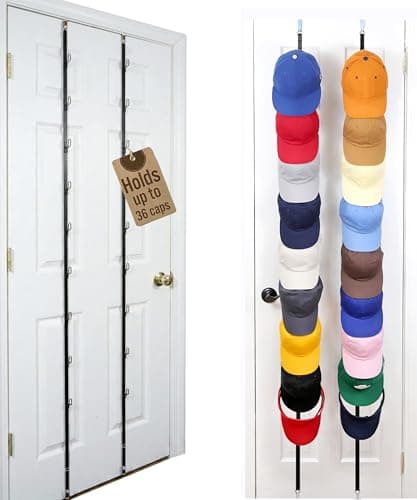
Perfect Curve CapRack Over-the-Door Hat OrganizerThirty-six caps on a door face, from the one listing in this category honest enough to name what it will not hold: fitted caps.
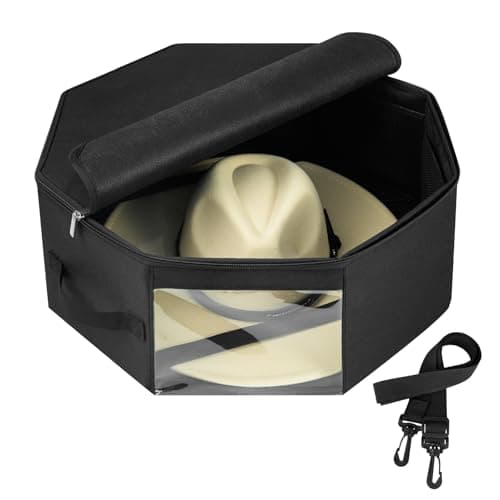
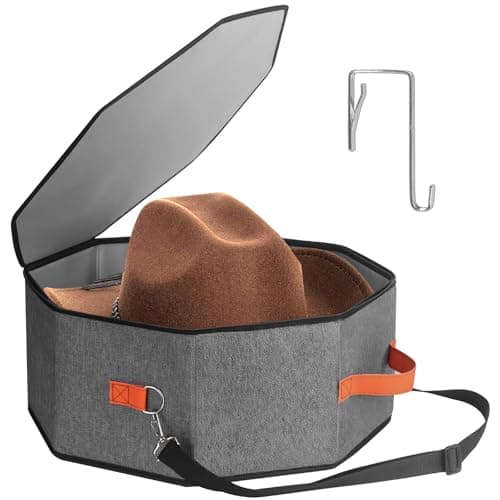
Bamneat Octagonal Hat Box for Wide-Brim HatsA 16.93-inch box that says it holds five 16-inch hats. That is under an inch of total clearance, and it is the figure to check your own brim against before ordering.
AOODA Stackable Cap Storage Boxes, 2-PackA closed box for caps on a shelf, which is the only format here that keeps dust off - at a stated 12 caps per box, which is a tight nest.
Mkono Wall-Mounted Hat Rack with 20 Hooks, Set of 2Two 17-inch rails with hooks you can move, which is the difference between a rack that fits your caps and a rack with a fixed pitch that does not.
NANATI Closet Rod Hat Hanger, 4 HooksThe only option here that hangs on a rod, and the only one that publishes a per-hook load - 10 lb, with hook dimensions to match.
kushon Hardboard Hat Storage Box with Door HookMDF-stiffened rather than cloth, and it claims three to five hats in seven inches instead of five - the more honest number of the two boxes here.
Scores are our own, from the published rubric on the methodology page. They are editorial judgments about published specifications, not test results — we have not handled these units.
01
Caps, on a door you were not using
Perfect Curve CapRack Over-the-Door Hat Organizer
Thirty-six caps on a door face, from the one listing in this category honest enough to name what it will not hold: fitted caps.
18 clips holding up to 2 caps each, so up to 36 capsSource: Retailer catalog listing, retrieved 26 September 2026
Door fit
Doors about 80 in tall and up to 1 3/8 in thick, per the listingSource: Retailer catalog listing, retrieved 26 September 2026
Configuration
2 separate straps, so it can serve two doorsSource: Retailer catalog listing, retrieved 26 September 2026
Clips
Injection-molded polypropylene, adjustable anywhere along the cordSource: Retailer catalog listing, retrieved 26 September 2026
Stated limitation
Not suitable for fitted caps, per the listingSource: Retailer catalog listing, retrieved 26 September 2026
Published load
Not published by the manufacturer in a form we could verify
What it gets right
Uses a door face, so it costs no shelf, no rod and no wall
Clips slide along the cord, so the spacing follows your caps rather than a fixed pitch
The listing states which caps it does not suit, which almost nothing in this category does
What it does not
Fitted caps are ruled out by the seller, and a stiff flat brim sits awkwardly in a clip
Two caps per clip means the back one is hidden behind the front one
A loaded strap swings when the door moves and can foul the door frame on a tight jamb
Who it is for
A large collection of adjustable caps, snapbacks and visors, and a spare door.
Skip this if
Your collection is mostly fitted caps. The listing says plainly that this is not for them.
02
Wide brims, with the clearance measured
Bamneat Octagonal Hat Box for Wide-Brim Hats
A 16.93-inch box that says it holds five 16-inch hats. That is under an inch of total clearance, and it is the figure to check your own brim against before ordering.
17 x 17 x 7 inSource: Retailer catalog listing, retrieved 26 September 2026
Stated capacity
3 to 5 hatsSource: Retailer catalog listing, retrieved 26 September 2026
Height per hat at that claim
About 1.4 to 2.3 in each - our arithmetic from the seller's own figures
Structure
High-density MDF panels with a linen coveringSource: Retailer catalog listing, retrieved 26 September 2026
Hanging
Includes a door hook, plus handles and a shoulder strapSource: Retailer catalog listing, retrieved 26 September 2026
Stated brim width
Not published by the manufacturer in a form we could verify. The listing names hat types rather than a brim measurement
What it gets right
MDF panels hold the box square under something stacked on top, where cloth sides flex
A door hook, so it can hang rather than occupy a shelf
The lower capacity claim means more height per hat, which is better for the hats
What it does not
No brim width is published, so a 17 in box against an unknown interior is still a measurement you have to make yourself
MDF is the least damp-tolerant material here and should not live against a cold exterior wall
At 7 in tall it takes the same shelf height as boxes claiming more capacity
Who it is for
A few good hats that need a rigid box, on a shelf or hung on a door.
Skip this if
You need to know the brim clearance before ordering. The octagonal box states a brim width; this one does not.
Fitted caps, and the claim nobody else makes
Perfect Curve's listing says its rack is not suitable for fitted caps. That single sentence is the most useful thing any seller in this category publishes, and it applies far more widely than to that one product.
A fitted cap has a stiffer crown with no strap opening at the back. It will not clip the way an adjustable cap does, it will not hang on an S-hook designed for a strap gap, and it does not nest into the cap below it in a box. If your collection is fitted caps, the honest options narrow to boxes with generous height per cap, rails where each cap gets its own hook, and shelf space where they sit crown-up in a row.
None of the nesting claims on this page were written with fitted caps in mind. Treat every capacity figure as roughly a third lower if that is what you own.
Door, wall, rod or shelf
The formats here spend four different resources, and the right one is usually whichever you have spare rather than whichever stores most.
A door is the cheapest space in most closets and the one people forget. The trade is that anything on a door swings, and a loaded strap can foul a tight frame. The weight caution for anything door-mounted is on closet door organizers.
A wall gives the most generous spacing per cap and needs screws, which rules it out in many rentals.
Closet rod costs you hanging space - the same arithmetic we apply to hanging closet organizers, where a foot of rod is about a dozen shirts.
A shelf is where boxes go, and boxes are the only format here that keeps dust off. They stack, so a shelf with height holds more than its surface area suggests.
Dust, light and the things that ruin a hat slowly
Hats degrade in storage in three ways, and none of them is sudden.
Dust settles on the crown, and on a pale felt or straw hat it grays the color before you notice it happening. This is the argument for a closed box over an open rail for anything you wear rarely.
Sunlight fades one side. A hat left on an open rack near a window ages unevenly, which is far more obvious than overall fading.
Damp softens structure. Felt and straw both relax in humid air, and a hat that relaxes while resting on its brim keeps the shape it relaxed into. If the closet is damp enough to smell, fix that first - the diagnosis is on why your closet smells musty.
One habit costs nothing and does more than any product: store a structured hat crown-down on its top, or supported inside a box, rather than resting on the brim. The brim is the part with no structural support, and it is the part that takes a permanent set.
What each format will not do
Clips and S-hooks will not hold a fitted cap properly, because both are designed around the strap gap at the back of an adjustable one.
Cap boxes will not hold a wide brim. At 8.7 inches wide, they are half the width a fedora needs.
Hat boxes will not hold a big collection. Five hats per box is the claim and three is the comfortable number, so a large collection becomes a stack of boxes.
Nothing here stores a hat you wear daily well. That hat wants a hook by the door, and the storage on this page is for the rest of the collection.
Material changes what the storage has to do
Capacity and clearance decide whether a hat fits. What the hat is made of decides how much the fit matters.
Felt is the least forgiving. It holds whatever shape it is left in, it relaxes in humid air, and a crease put in by a stacked brim stays. Felt hats are the ones that justify a rigid box with support in the sides.
Straw and raffia are brittle rather than plastic: instead of taking a set, they crack along a fold. A straw hat wants space around the brim rather than pressure on it, and it suffers most from being squeezed into a box that is fractionally too small.
Cotton and canvas caps are the forgiving end. They nest, they recover from being squashed, and they are what every high-capacity claim on this page is written around.
Wool and knit hats have no structure to protect at all, so they belong in a bin or a drawer rather than in any of the products here.
That ordering is also a spending guide. If the collection is cotton caps, buy on capacity and access, because the hats will survive almost anything. If it includes two or three felt or straw hats worth real money, those specific hats justify a box of their own - and the rest can go in whichever cap format suits the space you have.
What we are not telling you
We have not handled, filled or measured any of these products. Every dimension, capacity claim, hook count and load figure is published by the seller or listed in the retailer catalog, retrieved on 26 September 2026, and each product card labels it that way.
The per-cap and per-hat figures in the table are our arithmetic - each seller's own capacity divided into its own published dimensions - and they are labeled as ours rather than presented as specifications. Only one product here publishes a load rating, at a seller-stated 10 lb per hook. What nesting does to a crown over a year, and what a stacked brim does over a season, we have described by mechanism rather than measured. Prices are live from the retailer at the moment you look. The method is on how we pick.
FAQ
Questions people ask about this
What is the best way to store baseball caps?
On display, a rail that gives each cap its own hook keeps the crown from being crushed - the rails here work out to about 1.7 inches per cap. For caps you are storing rather than wearing, a zipped box keeps dust off, at the cost of nesting them tightly: 12 caps in a 6.7 inch box is about half an inch each.
How do you store hats without ruining them?
Keep structured hats off their brims. A brim has no structural support, and a hat that sits on its brim for months takes a permanent set. Store it crown-down or supported in a box, keep it out of direct sun, and keep the closet dry - felt and straw both relax in humid air.
What size hat box do I need?
Measure across the widest point of the brim, upside down, and buy a box with more interior than that. The box here that publishes a brim figure is 16.93 inches across for 16 inch hats, which is under half an inch of clearance a side - so a 17 inch western brim needs something larger.
Can you store fitted caps on a cap rack?
Not well. One listing here states outright that its rack is not suitable for fitted caps, and the reason generalizes: clips and S-hooks are designed around the strap gap at the back of an adjustable cap, which a fitted cap does not have. Fitted caps want their own hook, a roomy box or open shelf space.
How many hats actually fit in a hat box?
Fewer than the claim, if you care about the hats. A box claiming five hats in 7.87 inches of height gives each one about 1.57 inches, which means brims resting on brims. Three hats in a five-hat box is the comfortable number.
Is it better to hang hats or box them?
Hang the ones you wear, box the ones you keep. Open storage gives instant access and collects dust; a closed box protects but puts the hat out of mind. Most collections want both, split by how often each hat comes out.
Where can I store hats in a small closet?
The door face is the space most people have spare, and an over-door cap rack uses it without touching shelf or rod. After that, closet rod with a hanging hat hanger, then stacked boxes on the shelf above the rod, which is usually the least contested space in the closet.
Sources
Where these figures come from
Hat storage dimensions and capacity claims, as listed in the retailer catalogDimensions, stated hat and cap capacities, hook counts and any stated load for each product, taken from the Amazon catalog and the sellers' own listing text through the Creators API on 26 September 2026. These are listing figures rather than manufacturer specifications. The per-hat and per-cap allowances quoted on this page are our own arithmetic, dividing each seller's published dimensions by its own published capacity claim, and they are labeled as ours.
Availability check, 26 September 2026Every product on this page was resolved through the Amazon Creators catalog on that date and carried a New buy-box offer at the time of writing.
Garment rack load figures, as published by the sellerUnlike the closet systems on this site, garment racks are sold without manufacturer spec sheets. Where a capacity appears here it is the figure the seller states on the listing itself - useful, and a weaker class of source than an installation manual. Where no figure is stated, the row says so.
What is not a source hereWe have not handled these products. Nothing on this page is a test result, and no figure comes from a retailer listing, another publisher, or memory.