Small closets fail in specific, measurable ways. Find which dimension is short and the answer follows from it.
By Scooter M.Published September 1, 2026Content updated September 1, 2026Prices shown live on AmazonHow we pick
Bin & Basket earns a commission when you buy through our links, at no extra cost to you. We are an Amazon Associate. We accept no free products, no sponsored placements and no paid inclusion, and commission rate plays no part in what we recommend. Full disclosure.
Find out which dimension is short before you buy anything, because the answer is different for each. Under 22 inches deep, stop hanging conventionally — a hanger cannot sit square. Under 36 inches wide, the door frame eats the ends of the rod and shelving beats hanging. Under an 84 inch ceiling, double hang does not fit and the gain has to come from the floor and the top shelf instead.
"Small closet" describes at least three different problems and they have different solutions. Measure first — the routine takes five minutes and is on reach-in closet dimensions.
#
Product
Best for
Score
Price
01
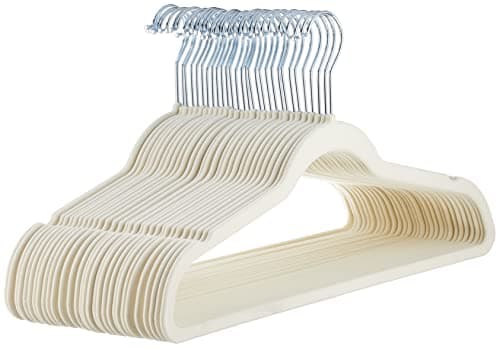
Amazon Basics Velvet Slim Non-Slip HangersA slim flocked hanger is the cheapest way to add hanging capacity to a closet you cannot make wider.
No imageSimple Houseware Hanging Closet Organizer with ShelvesA fabric shelf tower that hangs off the existing rod, adding folded storage with no hardware and no holes.
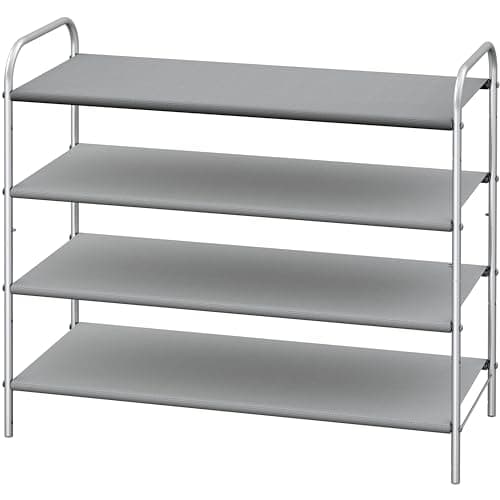
Simple Houseware 4-Tier Stackable Shoe RackA stackable metal frame that turns closet floor into four usable levels, and stacks further if the closet is tall.
Scores are our own, from the published rubric on the methodology page. They are editorial judgments about published specifications, not test results — we have not handled these units.
01
Getting more onto the same rod
Amazon Basics Velvet Slim Non-Slip Hangers
A slim flocked hanger is the cheapest way to add hanging capacity to a closet you cannot make wider.
Slim flocked plastic, materially thinner than a molded plastic hanger
Grip
Flocking holds wide necklines and satin that slide off smooth plastic
Capacity effect
Rod capacity is a function of hanger thickness — thinner hangers, more garments per foot
Published per-hanger load
Not published by the manufacturer in a form we could verify for flocked hangers as a class.
What it gets right
The single highest-impact cheap change in a crowded closet
Nothing slides off, which is the daily annoyance flocking actually fixes
A uniform hanger set makes a closet look organized on its own
What it does not
The plastic core snaps under a heavy winter coat
Flocking sheds onto dark clothing when new
Who it is for
Anyone whose closet is full because the hangers are thick, which is most people who think they have a space problem.
Skip this if
You are hanging tailoring or heavy coats. Slim hangers crease shoulders and the plastic core is not built for the weight — use wooden suit hangers for those.
02
No image
Renters and dorm closets
Simple Houseware Hanging Closet Organizer with Shelves
A fabric shelf tower that hangs off the existing rod, adding folded storage with no hardware and no holes.
Hangs from the existing closet rod on a hook-and-loop strap
Wall damage
None
Depth needed
Fabric shelf modules are shallower than a 24 in closet, so the door still closes
Published shelf load
Not published by the manufacturer in a form we could verify for fabric hanging organizers.
What it gets right
Zero holes and zero tools, which is the entire point in a rental
Turns dead vertical rod space into folded storage
Comes down and packs flat when you move
What it does not
It hangs off the rod, so it adds to the rod's load rather than relieving it
Fabric sags under books or anything dense
Who it is for
Anyone who cannot drill: a rental, a dorm, a room where the lease says no fixings.
Skip this if
Your rod is already bowing. A hanging organizer full of sweaters is a concentrated point load in the middle of the span, which is the worst place to add weight.
03
A closet with a solid door and no floor left
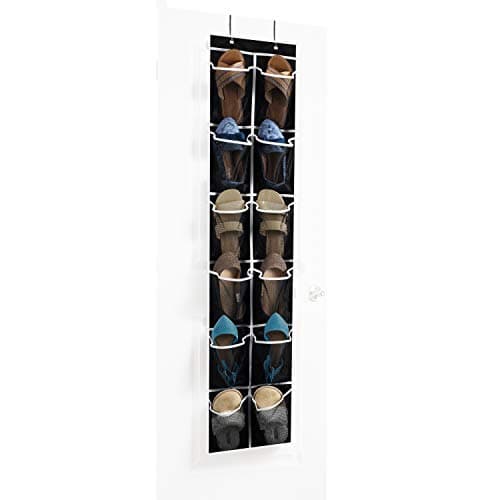
Zober Over-the-Door Shoe Organizer
Twenty-odd pockets on the back of the door, which is the only surface in most closets nobody is using.
Sits within a standard 24 in closet depth with the door closing
Stacking
Units stack on each other to use full closet height
Published load per tier
Not published by the manufacturer in a form we could verify for stackable shoe racks in this class.
What it gets right
Uses the height of the closet floor, which is usually wasted
Freestanding, so no fixings and no wall dependency
Stacks, so the same product scales from a small closet to a walk-in
What it does not
Bare metal bars mark soft soles over time
Tall stacks wobble if the floor is not flat
Who it is for
A reach-in or walk-in floor currently holding a pile of shoes.
Skip this if
Your shoes are mostly boots. Tier spacing on these racks is sized for shoes, and a knee boot does not fit under the next tier.
If depth is the problem
A standard hanger is 17 to 18 inches across and needs about 24 inches of closet to sit square with door clearance. Below roughly 22 inches, the hanger turns, the garment presents at an angle, and a full rod pushes against the inside of the door.
Accept it and stop hanging front-to-back. A pull-out side-hanging rail holds garments parallel to the wall and works in depths a normal rod cannot.
Convert to shelving and drawers. A shallow closet is a good shelf closet, and folded storage does not care about depth in the way hanging does.
Use a 12 inch shelf rather than 16. ClosetMaid publishes both depths across its wire ranges, and the shallower one exists for exactly this.
Check what the door costs you. A sliding door panel sits inside the opening and can take four inches off your usable depth before you have started.
If width is the problem
Under about 36 inches, hanging becomes inefficient because the frame eats the last few inches at each end of the rod and you cannot get a hand in there anyway. Two things help:
Slim hangers, which matter more at this width than anywhere else. Forty shirts is 10 inches of rod instead of 20, and in a 30 inch closet that is the difference between full and half full.
Full-height shelving down one side, with a short rod on the other. A narrow closet often stores more as a shelf stack than as a rod.
If the audit shows you have rod to spare and nowhere to put folded clothes, that is the exact situation a hanging closet organizer is for — it converts rod length into shelves, which is a good trade only in that direction.
If height is the problem
Double hang needs roughly 38 inches of clear drop twice, plus hardware. Under an 84 inch ceiling that does not fit, and forcing it means the upper garments brush the lower ones.
Single rod at 66 inches with a shelf above, and take the gain from the floor instead.
Stackable floor rack in the clear space under the rod. This is the biggest single gain available in a low closet.
Double hang across a narrow section only, for shirts, and leave the rest full height.
The single largest gain available in a small closet is usually taking the other season out of it entirely. Where it should go, and which container suits which fabric, is on best off-season clothes storage.
The changes that work in any small closet
Small-closet interventions by constraint
Constraint
First move
Second move
Depth under 22 in
Convert to shelving, or a side-hanging rail
12 in shelves rather than 16 in
Width under 36 in
Slim hangers
Shelf stack down one side
Height under 84 in
Floor rack under the rod
Shelf above the existing shelf
Sliding doors
Puck lights under the shelf, not a door bar
Nothing over-door — there is no top edge
No usable floor
Hanging fabric tower, if rod length allows
Over-door organizer, hinged doors only
All of the above
Slim hangers, then move out-of-season clothing out
Store elsewhere and accept the closet is small
Depth and door type are the two constraints no product solves. Everything else has a workaround.
When the closet genuinely runs out, the next space is under the bed, and the only figure that matters there is the clearance under the frame. The options are on best under-bed storage.
Where floor space has run out, boxes stack into the full height of a shelf in a way an open rack cannot. The sizing trap in that category - claims four sizes apart on boxes the same length - is covered on best shoe storage boxes.
The door face is usually the last unused surface in a small closet, and caps are what it takes best - up to 36 on a single over-door rack. The options are on best hat storage for a closet.
Small closets with sliding doors
Sliding doors have two specific costs. The panel sits inside the opening, so your usable depth is less than the measurement to the frame — measure to the inside face of the closed panel. And only half the closet is open at a time, so anything you need daily must be reachable in both positions.
They also rule out every over-door product, because there is no top edge to hook over. The alternatives and the hardware fixes are on closet door organizers.
FAQ
Questions people ask about this
How do you organize a small closet?
Measure first and find out which dimension is short, because depth, width and height each need a different answer. Then, in order: slim hangers, use the floor, move out-of-season clothing out, and add a shelf above the existing one.
How do you organize a small closet with lots of clothes?
Halve the rod space by switching to slim hangers, fold everything knitted into a drawer where it belongs anyway, and move out-of-season clothing into latching boxes elsewhere. Between them those three recover more than any product will.
What do you do with a closet that is too shallow?
Stop hanging front-to-back. Below about 22 inches a standard hanger cannot sit square. Convert to shelving and drawers, or fit a pull-out rail that hangs garments sideways, and use 12 inch shelves rather than 16.
How do you organize a small closet with sliding doors?
Measure your usable depth to the inside face of the closed panel, not to the frame, because the panel takes several inches. Keep daily items reachable in both door positions, and skip over-door products entirely — there is no top edge to hook over.
Can you double hang in a small closet?
Only if you have about 84 to 90 inches of internal height, and comfortably only at 90 or more. A shirt needs roughly 38 inches of clear drop twice, plus hardware. Below that, take the gain from the floor instead.
ClosetMaid published product specificationsSuperSlide and Shelf & Rod depth options and rod-support spacing.
What is not a source hereWe have not handled these products. Nothing on this page is a test result, and no figure comes from a retailer listing, another publisher, or memory.