Freestanding racks publish load figures with no conditions attached, which makes them the easiest thing in this category to compare honestly.
By Scooter M.Published September 1, 2026Content updated September 1, 2026Prices shown live on AmazonHow we pick
Bin & Basket earns a commission when you buy through our links, at no extra cost to you. We are an Amazon Associate. We accept no free products, no sponsored placements and no paid inclusion, and commission rate plays no part in what we recommend. Full disclosure.
A commercial NSF rack is the strongest pantry shelving you can buy, publishing up to 800 lb per shelf and 4,000 lb per unit with no wall involvement at all. That is roughly ten times what a wall-mounted closet system publishes per bracket, and it needs no studs, no permission and no drill. The trade is depth and looks: commercial racks come in 18 and 24 inch depths, and a pantry wants 12 to 16.
That depth mismatch is the real decision in this roundup. The commercial rack is stronger and adjustable and cheap for what it is; the shallower units suit the pantry depth band better. Which matters more depends on whether you are storing tins and bottled drinks or packets and boxes. The depth reasoning is on pantry shelf depth and spacing.
#
Product
Best for
Score
Price
01
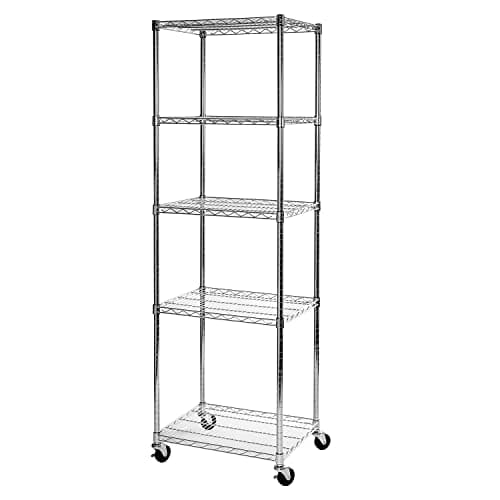
Seville Classics UltraDurable 5-Tier NSF Steel Wire ShelvingA freestanding NSF-rated rack with the highest published per-shelf load in this entire set, and no drilling at all.
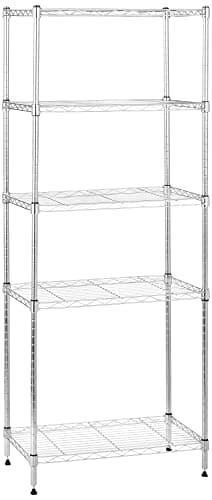
Amazon Basics 5-Shelf Adjustable Storage UnitThe commodity version of a wire rack: adjustable posts, no drilling, and a price that makes it the default first pantry.
Scores are our own, from the published rubric on the methodology page. They are editorial judgments about published specifications, not test results — we have not handled these units.
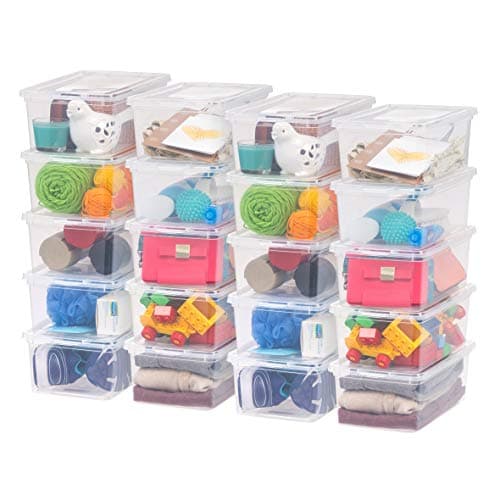
Rigid polypropylene with a latching or friction lid depending on model
Stackability
Designed to stack loaded
Published dimensions
Stated per size on the listing; check against your shelf depth
What it gets right
Stacks properly under load
Sizes that suit a shelf rather than a garage floor
Clear bodies mean no labeling required
What it does not
Rigid boxes waste corner space in an irregular pantry
Lids are a separate thing to lose
Who it is for
Deep pantry shelves where things get lost at the back.
Skip this if
Your pantry shelf spacing is under about 8 inches. Stacking is the reason to buy these, and there is no stacking headroom in a tight spacing.
Why freestanding beats wall-mounted in a pantry
A pantry stores the heaviest things in the house — tinned food, bottled drinks, bulk flour, appliances. Wall-mounted shelving transmits all of that into a few screws in drywall, and every manufacturer conditions its published rating on hitting studs. A freestanding rack transmits it straight down through four posts into the floor, and has no condition to satisfy.
That is why the highest published per-shelf figure in this entire site belongs to a rack that costs a fraction of a fitted system. The comparison across every system we compiled is on shelf span and weight.
Choosing a size
Matching a rack to the space
Space
Depth to look for
Note
Walk-in pantry
18 to 24 in
Commercial depths work here; you can walk past them
Cupboard pantry
12 to 16 in
Commercial racks are too deep; look at the shallower ranges
Alcove or gap
12 to 14 in, narrow width
Measure the narrowest point, not the opening
Garage overflow
24 in
Depth is free here and load is what matters
Under stairs
Variable, sloping
Adjustable posts matter more than depth; set each shelf to the slope
Commercial NSF racks are commonly available in 36 x 18 x 75 in and 48 x 24 x 76 in among other sizes.
Getting a wire rack to behave in a pantry
Bins on every shelf. Wire shelving lets small items tip and packets fall through. This is not optional — budget for bins at the same time as the rack.
Shelf liners only where you need them. A liner solves the tipping and removes the ventilation you bought wire for. Use them under things that tip, not everywhere.
Set the shelves before you load it. Adjusting a post-mounted shelf on a loaded rack means unloading it entirely.
Leveling feet, not casters, in a pantry. Casters are for a rack that moves; a pantry rack does not, and leveling feet stop it rocking on an uneven floor.
Heavy low. The published per-shelf figure applies to every shelf, but the unit's stability does not — a top-heavy rack tips.
Freestanding units earn their place most clearly in an awkward space, because they only have to clear an obstruction at one point rather than follow it. The under-stairs case, where that matters most, is on shelving an under-stairs pantry.
Where there is no alcove to shelve at all, the freestanding answer is a cabinet with doors, and the same published-figures problem applies to it: best freestanding pantry cabinets ranks them on what they actually publish.
When to build fixed shelving instead
A freestanding rack sits inside the pantry and its posts and frame consume space at the perimeter. Fixed shelving fitted wall to wall uses that space, which in a narrow cupboard pantry is a real gain — maybe an extra inch each side and a few inches of depth.
The costs are that fixed shelving depends on the wall, is not adjustable once installed, and cannot come with you. In a rental or a house you are not staying in, the rack wins on those grounds alone.
A walk-in pantry changes the question, because there is more wall than you can use and the limit becomes what each wall will carry. The published loads, which run from 40 lb to 250 lb a shelf on shelves of similar size, are compared on shelving a walk-in pantry.
FAQ
Questions people ask about this
What is the best pantry shelving unit?
A commercial NSF wire rack, if the depth suits your pantry. It publishes up to 800 lb per shelf and 4,000 lb per unit with no wall fixing at all. In a shallow cupboard pantry, a shallower unit in the 12 to 16 inch band is the better fit even though it publishes lower figures.
How much weight can pantry shelving hold?
Freestanding commercial racks publish up to 800 lb per shelf. Consumer freestanding units publish considerably less and state it per shelf on the listing. Wall-mounted shelving publishes lower figures again and conditions them on screws into studs.
How deep should a pantry shelving unit be?
12 to 16 inches for a pantry. Commercial racks are usually 18 or 24 inches, which is deeper than ideal for food storage — you end up with food behind food. Use commercial depths in a walk-in or garage, shallower units in a cupboard.
Is freestanding or fixed pantry shelving better?
Freestanding for load, for rentals and for anything you might reconfigure — it publishes far higher figures because it carries weight into the floor rather than the wall. Fixed shelving uses the perimeter space a rack's frame consumes, which matters in a narrow cupboard.
Do you need bins on wire pantry shelving?
Yes. Wire lets air through, which is why it is used, and the cost is that packets and small items tip and fall through the gaps. Budget for bins alongside the rack rather than discovering the problem after it is loaded.
What is not a source hereWe have not handled these products. Nothing on this page is a test result, and no figure comes from a retailer listing, another publisher, or memory.