Most pantry spending happens in the wrong order. Here is the sequence that gets the most out of the least.
By Scooter M.Published September 1, 2026Content updated September 1, 2026Prices shown live on AmazonHow we pick
Bin & Basket earns a commission when you buy through our links, at no extra cost to you. We are an Amazon Associate. We accept no free products, no sponsored placements and no paid inclusion, and commission rate plays no part in what we recommend. Full disclosure.
Buy in this order: measure first and buy nothing, then a tiered rack for tins, then clear bins for packets, then airtight containers for four staples only, then under-shelf baskets if the shelf thickness allows. Most people start with a matching container set, which is the most expensive step and the fourth most useful one.
The reason for the order is that each step tells you something about the next. Measuring tells you which containers can fit. A tiered rack shows you how much of your problem was visibility. Bins show you which categories you actually have. Only then does a container set make sense, because by that point you know what size to buy.
#
Product
Best for
Score
Price
01
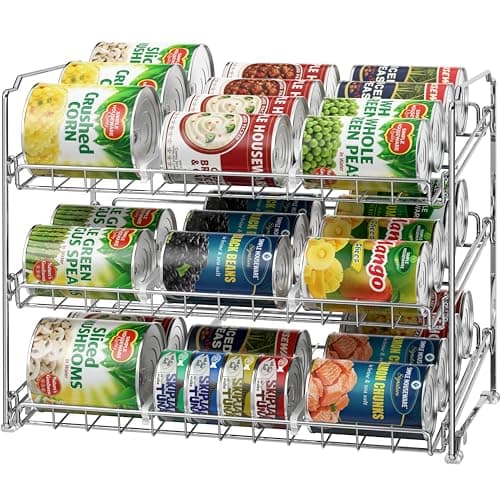
Simple Houseware 3-Tier Can Rack OrganizerA stepped rack that raises the back rows so you can read every label without taking the front row out.
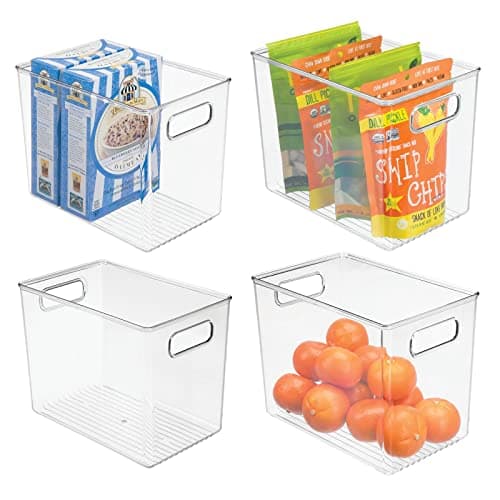
mDesign Clear Plastic Pantry Bins with HandlesOpen-top clear bins that turn the pile of half-open packets into a category you can pull out in one movement.
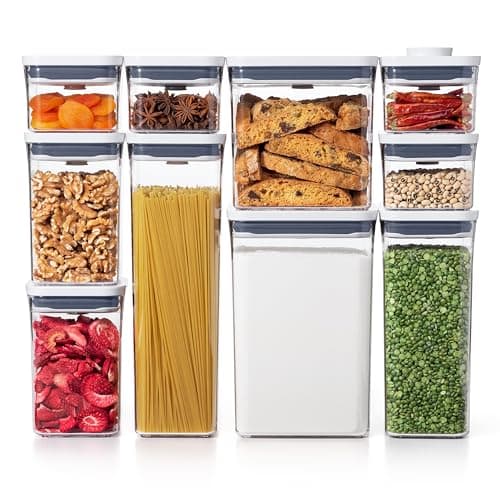
OXO Good Grips POP Container SetThe only set in this category whose manufacturer publishes an exact dimension for every single size, which is why it is first here.
Scores are our own, from the published rubric on the methodology page. They are editorial judgments about published specifications, not test results — we have not handled these units.
01
Tins on a deep shelf
Simple Houseware 3-Tier Can Rack Organizer
A stepped rack that raises the back rows so you can read every label without taking the front row out.
Tiered steps, so back rows sit higher than front rows
Shelf spacing needed
More than a flat row of tins: the top step raises the rear cans
Why it works
Standard cans are 4 to 5 in tall, and pantry shelves are commonly spaced 7 in for canned goods, which leaves the headroom a tiered rack needsSource: Dimensions.com pantry storage heights
Published capacity
Stated per model on the listing
What it gets right
Every label is readable without unloading the shelf
Uses the vertical headroom a flat row of tins wastes
Freestanding — lift it out to clean the shelf
What it does not
Only works for uniform can heights; tall tins foul the step above
Takes more shelf depth than stacking tins flat
Who it is for
Anyone whose tinned food lives three rows deep on a shelf.
Skip this if
Your shelf spacing is 6 inches or less. A tiered rack needs headroom above a 4 to 5 in can, and a tight spacing removes it.
02
Grouping loose packets
mDesign Clear Plastic Pantry Bins with Handles
Open-top clear bins that turn the pile of half-open packets into a category you can pull out in one movement.
Mini Square Short 0.5 qt is 3.1 x 3.1 x 6.7 in; Small Square Medium 1.7 qt is 4.1 x 4.1 x 9.8 in; Rectangle Short 1.7 qt is 6.3 x 4.1 x 6.7 in; Small Square Tall 2.3 qt is 4.1 x 4.1 x 13 in; Rectangle Medium 2.7 qt is 6.5 x 4.3 x 9.5 inSource: OXO POP container product pages, oxo.com
Seal
Push-button lid; the button pops up to double as a handleSource: OXO POP container product pages, oxo.com
Shelf depth needed
Every size above fits within a 12 in pantry shelf on its longest footprint dimension
Shelf height needed
The 13 in Small Square Tall needs a spacing well above the 7 to 10 in common band
What it gets right
Published dimensions for every size, so you can plan a shelf before buying
One-handed opening, which matters when the other hand holds a measuring cup
Square footprints tessellate on a shelf; round canisters waste the corners
What it does not
The most expensive option in this category by a wide margin
The button mechanism traps flour and needs disassembly to clean properly
Who it is for
A pantry you are laying out deliberately, where knowing the exact footprint before you buy is worth the premium.
Skip this if
Your shelf spacing is 8 inches or less. The tall sizes are 9.5 to 13 in and simply will not stand up — check the table above against your own shelf before ordering.
04
The dead air above your tins
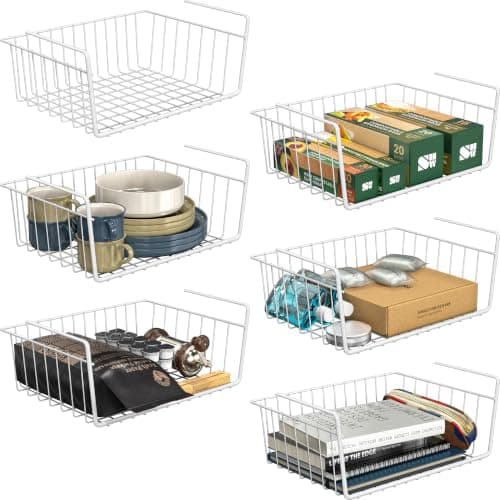
Simple Houseware Slide-Under Shelf Storage Basket
Hooks over an existing shelf and uses the vertical gap that a single row of short items leaves empty.
The hook opening is sized for a specific shelf thickness. Thick wooden shelves and some wire shelves will not accept it.
Headroom needed
The basket hangs below the shelf, so it consumes the spacing below
Published dimensions
Stated per model on the listing, including the hook opening
What it gets right
Uses space that is otherwise pure waste
No fixings, no tools, no damage
Cheap enough to fit several
What it does not
Hook opening is the whole compatibility question and is easy to get wrong
Steals headroom from the shelf below
Who it is for
A pantry with tall shelf spacing and short items on the shelves.
Skip this if
Your shelf is thicker than the basket's stated hook opening. This is the single most common reason these get returned — measure the shelf, not the gap.
The five steps
Step 0. Measure, and buy nothing
Shelf depth, shelf spacing on every shelf, and the height of the tallest item on each. It takes ten minutes and it is what stops you buying a 13 inch canister for an 8 inch shelf gap. The bands and what they hold are on pantry shelf depth and spacing.
While you are there, do the twenty-minute rearrangement: sort everything into daily, weekly and occasional and put the daily items at eye level. That is free and it is the single most durable change available — see pantry organization ideas.
Step 1. A tiered rack for tins
Cheap, immediate, and it fixes the most visible failure in most pantries: three rows of tins where you can only read the front one. Check you have 9 to 10 inches of headroom on that shelf first.
Step 2. Clear bins for loose packets
Two or three, not a whole set. Group the categories that genuinely exist in your pantry — snacks, baking, breakfast — and see whether pulling the category out as one object changes how you use the shelf. It usually does, and now you know what size the rest should be.
Step 3. Airtight containers, for four things only
Flour, sugar, rice and cereal. These are the staples that go stale in opened packaging, come in bags that will not stand up, and are the ones pantry moth larvae get into. Everything else in a bag can wait, and tins and sealed jars gain nothing at all.
Buy one first, check it against the shelf, then buy the rest. Which sets publish dimensions you can plan against is on best airtight containers.
Step 4. Under-shelf baskets, if your shelves take them
Last because the compatibility check comes first: measure the shelf thickness against the basket's hook opening. If it fits, this is the cheapest space in the pantry. If it does not, no amount of wanting it will help — under-shelf baskets covers the alternatives.
If cereal is a large part of what your pantry actually holds, a dedicated dispenser is worth bringing forward in this order — the sizes and the shelf-gap arithmetic are on best cereal containers.
One container that sits outside this order is the bread box, because it lives on the counter rather than in the pantry and is bought on lid type rather than capacity - it is covered on best bread boxes.
The bread box is also the one item on this list where the size on the label is unreliable - boxes sold as large span nearly 8 inches of length. Measure the gap under your cabinet and your usual loaf first: the figures are on bread box dimensions.
If the containers you are deciding between include OXO POP, the case for and against paying that premium - published dimensions on one side, a button mechanism that traps flour on the other - is in our OXO POP containers review.
One pantry category sits outside this order entirely: produce, where the container is managing light and air rather than a seal. The bins and the published storage guidance are on best potato and onion storage.
The order in one table
The pantry buying order
Step
What
Why here
Check first
0
Measure and rearrange
Free, and it decides everything after it
Depth, spacing, tallest item
1
Tiered rack for tins
Fixes the most visible failure, cheaply
9 to 10 in headroom
2
Two or three clear bins
Tells you what categories you have
Shelf depth minus an inch
3
Containers for four staples
The pest and freshness case, and only for the four
Container height against shelf spacing
4
Under-shelf baskets
Cheapest space, but only if the shelf fits
Shelf thickness against hook opening
Each step tells you something you need for the next one, which is why doing them out of order costs money.
Nothing in this sequence deals with the lids, which are the part of a container set that defeats a cabinet by themselves. The trays that stand them upright, and the two published figures that decide which one fits, are on best container lid organizers.
FAQ
Questions people ask about this
What should you buy first for a pantry?
Nothing — measure first. Shelf depth, shelf spacing, and the height of the tallest item on each shelf. Then a tiered rack for tins, then two or three clear bins, then airtight containers for four staples, then under-shelf baskets if your shelf thickness allows.
How many pantry containers do I need?
Fewer than you think. Flour, sugar, rice and cereal are the four staples that genuinely benefit. Tins and sealed jars gain nothing from decanting, and anything you get through in a week does not need a container.
Is it worth buying a matching pantry container set?
Not as a first purchase. It is the most expensive step and it is guesswork until you have measured your shelves. Buy one container of the size you expect to use most, check the fit for a week, then buy the set.
What is the cheapest way to organize a pantry?
Rearranging costs nothing and is the most durable change: sort everything into daily, weekly and occasional and put daily items at eye level. After that, a tiered rack for tins is the cheapest thing that makes a visible difference.
Do I need to decant everything in my pantry?
No. Decant flour, sugar, rice, pasta and cereal — the staples that go stale, attract pests, or come in bags that will not stand up. Leave tins, sealed jars and anything with cooking instructions you will need.
What is not a source hereWe have not handled these products. Nothing on this page is a test result, and no figure comes from a retailer listing, another publisher, or memory.