The moth you can see is not the one eating your sweaters. Understanding that changes what you should buy first.
By Scooter M.Published September 13, 2026Content updated September 13, 2026Prices verified September 14, 2026How we pick
Bin & Basket earns a commission when you buy through our links, at no extra cost to you. We are an Amazon Associate. We accept no free products, no sponsored placements and no paid inclusion, and commission rate plays no part in what we recommend. Full disclosure.
The adult moth flying out of your closet does not eat wool — it has no functioning mouthparts for it. The larvae do, and they are already in the garment. That single fact reorders the whole shopping list: a pheromone trap tells you whether the problem is live, cleaning and temperature treatment are what end it, and repellents only protect what is already clean. Buying repellent first, which is what most people do, is treating the symptom you can see rather than the one doing the damage.
So the order is: confirm it is active, find and clean the infested items, then protect what you put back. Traps first, because they cost little and tell you whether you have a current problem or found evidence of an old one.
What the larvae actually eat
Clothes-moth larvae feed on keratin, the protein in animal fibers. That means wool, cashmere, silk, fur, feathers and felt. It does not mean cotton, linen or polyester — those get damaged only incidentally, usually where they are blended with wool or carry a food stain.
This is why the damage clusters where it does. Larvae go for the parts of a garment carrying body oils, perspiration and food traces, which is why holes appear at cuffs, collars and underarms rather than randomly across a sweater. A clean wool garment is far less attractive than a worn one, and that is the whole mechanism behind the standing rule that you clean before you store.
It is also why they prefer the undisturbed dark. A sweater worn weekly is a bad host; one folded at the back of a shelf for eight months is a good one. The storage side of that is on best off-season clothes storage.
What a pheromone trap does, and what it does not
This is the most misunderstood product in the category, so it is worth being precise.
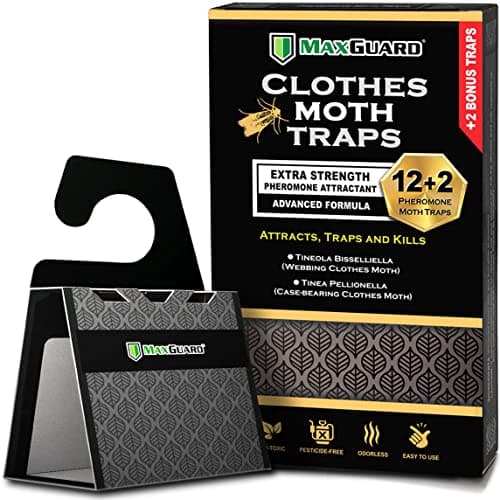
What it does: the lure mimics the female's pheromone and attracts adult males onto a sticky card. Catching them tells you an infestation is currently breeding, and where.
What it does not do: it does not attract females, and it does not touch larvae — the stage that is actually eating your clothes. A closet can be full of larvae with an empty trap.
Why it is still worth buying first: it costs very little and it answers the only question that matters at the start, which is whether this is happening now or happened last year.
How it misleads: a lure that has expired stops catching, and an empty trap then reads as an all-clear it has not earned. Date the trap when you put it out.
Treat traps as a smoke alarm rather than a fire extinguisher. Put several out, one per closet and one per room you suspect, and use the pattern of catches to find the source.
#
Product
Best for
Score
Price
01
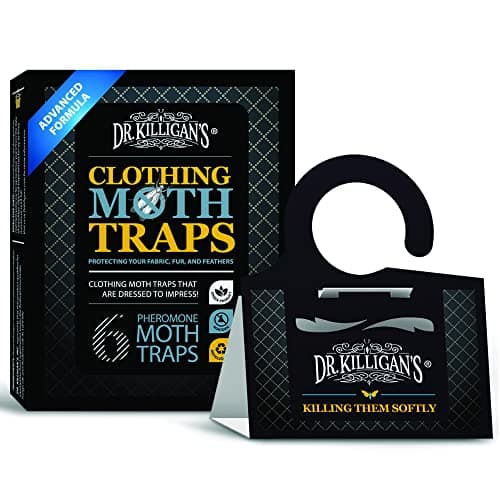
Dr. Killigan's Premium Clothing Moth Traps with PheromonesA pheromone trap is a monitoring device, not a cure - and knowing whether the problem is active is the first thing worth buying.
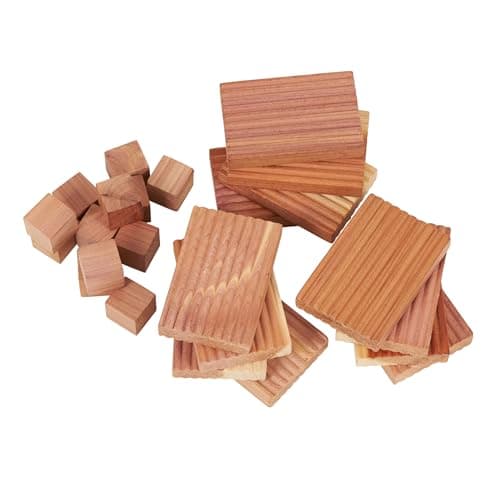
Household Essentials Aromatic Red Cedar Blocks and RingsCedar oil is a genuine moth deterrent while the oil is still present, and sanding restores it rather than replacing the block.
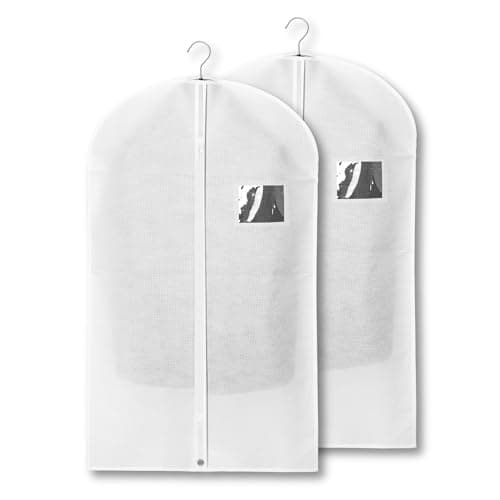
ZARLOO Breathable Garment BagsBreathable is the operative word - a sealed plastic bag traps moisture against wool, which causes a different problem from the one you were solving.
MaxGuard Clothes Moth Traps, Extra StrengthThe same monitoring job in a larger pack, which is what you want when you are trying to work out which room the problem started in.
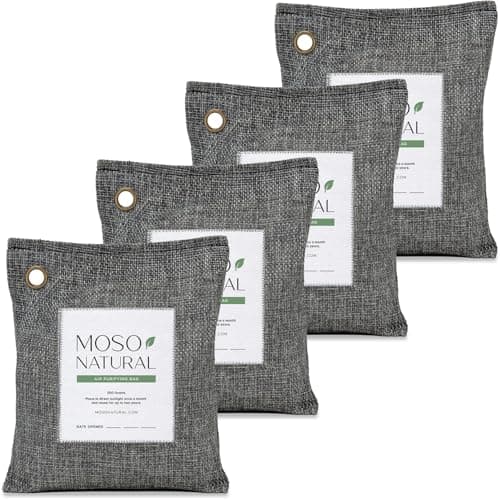
Moso Natural Activated Charcoal Air-Purifying BagsBamboo charcoal in a bag: it adsorbs odor rather than covering it, and it recharges in sunlight instead of being replaced.
Scores are our own, from the published rubric on the methodology page. They are editorial judgments about published specifications, not test results — we have not handled these units.
01
Finding out whether you actually have moths
Dr. Killigan's Premium Clothing Moth Traps with Pheromones
A pheromone trap is a monitoring device, not a cure - and knowing whether the problem is active is the first thing worth buying.
Adsorption onto activated bamboo charcoal — it takes odor molecules out of the air
Fragrance
None. It does not add a scent.
Recharge
Sunlight for a stated period, per the manufacturer's instructions
Published coverage area
Stated per bag size on the listing
What it gets right
No added fragrance, which is the point if you dislike scented closets
Recharges in the sun rather than being consumed
Nothing to spill onto clothing
What it does not
Works slowly and quietly; there is no dramatic effect
Does nothing about the underlying moisture causing the smell
Who it is for
A closed closet with a stale smell and no obvious damp problem.
Skip this if
The closet is actively damp. Charcoal adsorbs odor, not water — a damp closet needs a moisture absorber and ventilation first.
The order of operations that actually works
Trap first, for two weeks. Catches confirm an active problem and localize it. No catches after a fortnight in a closet you suspect is a genuine signal, though not a guarantee.
Empty the closet completely. Every item out. Larvae and eggs are on garments and in the corners, not floating in the air.
Inspect the animal fibers. Look for small irregular holes, silky webbing or tubes, and gritty frass that looks like sand the color of the fabric. That grit is the clearest sign.
Clean everything that was in there. Washing or dry cleaning kills every stage. This step is the one that ends the infestation, and skipping it is why infestations come back.
Treat what cannot be washed with temperature. Sustained freezing or sustained heat kills eggs and larvae where laundering is not an option. Follow the garment's own care label first.
Vacuum the empty closet thoroughly — corners, shelf edges, the carpet against the skirting — and empty the vacuum outside afterwards.
Only now add repellents, and only to a clean closet. Cedar and other repellents discourage adults from laying; they do not kill what is already there.
Store the vulnerable items in breathable bags, cleaned, and re-trap in a month to confirm the catch rate has gone to zero.
Cedar, and what it honestly does
Cedar is the oldest answer in this category and the most oversold. What the aromatic oil does is deter adult moths from choosing that spot to lay. What it does not do is kill larvae already feeding, and the effect fades as the oil off-gasses — which is why cedar blocks need periodic sanding to expose fresh wood.
That makes cedar a reasonable maintenance product in an already-clean closet and a poor rescue product in an infested one. The same is true of every scented repellent, and it is worth being clear-eyed about it before spending. The wider odor-control picture is on best closet deodorizers.
What does not work
Repellent alone in an infested closet. It changes nothing about the larvae currently feeding.
Sealing an unwashed garment in a bag. You have contained the larvae with their food supply and given them eight undisturbed months.
Treating one closet when catches are house-wide. Moths move. If traps catch in two rooms, both need clearing or it recurs.
Assuming an empty trap means an empty closet. Traps catch males only, and an expired lure catches nothing at all.
What we are not telling you
We have not run a pest-control trial. The biology above — that larvae feed on keratin, that adults are not the feeding stage, and that soiling attracts them — is standard extension-service entomology, cited at the foot of this page. The trap mechanism is how pheromone monitoring devices are described by their regulator.
What we cannot give you is a kill rate for any product here, because none is published in a form we could verify, and we are not going to estimate one for a pest problem. Where a product's contribution is monitoring rather than control, its entry says exactly that. The method is on how we pick.
FAQ
Questions people ask about this
Do clothes moth traps actually work?
They work as monitors, not as cures. The pheromone lure attracts adult males onto a sticky card, which tells you an infestation is active and roughly where. It does not attract females and has no effect on larvae, which are the stage that eats the wool.
What do clothes moth larvae eat?
Keratin, the protein in animal fibers — wool, cashmere, silk, fur and feathers. They concentrate on areas carrying body oils, perspiration and food traces, which is why holes appear at cuffs, collars and underarms rather than at random.
How do you get rid of clothes moths permanently?
Empty the closet, inspect and clean every animal-fiber garment that was in it, treat unwashable items with sustained freezing or heat, vacuum the closet thoroughly and empty the vacuum outside. Cleaning is the step that ends it; repellents added afterwards keep a clean closet clean.
Does cedar actually repel moths?
Cedar deters adults from laying in that spot, which is useful maintenance in an already-clean closet. It does not kill larvae that are already feeding, and the aromatic oil fades over time, so blocks need periodic sanding. It is not a rescue product for an active infestation.
How can you tell if clothes moths are active?
Look for gritty frass that resembles sand in the color of the fabric, silky webbing or tubes, and small irregular holes clustered at soiled areas. Then put pheromone traps out for two weeks — catches confirm a live breeding population rather than old damage.
Are clothes moths the same as pantry moths?
No. Clothes moths feed on animal fibers like wool; pantry moths feed on stored dry food and are a kitchen problem with a different fix. If the moths are around food rather than textiles, the guide you want is our pantry moths page.
Availability check, 13 September 2026Every product added for these pages was resolved through the Amazon Creators catalog on that date and carried a New buy-box offer at the time of writing. Products with no verifiable listing were not featured.
What is not a source hereWe have not handled these products. Nothing on this page is a test result, and no figure comes from a retailer listing, another publisher, or memory.