Tins are short, uniform and heavy, which makes them the easiest thing in a pantry to organize properly and the most commonly stacked three deep.
By Scooter M.Published September 1, 2026Content updated September 1, 2026Prices shown live on AmazonHow we pick
Bin & Basket earns a commission when you buy through our links, at no extra cost to you. We are an Amazon Associate. We accept no free products, no sponsored placements and no paid inclusion, and commission rate plays no part in what we recommend. Full disclosure.
A tiered rack is the right default, because it makes every label readable without unloading the front row and it needs only vertical headroom. A standard can is 4 to 5 inches tall and pantry shelves are commonly spaced around 7 inches for canned goods, which leaves enough for a rack that raises the rear rows. A gravity dispenser is better if you keep a lot of one can size and want rotation enforced, but it needs real shelf depth.
The problem with tins is specific: they are uniform enough to stack neatly and short enough that you can put three rows behind each other, at which point the back two are invisible. Every product here is a different answer to that.
#
Product
Best for
Score
Price
01
Simple Houseware 3-Tier Can Rack OrganizerA stepped rack that raises the back rows so you can read every label without taking the front row out.
Scores are our own, from the published rubric on the methodology page. They are editorial judgments about published specifications, not test results — we have not handled these units.
01
Tins on a deep shelf
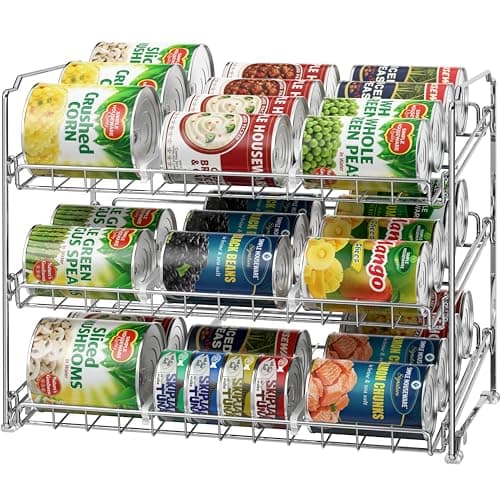
Simple Houseware 3-Tier Can Rack Organizer
A stepped rack that raises the back rows so you can read every label without taking the front row out.
Tiered steps, so back rows sit higher than front rows
Shelf spacing needed
More than a flat row of tins: the top step raises the rear cans
Why it works
Standard cans are 4 to 5 in tall, and pantry shelves are commonly spaced 7 in for canned goods, which leaves the headroom a tiered rack needsSource: Dimensions.com pantry storage heights
Published capacity
Stated per model on the listing
What it gets right
Every label is readable without unloading the shelf
Uses the vertical headroom a flat row of tins wastes
Freestanding — lift it out to clean the shelf
What it does not
Only works for uniform can heights; tall tins foul the step above
Takes more shelf depth than stacking tins flat
Who it is for
Anyone whose tinned food lives three rows deep on a shelf.
Skip this if
Your shelf spacing is 6 inches or less. A tiered rack needs headroom above a 4 to 5 in can, and a tight spacing removes it.
02
Rotating stock so nothing expires
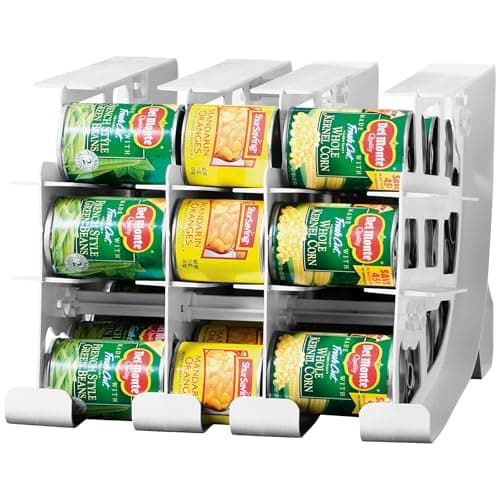
FIFO First-In-First-Out Can Dispenser
Cans roll to the front as you take one, which enforces rotation instead of asking you to remember it.
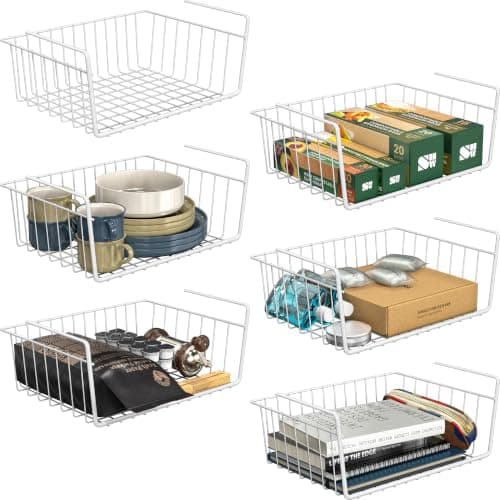
The hook opening is sized for a specific shelf thickness. Thick wooden shelves and some wire shelves will not accept it.
Headroom needed
The basket hangs below the shelf, so it consumes the spacing below
Published dimensions
Stated per model on the listing, including the hook opening
What it gets right
Uses space that is otherwise pure waste
No fixings, no tools, no damage
Cheap enough to fit several
What it does not
Hook opening is the whole compatibility question and is easy to get wrong
Steals headroom from the shelf below
Who it is for
A pantry with tall shelf spacing and short items on the shelves.
Skip this if
Your shelf is thicker than the basket's stated hook opening. This is the single most common reason these get returned — measure the shelf, not the gap.
What each one needs from your shelf
Shelf requirements by organizer type
Organizer
Needs vertical
Needs depth
Enforces rotation
Flat row (no organizer)
About 7 in
Any
No
Tiered rack
9 to 10 in — the top step raises the rear cans
12 in and up
No, but you can see the dates
Gravity dispenser
Per model
Real depth — poor value under 16 in
Yes, automatically
Under-shelf basket
Steals headroom from the shelf below
Any
No
Stacking tins directly
Two cans plus clearance
Any
No, and the bottom is unreachable
Can height of 4 to 5 in and the roughly 7 in canned-goods spacing per Dimensions.com pantry storage height data.
Rotation, and why it matters more than tidiness
The reason tins expire is not disorganization, it is that new stock goes at the front and old stock migrates to the back. Every time you shop, the oldest can gets pushed further away.
A gravity dispenser solves this structurally: you load at the back and take from the front, so the oldest can is always the next one out. That is worth more than any amount of tidying, and it is the reason it ranks second here despite needing a shelf most pantries do not have. If you cannot fit one, the manual version is the two-zone rule on organizing deep pantry shelves.
For jars and bottles rather than tins, a turntable does the same job from the other direction: instead of raising the back row so you can read it, you rotate it to the front. It costs you the corners of the shelf, which a tiered rack does not, and the trade is set out on best lazy susans for a pantry.
The tall-tin problem
Tiered racks assume uniform can heights. A tall tin — passata, some soups, coffee — fouls the step above and either will not sit or blocks the row behind it.
Sort by height before you buy. If a third of your tins are tall, a tiered rack will annoy you.
Give tall tins their own flat row at the front of a shelf, or their own shelf.
Use an expandable rack if one is available, since the tier depth is often adjustable on those.
Do not force it. A tin wedged under a step is a tin you cannot get out one-handed.
FAQ
Questions people ask about this
What is the best can organizer for a pantry?
A tiered rack, in most pantries. It raises the back rows so every label is readable without unloading the front, and it needs only vertical headroom rather than depth. A gravity dispenser is better if you keep a lot of one can size and want rotation handled automatically.
How much shelf space does a can rack need?
About 9 to 10 inches of vertical clearance, because a standard can is 4 to 5 inches and the top step raises the rear ones. Pantry shelves are commonly spaced around 7 inches for flat rows of cans, so you may need to move a shelf.
Do gravity can dispensers work?
Yes, and they are the only option here that enforces rotation automatically — you load at the back and take from the front, so the oldest can is always next out. They need real shelf depth to hold a worthwhile run, and they handle only one can diameter reliably.
How do you stop canned food expiring at the back?
Structurally, with a gravity dispenser that enforces first-in-first-out. Manually, with a rule that the back of a deep shelf holds only duplicates of what is at the front, so nothing unique ever ends up where you cannot see it.
Where should canned food go in a pantry?
On the bottom shelf. Tins are the heaviest items in most pantries, which matters for safe lifting, for shelf sag, and for the stability of a freestanding rack.
What is not a source hereWe have not handled these products. Nothing on this page is a test result, and no figure comes from a retailer listing, another publisher, or memory.