The only question that matters is whether the bag you buy fits the container you bought. Almost nothing on a product page tells you.
By Scooter M.Published September 13, 2026Content updated September 13, 2026Prices verified September 14, 2026How we pick
Bin & Basket earns a commission when you buy through our links, at no extra cost to you. We are an Amazon Associate. We accept no free products, no sponsored placements and no paid inclusion, and commission rate plays no part in what we recommend. Full disclosure.
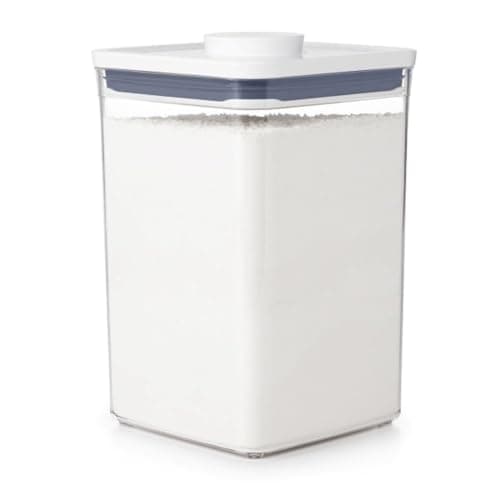
Size the container to the bag, not to the shelf. A standard 5 lb bag of flour needs roughly 4.4 quarts of container, and the single most common mistake in this category is buying a handsome 2 or 3 quart canister and discovering half the bag has nowhere to go. OXO's 4.4 qt POP is the pick precisely because OXO publishes exact dimensions for every size, so you can check both the bag and the shelf before ordering. For rice bought by the sack, a dispenser beats a canister outright.
Everything else here — glass or plastic, square or round — is secondary to getting that volume right.
Bag size to container volume
What each common bag actually needs
What you buy
Approximate container volume needed
Notes
5 lb flour
About 4.4 qt
The size most people get wrong. A 2.8 qt canister takes roughly half a bag
4 lb granulated sugar
About 3.5 to 4 qt
Denser than flour, so it needs less volume per pound
2 lb brown sugar
About 2 qt
Wants a good seal more than it wants volume — it hardens as it dries
5 lb rice
About 4 to 4.5 qt
Similar density to sugar
20 to 25 lb rice sack
A dispenser, not a canister
At this weight you are decanting rather than pouring
1 lb pasta
About 2 qt for long shapes
Length, not volume, is the constraint for spaghetti
These are planning figures derived from ordinary bag weights and the densities of each staple, not manufacturer specifications, and the table labels them as such. Check the maker's own published volume before ordering.
#
Product
Best for
Score
Price
01
OXO Good Grips POP Container, 4.4 QtThe size that actually swallows a standard 5 lb flour bag, which is the single most common reason this purchase goes wrong.
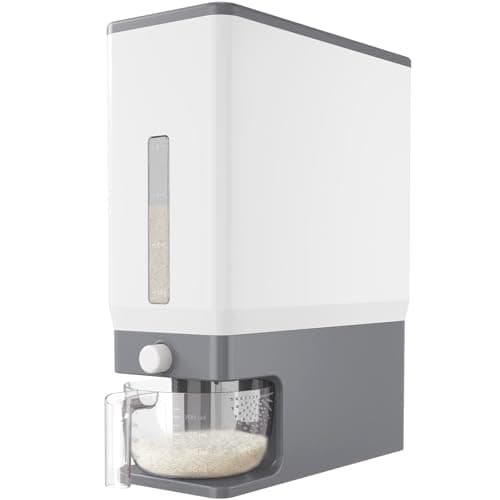
Lifewit Rice Container, 25 lb, One-Press DispenserA dispenser rather than a canister, which is the right shape for a staple you measure out several times a week.
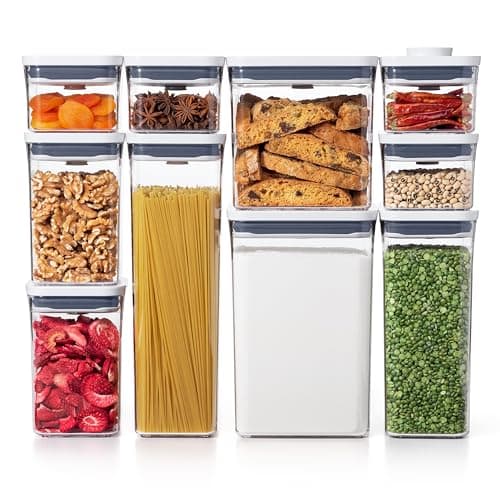
OXO Good Grips POP Container SetThe only set in this category whose manufacturer publishes an exact dimension for every single size, which is why it is first here.
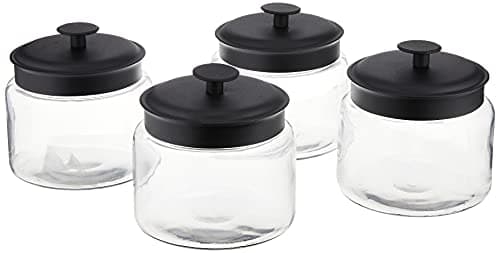
Anchor Hocking Glass Storage Jars with Sealing LidsGlass does not absorb oil or odor and does not scratch, which is the whole argument against plastic for some foods.
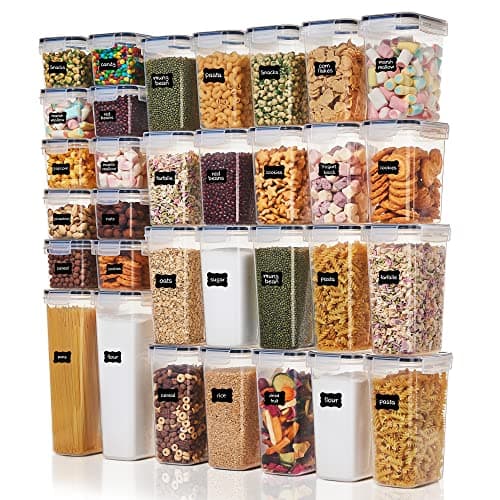
Vtopmart Airtight Food Storage Container SetA large multi-piece set at a price that lets you convert an entire pantry in one go, with a real gasket seal.
Scores are our own, from the published rubric on the methodology page. They are editorial judgments about published specifications, not test results — we have not handled these units.
01
A 5 lb bag of flour, exactly
OXO Good Grips POP Container, 4.4 Qt
The size that actually swallows a standard 5 lb flour bag, which is the single most common reason this purchase goes wrong.
Mini Square Short 0.5 qt is 3.1 x 3.1 x 6.7 in; Small Square Medium 1.7 qt is 4.1 x 4.1 x 9.8 in; Rectangle Short 1.7 qt is 6.3 x 4.1 x 6.7 in; Small Square Tall 2.3 qt is 4.1 x 4.1 x 13 in; Rectangle Medium 2.7 qt is 6.5 x 4.3 x 9.5 inSource: OXO POP container product pages, oxo.com
Seal
Push-button lid; the button pops up to double as a handleSource: OXO POP container product pages, oxo.com
Shelf depth needed
Every size above fits within a 12 in pantry shelf on its longest footprint dimension
Shelf height needed
The 13 in Small Square Tall needs a spacing well above the 7 to 10 in common band
What it gets right
Published dimensions for every size, so you can plan a shelf before buying
One-handed opening, which matters when the other hand holds a measuring cup
Square footprints tessellate on a shelf; round canisters waste the corners
What it does not
The most expensive option in this category by a wide margin
The button mechanism traps flour and needs disassembly to clean properly
Who it is for
A pantry you are laying out deliberately, where knowing the exact footprint before you buy is worth the premium.
Skip this if
Your shelf spacing is 8 inches or less. The tall sizes are 9.5 to 13 in and simply will not stand up — check the table above against your own shelf before ordering.
04
Anything oily or strongly flavored
Anchor Hocking Glass Storage Jars with Sealing Lids
Glass does not absorb oil or odor and does not scratch, which is the whole argument against plastic for some foods.
2.8 L in the multi-piece setsSource: Vtopmart product listing
Per-piece dimensions
Not published by the manufacturer in a form we could verify — the manufacturer does not publish a per-piece dimension table for the multi-piece sets. Measure your shelf spacing and treat the tall canisters with caution.
What it gets right
Enough pieces to convert a whole pantry rather than a corner of it
The gasket seal is a genuine airtight seal, not a friction lid
Labels are included, which the cheaper sets skip
What it does not
No published per-piece dimension table, so shelf planning is guesswork
Lid latches are the failure point on this style of container
Who it is for
Converting a whole pantry to matching containers on a normal budget.
Skip this if
You need to know the exact footprint before you buy. The dimensions are not published per piece — if your shelf is tight, buy a set that publishes them.
Why the scoop decides daily use
Volume gets the container into the house; mouth shape decides whether you keep using it. Flour and sugar are scooped, not poured, and that makes the opening the thing you interact with every time.
Wide square mouth. A measuring cup goes straight in and comes out level. This is the right shape for baking staples and it is why the tall narrow canisters that look good in a row are frustrating in use.
Narrow round mouth. Fine for pouring rice into a pan, awkward for getting a cup of flour out without wearing some of it.
Dispenser. Right at sack scale, where lifting and tipping 25 lb is the alternative. Adds a mechanism that can jam on a broken grain.
Wide mouth plus flat lid. The lid becomes somewhere to rest a sticky scoop, which sounds trivial and is not.
Cereal is the opposite case — poured rather than scooped, which is why it wants a spout and a different container entirely. That comparison is on best cereal containers.
Seal type, and which staple actually needs one
Not every staple needs the same seal, and paying for a gasket on something that does not need one is wasted.
Brown sugar needs the best seal here. It hardens by losing moisture, and a friction lid will not stop that.
Flour needs a good seal for pests rather than freshness. Larvae chew through paper bags and cannot get through rigid plastic or glass with a compressed gasket — the mechanism is set out on pantry moths.
Rice and pasta are the most tolerant. They keep well; the seal is about pests and spills rather than staleness.
Anything bought in bulk needs a seal most of all, simply because it sits longest.
Glass or plastic for staples
The general comparison is on glass vs plastic containers; what is specific to flour, sugar and rice is weight and breakage.
A 4 qt glass jar full of flour is heavy, and it is being lifted down from a shelf by someone whose hands are floury. That is a genuine argument for plastic at this size, and it runs the other way from the usual glass-is-better instinct. Glass earns its place for the small, pretty, low-turnover staples on an open shelf — and plastic for the 4 lb bag you move twice a week.
Square beats round here too
A round canister on a rectangular shelf wastes the gaps between it and its neighbors plus the corners of the row. Square and rectangular footprints tessellate. On a full staples shelf holding six containers that difference is substantial, and it is the same argument made on best airtight food storage containers.
The counterweight is that round containers are easier to scoop the last of the flour out of, because there is no corner for it to hide in. Make that trade deliberately rather than by accident.
What we are not telling you
We have not handled every container here. Capacities and seal types are the manufacturers' published figures, and OXO is the one brand publishing exact dimensions for every size — which is most of why it leads this page.
The bag-to-volume table is planning arithmetic from ordinary bag weights and staple densities, not a manufacturer specification, and it is labeled that way. Where a maker publishes no dimension we say so rather than estimating. The method is on how we pick.
FAQ
Questions people ask about this
What size container do I need for a 5 lb bag of flour?
Roughly 4.4 quarts. This is the single most common mistake in the category: a 2.8 quart canister looks generous and takes about half a bag, leaving the rest in the paper sack it was supposed to replace.
What is the best container for flour and sugar?
One sized to the bag with a wide square mouth, because both are scooped rather than poured and a measuring cup has to fit. OXO's POP range leads here mainly because it publishes exact dimensions for every size, so the fit is checkable before you order.
Should flour containers be airtight?
Yes, mainly for pests rather than freshness. Larvae chew through paper bags but cannot get through rigid plastic or glass with a properly compressed gasket. Brown sugar is the one that needs a seal for its own sake, since it hardens as it dries out.
What is the best way to store a 25 lb bag of rice?
A dispenser rather than a canister. At sack scale the alternative is lifting and tipping 25 pounds every time you cook, and a one-press dispenser with a measuring cup removes that entirely. Keep it low on a shelf — fully loaded it is a two-handed lift.
Are glass or plastic containers better for flour?
Plastic, at the sizes flour comes in. A 4 quart glass jar full of flour is heavy and is being lifted by floury hands. Glass earns its place for smaller, low-turnover staples on an open shelf where looks matter and weight does not.
Are square or round staple containers better?
Square, for storage — rectangular footprints tessellate on a shelf while round ones waste the gaps and the corners of the row. Round containers are easier to scoop the last of the flour out of, since nothing hides in a corner. Make that trade deliberately.
Availability check, 13 September 2026Every product added for these pages was resolved through the Amazon Creators catalog on that date and carried a New buy-box offer at the time of writing. Products with no verifiable listing were not featured.
What is not a source hereWe have not handled these products. Nothing on this page is a test result, and no figure comes from a retailer listing, another publisher, or memory.