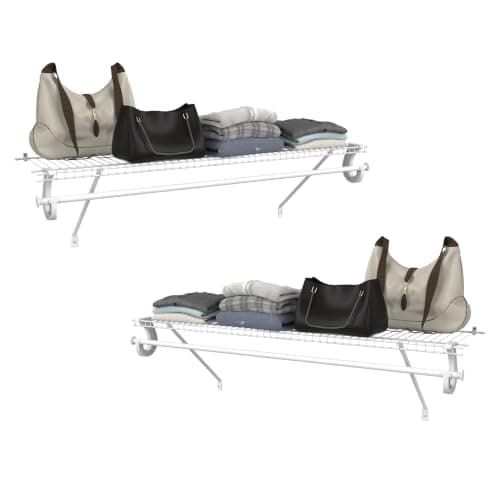
Four systems, four published load figures, and the fixing condition attached to every one of them.
By Scooter M.Published September 1, 2026Content updated September 1, 2026Prices shown live on AmazonHow we pick
Bin & Basket earns a commission when you buy through our links, at no extra cost to you. We are an Amazon Associate. We accept no free products, no sponsored placements and no paid inclusion, and commission rate plays no part in what we recommend. Full disclosure.
For a fixed hanging run, ClosetMaid SuperSlide is the pick, because the rod is continuous and hangers slide past the supports instead of stopping at them. If you want to move shelves later, ShelfTrack is the same manufacturer's adjustable version. If your closet width does not match a stock kit, Rubbermaid Configurations expands to fit without cutting. And if the wall is unreliable or you rent, a freestanding NSF rack publishes up to 800 lb per shelf with no stud requirement at all.
Wire shelving is the default in this category for two reasons: it publishes load figures, and it ventilates. Solid closet shelving mostly does neither. The trade is that things tip and fall through, which is why every wire closet ends up with bins on it. Before you buy any of these, check shelf span and weight — every figure below is conditional on how it is fixed.
#
Product
Best for
Score
Price
01
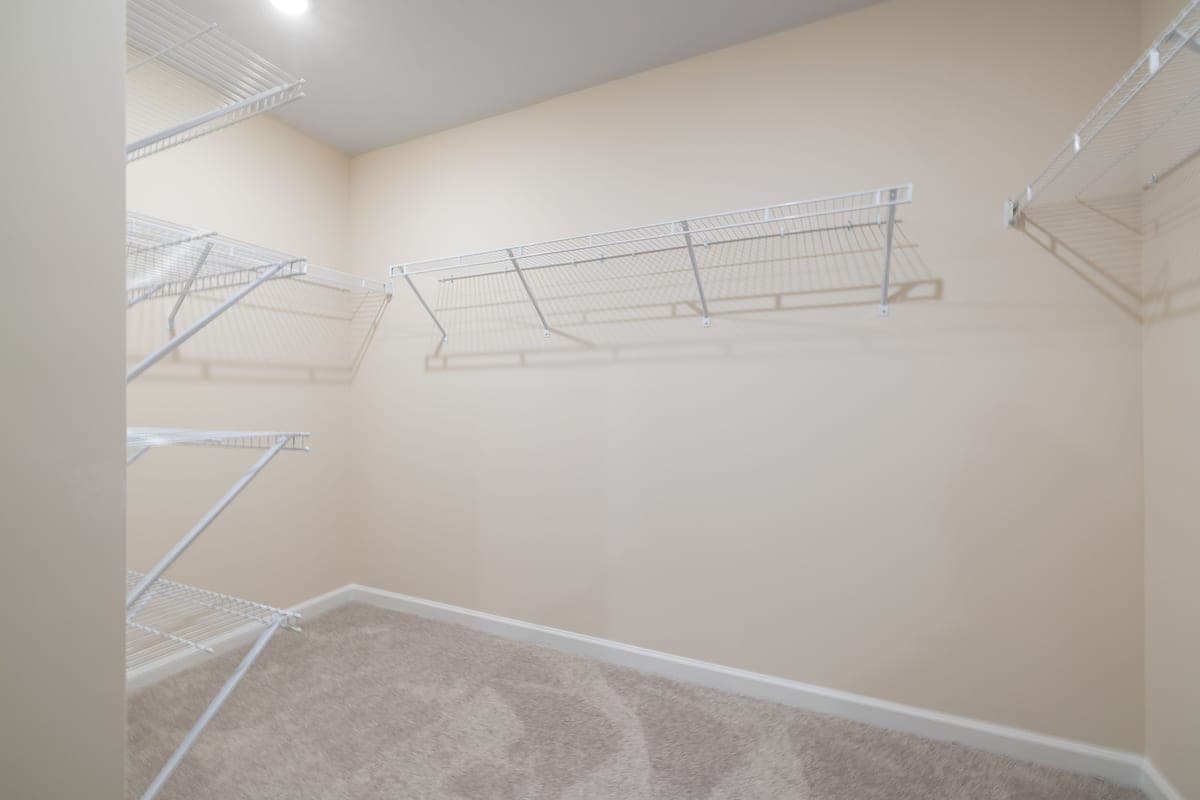
ClosetMaid SuperSlide Ventilated Shelf Kit with Closet RodThe continuous-slide version: the rod runs the full length with no bracket interrupting it, so hangers never stop halfway.
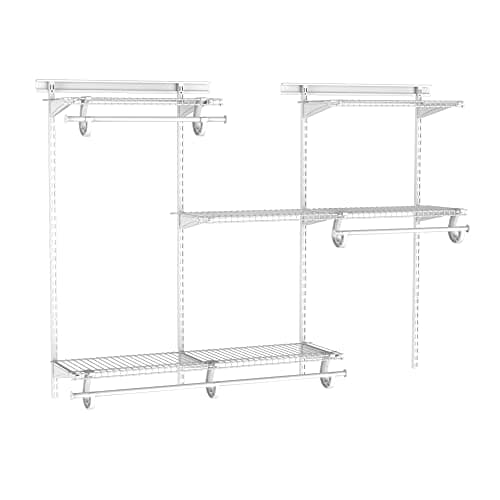
ClosetMaid ShelfTrack Adjustable Closet Organizer KitAn adjustable hang-track system that lets you move every shelf later, which is the thing you will actually want to do.
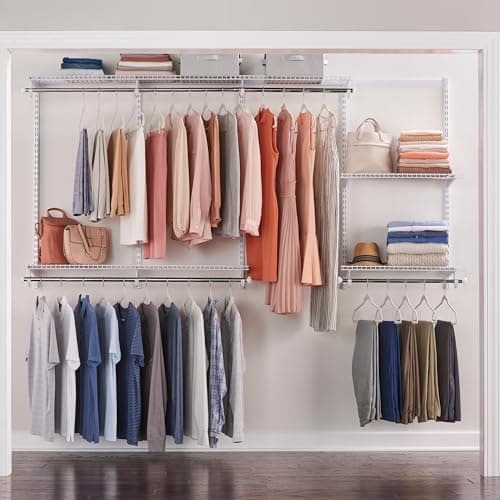
Rubbermaid Configurations Custom Closet KitTelescoping shelves that expand to fill a range of closet widths, so an awkward opening does not force you to cut metal.
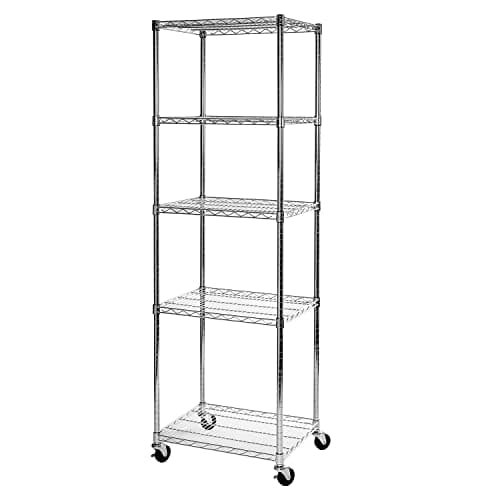
Seville Classics UltraDurable 5-Tier NSF Steel Wire ShelvingA freestanding NSF-rated rack with the highest published per-shelf load in this entire set, and no drilling at all.
Scores are our own, from the published rubric on the methodology page. They are editorial judgments about published specifications, not test results — we have not handled these units.
01
Hangers that actually slide
ClosetMaid SuperSlide Ventilated Shelf Kit with Closet Rod
The continuous-slide version: the rod runs the full length with no bracket interrupting it, so hangers never stop halfway.
12 in and 16 inSource: ClosetMaid published product specifications
Rod support spacing
One support every 36 in of hang rod, and one at each end of the shelf and rodSource: ClosetMaid published product specifications
Difference from Shelf & Rod
SuperSlide is the continuous-slide line; Shelf & Rod is the fixed-rod economy line. Hangers pass supports on SuperSlide and stop at them on Shelf & Rod.Source: ClosetMaid published product specifications
Material
Vinyl-coated steel wire
What it gets right
Hangers slide the full run, which is the single biggest daily difference in a closet
Fixed-mount shelf is more rigid than an adjustable track for the same money
Depth choice of 12 or 16 in covers both a shallow and a standard reach-in
What it does not
Fixed height — moving it later means new holes
The 16 in shelf needs a genuine 24 in of closet depth to leave door clearance
Who it is for
A closet whose job is settled: an adult wardrobe in a house you are staying in, where hanging space is the whole requirement.
Skip this if
You expect to reconfigure. This is a fixed installation and re-siting it leaves a wall to patch.
12 in and 16 inSource: ClosetMaid published product specifications
Maximum standard spacing
24 in apart, and no more than 4 in from the end of the shelfSource: ClosetMaid ShelfTrack Installation Tips
Published load
About 83 lb per bracket, up to 1,000 lb across a full systemSource: ClosetMaid Wire Shelving Specifications, rev 6/12
What the rating depends on
At least 3 screws into studs in the hang track and 3 in the middle standards. Fewer than that and the published figure does not apply.Source: ClosetMaid ShelfTrack Installation Tips
Adjustable after install
Yes — shelves move on the standards without re-drilling
What it gets right
Shelf heights change later without new holes in the wall
The hang track spreads load across studs rather than into single anchors
Widely stocked, so a replacement bracket is easy to find years from now
What it does not
The visible track and standards are not a design feature; some people hate the look
Rated capacity is entirely dependent on hitting studs, which older homes make harder
Who it is for
Anyone with a standard 24-inch-deep reach-in who expects the contents to change — a growing child's closet, a first apartment, a closet you are not sure about yet.
Skip this if
Your closet wall is masonry or plaster over brick. The published load figures assume wood studs, and anchor-only installs do not reach them.
03
Fitting an odd width without cutting
Rubbermaid Configurations Custom Closet Kit
Telescoping shelves that expand to fill a range of closet widths, so an awkward opening does not force you to cut metal.
Telescoping shelves expand across a width range rather than one fixed size
Mounts to
A single hang rail spanning the closet, screwed into studs
What the rating depends on
Rubbermaid's rail guidance is that the rail begins and ends on a stud, with anchors every 8 in between. At 24 in stud spacing the maximum rated capacity is not achievable.Source: Rubbermaid FastTrack Rail and Shelving Installation Guide
Per-kit published load
Not published by the manufacturer in a form we could verify for the Configurations kits specifically.
What it gets right
Expanding shelves absorb a width that does not match a standard kit
One rail carries the whole system, so there is one line to level rather than several
Comes as a kit — rod, shelves and hardware in one box
What it does not
A telescoping shelf is two overlapping pieces, which is less rigid than one solid run
The rail concentrates everything on one line of fixings; a bad rail install compromises the lot
Who it is for
Someone with a non-standard opening who would rather set a width dial than take a hacksaw to a shelf.
Skip this if
Your studs are on 24 in centers. Rubbermaid's own guidance is that maximum rated capacity is not achievable at that spacing, and a closet full of winter coats is exactly where that matters.
Leveling feet or 4 in casters depending on modelSource: Seville Classics UltraDurable product specification
Wall fixing
None required — the unit is freestanding
What it gets right
The published per-shelf figure is an order of magnitude above wall-mounted closet shelving
No holes, which makes it the default answer in a rental
Shelf heights adjust on the posts in one-inch increments
What it does not
It is a commercial rack and looks like one
Wire shelf gaps let small containers tip; it wants bins on top of it
Who it is for
A pantry, a utility room, a garage, or any rental where drilling into the wall is not on the table.
Skip this if
You are putting it in a bedroom closet under 24 in deep. The 18 in and 24 in depths are pantry and garage dimensions, and they will foul the door.
If the deciding factor is how hard each one is to put up rather than what it holds, the systems here are ranked by install difficulty on best DIY closet systems.
How to choose between them
The decision is a short one, and it runs in this order:
Can you hit studs? If not, stop and buy the freestanding rack. Every wall-mounted figure in this roundup assumes screws into studs, and the manufacturers say so in their own documents.
Will the closet's contents change? If yes, take the adjustable ShelfTrack. Moving a shelf on a fixed kit means new holes and a wall to patch.
Does your width match a stock shelf? If not, either cut — see cutting wire shelving — or take the telescoping Rubbermaid kit and skip the hacksaw.
Do hangers need to slide the full run? If yes, SuperSlide. This is the single biggest daily difference between these systems and it is the reason it ranks first.
The numbers, in one place
Published figures for the systems above
System
Depths offered
Published load
Fixing condition
ClosetMaid SuperSlide
12 in and 16 in
Per the ClosetMaid wire range
Rod support every 36 in plus each end
ClosetMaid ShelfTrack
12 in and 16 in
About 83 lb per bracket; up to 1,000 lb per system
3+ screws into studs in the hang track and 3 in the middle standards
Rubbermaid Configurations
Telescoping shelves across a width range
Not published per kit
Rail begins and ends on a stud; max capacity unavailable at 24 in stud spacing
Seville Classics UltraDurable
Includes 18 in and 24 in
Up to 800 lb per shelf; 4,000 lb per unit
None — freestanding
Sources named below. We have not tested any of these systems; every figure is the manufacturer's own.
If the closet is currently an empty alcove, settle the rod height and the support spacing before choosing between these — the sequence is on building a simple closet.
One room where that marking problem matters most is the linen closet, where folded towels sit still long enough to take an impression - and where ventilation is worth more than anywhere else. That case is on best linen closet shelving.
The adjustable system in that comparison gets a page of its own, because its published load carries a condition most reviews skip: ClosetMaid ShelfTrack review.
Wire shelving needs a liner for anything small or soft, and the liner has to be thick enough not to drape into the gaps. The published thicknesses and pre-cut panel sizes are on best shelf liners.
What wire shelving is bad at
Small items. They tip, and small things fall through the gaps. Budget for bins from the start.
Looking finished. In an open or doorless closet, wire reads as utility. Wire vs wood covers the trade honestly.
Folded knitwear. The wires emboss a pattern into a folded jumper left there for a season.
Recovering from sag. A deflected wire shelf never comes back. Space the supports for the load you will eventually store.
Turning one of these runs through 90 degrees needs the manufacturer's own corner section, and it carries a fraction of what the straight shelf does. The published corner loads, from 15 lb to 70 lb a tier, are on best corner closet shelves.
FAQ
Questions people ask about this
What is the best wire closet shelving?
For a fixed hanging run, ClosetMaid SuperSlide, because its rod is continuous and hangers pass the supports. For a closet that will be reconfigured, ClosetMaid ShelfTrack. For a rental or a wall you cannot fix to, a freestanding NSF rack, which publishes up to 800 lb per shelf with no stud requirement.
How much weight can wire closet shelving hold?
ClosetMaid publishes about 83 lb per bracket and up to 1,000 lb per ShelfTrack system, and up to 600 lb per 6 ft shelf on its Maximum Load line. All of those figures assume at least three screws into studs in the hang track and three in the middle standards.
What depth wire shelving do I need for a closet?
12 inches for a shallow closet or a shelf above a rod; 16 inches in a standard 24 inch reach-in where you want the full depth. Measure to the inside face of the closed door — a 16 inch shelf in a closet with a sliding door can foul the panel.
Is wire shelving strong enough for a closet full of clothes?
Comfortably, if it is fixed as specified. A six-foot rod of mixed garments is somewhere between 30 and 80 lb, well inside the published system figures. The failures in this category are fixing failures, not capacity failures.
Can you install wire closet shelving in a rental?
Only if fixings are permitted, because every wall-mounted system here needs screws into studs to reach its rating. If they are not, the freestanding NSF rack does the job with no holes and a much higher per-shelf figure.
What is not a source hereWe have not handled these products. Nothing on this page is a test result, and no figure comes from a retailer listing, another publisher, or memory.