Any pantry looks organized on day one. These are the changes that are still working in week six.
By Scooter M.Published September 1, 2026Content updated September 1, 2026Prices shown live on AmazonHow we pick
Bin & Basket earns a commission when you buy through our links, at no extra cost to you. We are an Amazon Associate. We accept no free products, no sponsored placements and no paid inclusion, and commission rate plays no part in what we recommend. Full disclosure.
The rule behind every durable pantry change is visibility: if you cannot see it, you will buy another one and the first will expire. That single test explains why clear bins beat opaque baskets, why tiered racks beat flat rows, why labels matter on anything you cannot see into, and why the back of a deep shelf is where food goes to die.
Pantry organization content is mostly photographs of decanted staples in matching jars. That is one idea, it is expensive, and it is the fourth most useful thing on this list.
#
Product
Best for
Score
Price
01
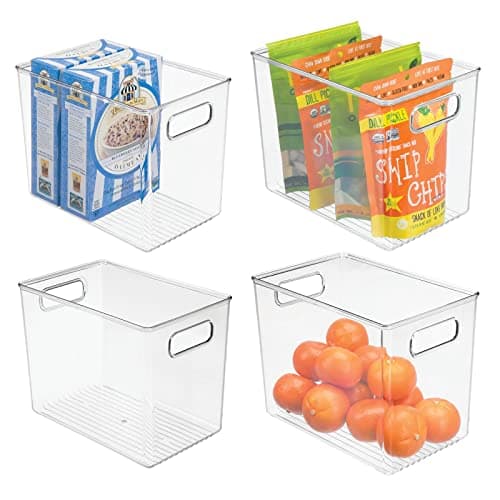
mDesign Clear Plastic Pantry Bins with HandlesOpen-top clear bins that turn the pile of half-open packets into a category you can pull out in one movement.
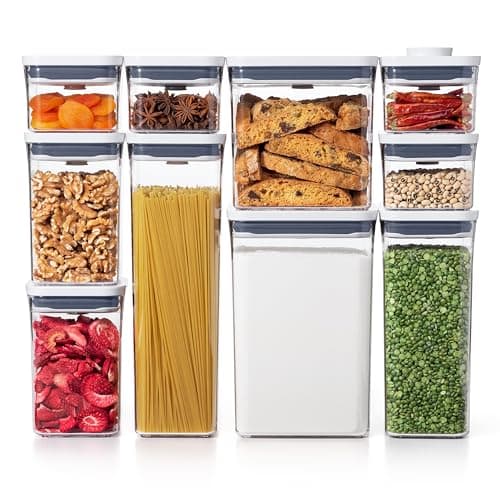
OXO Good Grips POP Container SetThe only set in this category whose manufacturer publishes an exact dimension for every single size, which is why it is first here.
Scores are our own, from the published rubric on the methodology page. They are editorial judgments about published specifications, not test results — we have not handled these units.
01
Grouping loose packets
mDesign Clear Plastic Pantry Bins with Handles
Open-top clear bins that turn the pile of half-open packets into a category you can pull out in one movement.
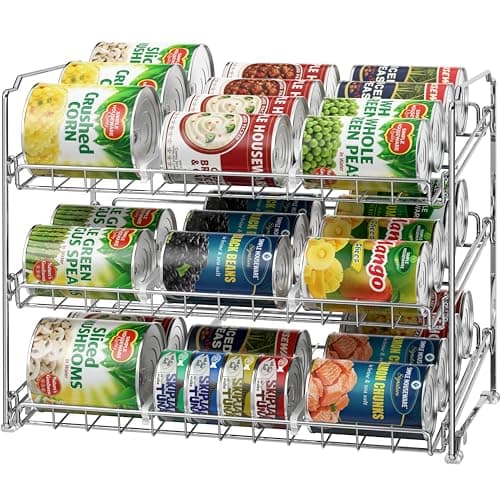
Tiered steps, so back rows sit higher than front rows
Shelf spacing needed
More than a flat row of tins: the top step raises the rear cans
Why it works
Standard cans are 4 to 5 in tall, and pantry shelves are commonly spaced 7 in for canned goods, which leaves the headroom a tiered rack needsSource: Dimensions.com pantry storage heights
Published capacity
Stated per model on the listing
What it gets right
Every label is readable without unloading the shelf
Uses the vertical headroom a flat row of tins wastes
Freestanding — lift it out to clean the shelf
What it does not
Only works for uniform can heights; tall tins foul the step above
Takes more shelf depth than stacking tins flat
Who it is for
Anyone whose tinned food lives three rows deep on a shelf.
Skip this if
Your shelf spacing is 6 inches or less. A tiered rack needs headroom above a 4 to 5 in can, and a tight spacing removes it.
03
Flour, sugar and cereal
OXO Good Grips POP Container Set
The only set in this category whose manufacturer publishes an exact dimension for every single size, which is why it is first here.
Mini Square Short 0.5 qt is 3.1 x 3.1 x 6.7 in; Small Square Medium 1.7 qt is 4.1 x 4.1 x 9.8 in; Rectangle Short 1.7 qt is 6.3 x 4.1 x 6.7 in; Small Square Tall 2.3 qt is 4.1 x 4.1 x 13 in; Rectangle Medium 2.7 qt is 6.5 x 4.3 x 9.5 inSource: OXO POP container product pages, oxo.com
Seal
Push-button lid; the button pops up to double as a handleSource: OXO POP container product pages, oxo.com
Shelf depth needed
Every size above fits within a 12 in pantry shelf on its longest footprint dimension
Shelf height needed
The 13 in Small Square Tall needs a spacing well above the 7 to 10 in common band
What it gets right
Published dimensions for every size, so you can plan a shelf before buying
One-handed opening, which matters when the other hand holds a measuring cup
Square footprints tessellate on a shelf; round canisters waste the corners
What it does not
The most expensive option in this category by a wide margin
The button mechanism traps flour and needs disassembly to clean properly
Who it is for
A pantry you are laying out deliberately, where knowing the exact footprint before you buy is worth the premium.
Skip this if
Your shelf spacing is 8 inches or less. The tall sizes are 9.5 to 13 in and simply will not stand up — check the table above against your own shelf before ordering.
04
The dead air above your tins
Simple Houseware Slide-Under Shelf Storage Basket
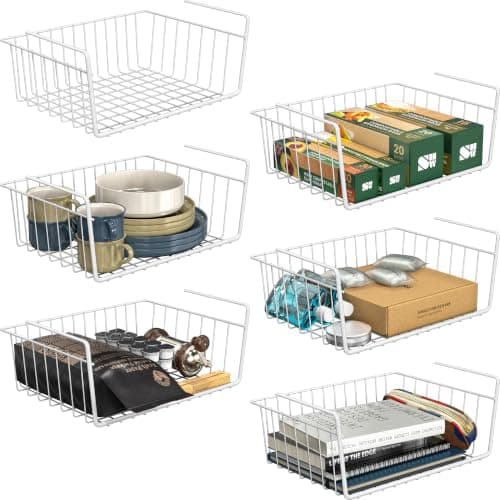
Hooks over an existing shelf and uses the vertical gap that a single row of short items leaves empty.
The hook opening is sized for a specific shelf thickness. Thick wooden shelves and some wire shelves will not accept it.
Headroom needed
The basket hangs below the shelf, so it consumes the spacing below
Published dimensions
Stated per model on the listing, including the hook opening
What it gets right
Uses space that is otherwise pure waste
No fixings, no tools, no damage
Cheap enough to fit several
What it does not
Hook opening is the whole compatibility question and is easy to get wrong
Steals headroom from the shelf below
Who it is for
A pantry with tall shelf spacing and short items on the shelves.
Skip this if
Your shelf is thicker than the basket's stated hook opening. This is the single most common reason these get returned — measure the shelf, not the gap.
The ideas, ranked by whether they last
Pantry changes and their durability
#
Change
Why it lasts
Cost
01
Zone by frequency, not by category
You stop reaching past daily items to get to weekly ones
Free
02
Tiered rack for cans and jars
Every label readable without unloading the front row
Low
03
Clear bins for loose packets
Pull out the category instead of reaching past things
Low
04
Decant only flour, sugar, rice and cereal
The staples that go stale and attract pests; the rest is decoration
Medium
05
Under-shelf baskets where spacing is generous
Recovers dead air you were already paying for
Low
06
Move spices to the door
Frees an entire shelf and puts every label in one plane
Low
07
One bin for 'oldest first' items
Rotation without a system to maintain
Free
08
Labels on anything opaque
Removes the guess, which is what makes people stop using a bin
Very low
09
Bottom shelf for heavy items
Safety, and it stops the shelf above sagging
Free
10
Full-height section for what does not conform
Stops one tall item wrecking the shelf spacing
Free
Ranked by how much of the effect survives a month of ordinary use.
01. Zone by frequency
The standard advice is to zone by category — baking together, breakfast together, tins together. It photographs well and it fights you daily, because your daily items end up scattered across four zones and half of them are behind something.
Zone by how often you reach for it instead. Daily items at eye level and at the front. Weekly items above and below. Occasional items on the top shelf and at the back. Category can be the secondary sort inside each band. This costs nothing, takes twenty minutes, and it is the change you will still notice in six months.
04. Decanting, honestly
Decanting into matching containers does three genuinely useful things: it makes the contents visible, it seals out pests, and it makes odd-shaped packaging stack. It also costs real money, adds a washing-up task, and loses you the cooking instructions on the back of the packet.
Decant what benefits: flour, sugar, rice, pasta, cereal, anything in a bag that will not stand up. Do not decant tins, jars, or anything in packaging that already seals and stacks. The pest argument is the strongest one and it is genuinely load-bearing — larvae chew through thin cardboard and plastic bags but cannot get through rigid plastic, glass or metal. That mechanism is set out on pantry moths.
The ideas that do not survive contact
Opaque matching baskets everywhere. They photograph beautifully and hide the contents, which is the exact failure the visibility rule describes.
Decanting everything. Tins and jars gain nothing, and you have added washing-up for aesthetics.
Alphabetizing spices. It survives about two weeks of anyone else using the kitchen.
Chalkboard labels on clear containers. You could already see what was in it. Label the opaque things instead.
A walk-in pantry is shelved differently from a cupboard, because the constraint moves from how much wall there is to what each wall will carry. The published loads and the wall-mounted against freestanding decision are on shelving a walk-in pantry.
FAQ
Questions people ask about this
What is the best way to organize a pantry?
Zone by how often you use something rather than by category, so daily items sit at eye level and at the front. Then add tiered racks so back rows are readable and clear bins so loose packets pull out as a group. Decant only the staples that benefit.
Should you decant everything in a pantry?
No. Decant flour, sugar, rice, pasta and cereal — things that go stale, attract pests, or come in bags that will not stand up. Tins and sealed jars gain nothing from being moved and you lose the cooking instructions on the packaging.
How do you keep a pantry organized long term?
Make everything visible. Clear bins, tiered racks for cans, labels on anything opaque, and nothing stored where you cannot see it. The failure mode is always the same: you cannot see an item, you buy another, and the first expires at the back.
What pantry organization ideas are not worth doing?
Opaque matching baskets, which hide contents; decanting tins and sealed jars, which gains nothing; and alphabetized spices, which survives about two weeks of shared use.
Where should you put things in a pantry?
Daily items at eye level and at the front. Heavy items — tins and bottled drinks — on the bottom shelf. Light and occasional items high. Keep one full-height section for anything tall that would otherwise dictate all your shelf spacing.
What is not a source hereWe have not handled these products. Nothing on this page is a test result, and no figure comes from a retailer listing, another publisher, or memory.