A small pantry is usually a badly spaced one. The space is above the tins, and there is more of it than you think.
By Scooter M.Published September 1, 2026Content updated September 1, 2026Prices shown live on AmazonHow we pick
Bin & Basket earns a commission when you buy through our links, at no extra cost to you. We are an Amazon Associate. We accept no free products, no sponsored placements and no paid inclusion, and commission rate plays no part in what we recommend. Full disclosure.
In a small pantry the wasted space is vertical, and it is above the short items. A standard food can is 4 to 5 inches tall on a shelf spaced 12 inches, which is seven inches of air per shelf doing nothing. Reset the spacing to the contents, add under-shelf baskets where the gap is generous, and use the door. Those three together typically recover more than the pantry appeared to be short of.
Before buying anything, measure your shelf spacing and the height of what is actually on each shelf. The gap between those two figures is your available space, and in most small pantries it is substantial. The bands are on pantry shelf depth and spacing.
#
Product
Best for
Score
Price
01
Simple Houseware Slide-Under Shelf Storage BasketHooks over an existing shelf and uses the vertical gap that a single row of short items leaves empty.
mDesign Clear Plastic Pantry Bins with HandlesOpen-top clear bins that turn the pile of half-open packets into a category you can pull out in one movement.
No imageSimple Houseware Over-the-Door Wire Storage RackRigid wire baskets on a door bracket, which is what you want when the fabric-pocket version keeps sagging.
Scores are our own, from the published rubric on the methodology page. They are editorial judgments about published specifications, not test results — we have not handled these units.
01
The dead air above your tins
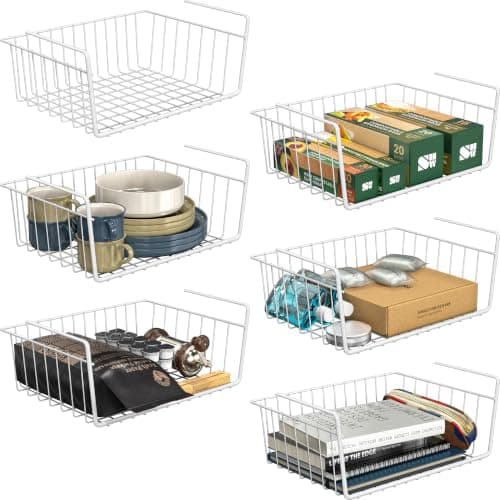
Simple Houseware Slide-Under Shelf Storage Basket
Hooks over an existing shelf and uses the vertical gap that a single row of short items leaves empty.
The hook opening is sized for a specific shelf thickness. Thick wooden shelves and some wire shelves will not accept it.
Headroom needed
The basket hangs below the shelf, so it consumes the spacing below
Published dimensions
Stated per model on the listing, including the hook opening
What it gets right
Uses space that is otherwise pure waste
No fixings, no tools, no damage
Cheap enough to fit several
What it does not
Hook opening is the whole compatibility question and is easy to get wrong
Steals headroom from the shelf below
Who it is for
A pantry with tall shelf spacing and short items on the shelves.
Skip this if
Your shelf is thicker than the basket's stated hook opening. This is the single most common reason these get returned — measure the shelf, not the gap.
02
Tins on a deep shelf
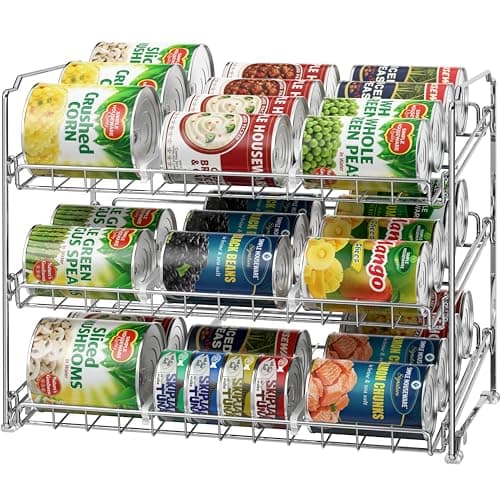
Simple Houseware 3-Tier Can Rack Organizer
A stepped rack that raises the back rows so you can read every label without taking the front row out.
Tiered steps, so back rows sit higher than front rows
Shelf spacing needed
More than a flat row of tins: the top step raises the rear cans
Why it works
Standard cans are 4 to 5 in tall, and pantry shelves are commonly spaced 7 in for canned goods, which leaves the headroom a tiered rack needsSource: Dimensions.com pantry storage heights
Published capacity
Stated per model on the listing
What it gets right
Every label is readable without unloading the shelf
Uses the vertical headroom a flat row of tins wastes
Freestanding — lift it out to clean the shelf
What it does not
Only works for uniform can heights; tall tins foul the step above
Takes more shelf depth than stacking tins flat
Who it is for
Anyone whose tinned food lives three rows deep on a shelf.
Skip this if
Your shelf spacing is 6 inches or less. A tiered rack needs headroom above a 4 to 5 in can, and a tight spacing removes it.
03
Grouping loose packets
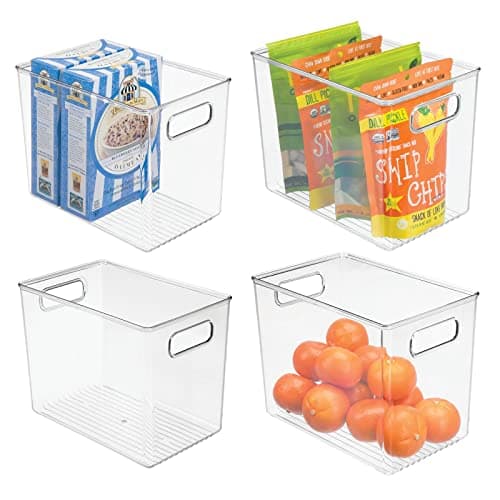
mDesign Clear Plastic Pantry Bins with Handles
Open-top clear bins that turn the pile of half-open packets into a category you can pull out in one movement.
Over-door brackets, with screw-fix option on most models
Door requirement
A solid hinged door with clearance behind it when closed
Construction
Coated steel wire baskets, rigid rather than fabric
Published load per basket
Not published by the manufacturer in a form we could verify for most over-door wire racks; check the specific listing.
What it gets right
Rigid baskets hold tins and bottles that would tear fabric pockets
Screw-fix option converts it from a renter product to a permanent one
Wire lets you see the contents from the side
What it does not
Needs real clearance behind the door; tight frames will not close
The over-door brackets scuff the top edge of the door
Who it is for
A pantry or closet door with a couple of inches of clearance behind it.
Skip this if
Your door is bifold or sliding, or there is a wall within a few inches of the open door. Both make this unusable.
The audit, shelf by shelf
Measure the spacing of each shelf, top of one to underside of the next.
Measure the tallest item on each shelf. Cans are 4 to 5 inches; cereal boxes 10 to 13.
Subtract. The difference is wasted vertical space on that shelf.
If a shelf is adjustable and the waste is over 3 inches, move it. That is free storage.
If it is not adjustable, hang an under-shelf basket — but measure the shelf thickness first, because the hook opening is sized for a specific thickness and that is the number these fail on.
Where the space actually is
Typical wasted space in a small pantry
Location
Typical waste
How to recover it
Above cans on a 12 in shelf gap
About 7 in per shelf
Tiered rack, or reset the shelf, or an under-shelf basket
Behind the front row on a deep shelf
The whole back half
Tiered rack, or pull-out hardware
The pantry door
The whole surface
Rigid rack or spice rack, if clearance allows
The floor of the pantry
Usually a heap
Stackable bins or a low rack
Above the top shelf
Whatever is left to the ceiling
One more shelf, for occasional items
Between an item and the shelf edge
A few inches at the front
Push everything forward; back-of-shelf storage is lost storage
Can height per Dimensions.com pantry storage height data; the rest follows from measuring your own shelves.
If the pantry is small because it is under a staircase rather than simply narrow, the slope changes the approach — measure the headroom at three points and zone it, as set out on shelving an under-stairs pantry.
The tall-item exception
One cereal box or one tall canister sets the spacing for the whole shelf, and in a small pantry that single item can cost you a shelf's worth of space. The fix is to give the tall items their own section rather than letting them dictate the spacing everywhere.
One full-height section on one side, with everything else spaced tightly, stores substantially more than uniform shelving set to the tallest thing you own. If your shelves are fixed, decant the tall bagged items into shorter containers — that is one of the few cases where decanting genuinely buys space rather than looks. Which sets publish heights you can plan against is on best airtight containers.
If the kitchen has no pantry space to organize in the first place, a tall freestanding cabinet adds one against a 31 in stretch of wall. The five we measured are on best freestanding pantry cabinets.
Produce is the exception to most pantry advice, because potatoes want darkness and onions want air and no kitchen container delivers the cold storage either would prefer. The published guidance and the bins that suit it are on best potato and onion storage.
What not to do in a small pantry
Do not buy deep bins. In a shallow pantry a deep bin means reaching past its front contents to get to its back contents. Shallow and wide beats deep and narrow here.
Do not decant into round canisters. Round containers waste the corners of a shelf. Square footprints tessellate, which is worth real space in a small pantry.
Do not stack more than two high. Anything under two more things is effectively not stored, it is buried.
Do not store bulk here. A small pantry is for what you are using. Bulk belongs in a garage, a basement or under a bed.
FAQ
Questions people ask about this
How do you organize a small pantry?
Find the wasted vertical space, which is usually above the short items — a 4 to 5 inch can on a 12 inch shelf gap wastes seven inches. Reset adjustable shelves to the contents, hang under-shelf baskets where you cannot, and use the door.
How do you make a small pantry hold more?
Tighten the shelf spacing to what is actually on each shelf, give tall items their own full-height section instead of letting them set the spacing everywhere, add a tiered rack so back rows are usable, and put spices on the door.
What size containers work in a small pantry?
Square footprints rather than round, because square tessellates and round wastes the corners. Shallow and wide rather than deep and narrow, so you are not reaching past a bin's own contents. And short enough for your actual shelf spacing — check the published height before ordering.
Should you store bulk food in a small pantry?
No. A small pantry is for what you are currently using. Bulk buying belongs in a garage, basement or under-bed storage, otherwise it consumes the space you need for everyday access.
Do under-shelf baskets work in every pantry?
Only where the shelf thickness matches the basket's hook opening, which is the specification these fail on far more often than the vertical gap. Measure the shelf itself, not the space beneath it.
What is not a source hereWe have not handled these products. Nothing on this page is a test result, and no figure comes from a retailer listing, another publisher, or memory.