A hanging organizer converts rod into shelves. That is the whole product, and whether it is a good deal depends on which one you have spare.
By Scooter M.Published September 6, 2026Content updated September 6, 2026Prices verified September 14, 2026How we pick
Bin & Basket earns a commission when you buy through our links, at no extra cost to you. We are an Amazon Associate. We accept no free products, no sponsored placements and no paid inclusion, and commission rate plays no part in what we recommend. Full disclosure.
Every hanging organizer makes the same trade: it takes about a foot of your closet rod and gives you shelves in exchange. So the first question is not which one to buy, it is which resource your closet actually has spare. If the rod is full and the shelf is empty, this whole category is the wrong purchase. If you have a foot of unused rod and nowhere to put folded clothes, it is one of the best-value things in a closet.
Given that, the 6-shelf Household Essentials unit is the pick for most people because it extracts the most divisions from the rod it consumes. Buy the 3-shelf Whitmor instead if you are storing bulky folded knitwear, because six divisions in the same column height leaves gaps too short for a real sweater stack.
The trade nobody puts on the box
These are marketed as free storage. They are not free; they are a currency exchange. A hanging organizer hooks over the rod and occupies roughly 12 inches of its length, which at typical slim-hanger density is somewhere around 20 to 25 garments of hanging capacity given up.
That is a good trade when the thing you are short of is shelf and the thing you have spare is rod. It is a bad trade in the far more common closet where the rod is crushed and the top shelf is half empty. Work out which one you are in before you spend anything — the audit is on organizing a small closet.
The four types, and what each is for
Hanging organizer types compared
Type
What it does
Best for
The limit
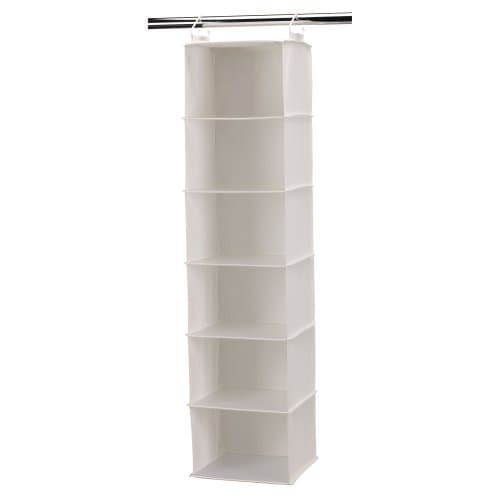
Many-shelf column (6+)
Divides one tall column into six or more slots
T-shirts, jeans, bags
Each gap is short — bulky knitwear will not fit
Few-shelf column (3)
Three taller, deeper divisions
Sweaters and folded stacks that need height
Fewer slots for the same rod consumed
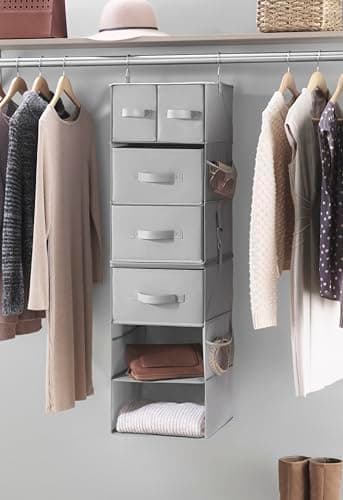
Shelves plus drawer inserts
Open shelves above, pull-out fabric inserts below
Socks, underwear, small accessories
Inserts are lined pockets, not runners; they sag when full
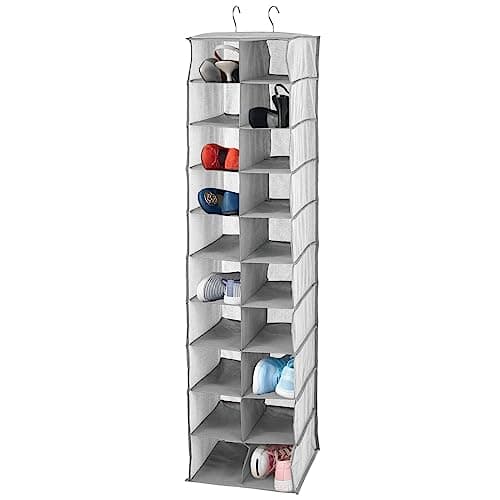
Shoe column
Narrow shelves sized to pairs
Shoes you want visible and off the floor
Sized for shoes and largely useless for anything else
None of these manufacturers publishes a per-shelf clear height or a load rating we could verify, which is why the right-hand column is phrased as a behavior rather than a number.
The specification nobody publishes, and why it matters
Here is the honest gap in this category. Whitmor and Household Essentials both publish a shelf count and an overall size. Neither publishes a per-shelf clear height, and neither publishes a load rating. Those are exactly the two figures that decide whether the product works for you.
A folded sweater stack is roughly 8 to 10 inches tall. A six-shelf unit in a standard column height gives each shelf appreciably less than that. You can work out from the shelf count and the overall height roughly what you are getting, but you are doing arithmetic the manufacturer could have saved you — and we are not going to invent the number on their behalf.
#
Product
Best for
Score
Price
01
Household Essentials 6-Shelf Hanging Closet OrganizerSix shelves in one rod-width column, which is the most vertical division you can add to a closet without owning it.
No imageWhitmor Hanging 3-Shelf Closet OrganizerTurns 3 ft of hanging rod into three shelves without a single screw, which is the only shelving most renters can legally install.
Whitmor Multifunctional Hanging Organizer with Drawer InsertsThe hanging organizer that admits open shelves do not work for socks, and puts pull-out inserts in the bottom half instead.
Scores are our own, from the published rubric on the methodology page. They are editorial judgments about published specifications, not test results — we have not handled these units.
Adds a concentrated load to the rod rather than to the floor
Published capacity
Not published by the manufacturer in a form we could verify per compartment.
What it gets right
Shoes are visible and reachable without bending
No fixings
Compartments keep pairs together
What it does not
Consumes a section of hanging rail
Loads the rod at one point, which is where a rod sags
Who it is for
A closet with spare rod length and no usable floor.
Skip this if
Hanging space is your constraint. This trades rod length for shoe storage, and in a small closet that is a bad trade.
Why they lean, and what to do about it
The universal complaint about hanging organizers is that they end up leaning. The cause is structural rather than a defect: the sides are fabric, so the only thing holding the column square is the evenness of the load inside it. Put six heavy jeans on the bottom shelf and two t-shirts on top and the column racks over.
Load heavy at the bottom, light at the top. This is most of the fix and it costs nothing.
Fill every shelf to roughly the same depth, front to back. Uneven front-loading pulls the column forward.
Do not overfill. A stack proud of the shelf above transfers load onto the shelf lip, which is the softest part of the structure.
Butt it against a side wall or a full section of hanging if you can, so something braces it.
Choose fewer shelves if your items are bulky. Half the leaning complaints are a six-shelf unit doing a three-shelf job.
What belongs in one, and what does not
Good: t-shirts, jeans, folded knitwear (in a 3-shelf unit), handbags, hats, gym clothes — anything foldable you reach for weekly.
Good: the overflow that currently sits in a heap on the closet floor. Getting it off the floor is most of the benefit.
Marginal: shoes, unless you buy a purpose-made shoe column. General shelves are too deep and too tall for pairs, and you waste the space.
Bad: anything heavy and dense — books, tools, stacked boxes. No maker here publishes a load rating and fabric shelves are the wrong structure for it.
Bad: things you need daily at eye level. The shelves are stacked vertically, so most of them are above or below the height you actually want.
The cheaper thing to try first
Before converting rod into shelves, check whether you can simply get more out of the rod you have. Swapping bulky molded hangers for slim flocked ones roughly halves the space each garment occupies, which is a bigger capacity change than any organizer here and it is reversible. The figures are on best hangers by garment.
If the real problem is that the closet has one rod and one shelf and nothing else, the structural answer is a system rather than a fabric column — and the renter-safe options are on renter-friendly closet organizers.
What we are not telling you
We have not handled any of these organizers. Unusually for this site there are almost no manufacturer figures to report: shelf counts and overall sizes are published, per-shelf heights and load ratings are not. Every row above that would normally carry a number says so instead.
That is a genuine weakness of this category rather than a gap in our research, and it is why the ranking here leans on structure and use case rather than on specifications. The method is on how we pick.
FAQ
Questions people ask about this
What is the best hanging closet organizer?
A 6-shelf column for t-shirts, jeans and bags, because it extracts the most divisions from the rod length it consumes. Choose a 3-shelf unit instead if you are storing bulky folded knitwear, since six divisions in the same height leaves each gap too short for a sweater stack.
Do hanging closet organizers take up rod space?
Yes, and this is the trade the packaging never states. Each one occupies roughly a foot of rod, which is somewhere around 20 to 25 garments of hanging capacity at slim-hanger density. They are only worth it if rod is what you have spare.
Why does my hanging closet organizer lean?
The sides are fabric, so the load inside is the only thing holding the column square. Load heavy items on the bottom shelves and light ones on top, fill each shelf to a similar depth front to back, and do not overfill. Uneven loading causes almost all of it.
How much weight can a hanging closet organizer hold?
No manufacturer in this category publishes a figure we could verify. Treat them as suitable for folded clothes and bags, and keep books, tools and dense boxes out of them. The absence of a published rating is itself the answer.
Are hanging organizers good for sweaters?
Only the ones with fewer, taller shelves. A folded sweater stack is roughly 8 to 10 inches; a six-shelf column in a standard height gives each shelf appreciably less than that. Buy a 3-shelf unit for knitwear.
Do hanging closet organizers damage the closet?
No. They hook over the existing rod, need no fixings and leave no marks, which makes them one of the few storage additions a renter can make freely. The cost is rod length, not wall damage.
Sources
Where these figures come from
Hanging organizer dimensionsWhitmor and Household Essentials publish a shelf count and an overall size per model but not a per-shelf clear height or a load rating. Where this site quotes a figure it is the manufacturer's; where none exists the row says so.
Availability check, 6 September 2026Every product added for these pages was confirmed on sale at a national retailer on that date. Products that could not be confirmed in stock were not featured.
What is not a source hereWe have not handled these products. Nothing on this page is a test result, and no figure comes from a retailer listing, another publisher, or memory.