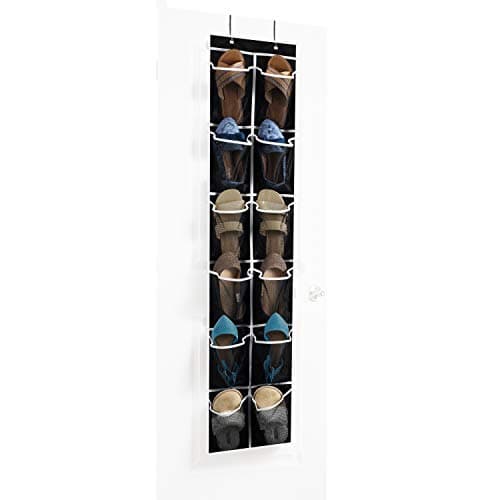
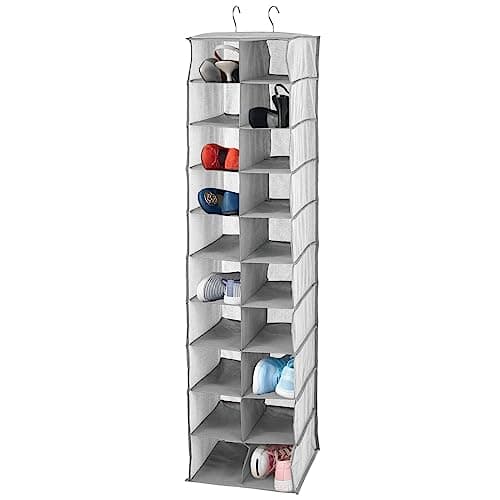
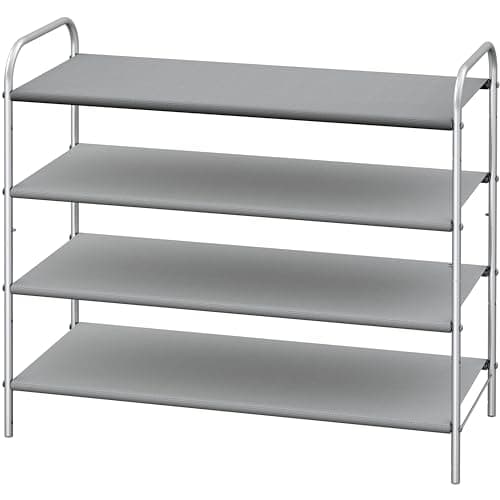
Three places to put shoes and three products that use them. Which one you can use is decided by your door.
By Scooter M.Published September 1, 2026Content updated September 1, 2026Prices shown live on AmazonHow we pick
Bin & Basket earns a commission when you buy through our links, at no extra cost to you. We are an Amazon Associate. We accept no free products, no sponsored placements and no paid inclusion, and commission rate plays no part in what we recommend. Full disclosure.
Use the floor first, the door second, and the rod last. A stackable floor rack turns the dead space under a hanging run into three or four levels and costs the least. An over-door organizer uses a surface nothing else can use — but it only works on a solid hinged door, and it is the single most common return in this category because bifold and sliding doors have no edge to hook over.
Rod-hung shoe shelves are last because they trade something you probably need — hanging length — for something you can get elsewhere. In a closet with spare rod, they are fine. In a small closet, they are a bad swap.
#
Product
Best for
Score
Price
01
Simple Houseware 4-Tier Stackable Shoe RackA stackable metal frame that turns closet floor into four usable levels, and stacks further if the closet is tall.
Scores are our own, from the published rubric on the methodology page. They are editorial judgments about published specifications, not test results — we have not handled these units.
01
A closet floor with shoes on it
Simple Houseware 4-Tier Stackable Shoe Rack
A stackable metal frame that turns closet floor into four usable levels, and stacks further if the closet is tall.
Adds a concentrated load to the rod rather than to the floor
Published capacity
Not published by the manufacturer in a form we could verify per compartment.
What it gets right
Shoes are visible and reachable without bending
No fixings
Compartments keep pairs together
What it does not
Consumes a section of hanging rail
Loads the rod at one point, which is where a rod sags
Who it is for
A closet with spare rod length and no usable floor.
Skip this if
Hanging space is your constraint. This trades rod length for shoe storage, and in a small closet that is a bad trade.
Choosing by your door
Which shoe storage each door type allows
Your door
Floor rack
Over-door organizer
Rod-hung shelf
Solid hinged
Yes
Yes — this is the door it is designed for
Yes
Bifold
Yes
No — no top edge to hook over
Yes
Sliding / bypass
Yes, but depth is reduced by the panel
No
Yes
No door
Yes
No
Yes
Solid hinged, tight frame
Yes
Only if the door still closes over the hooks
Yes
The over-door row is the whole table. Check your door before ordering one — this single fact is why so many of these come back.
A coat closet floor is the worst case of this, because boots arrive wet and get dropped rather than placed. Zoning one properly is on organizing a coat closet.
The floor is the answer most people miss
Under a double-hang lower rod there is roughly 40 inches of clear vertical space. Under a single full-height rod there is less, but there is still enough for two levels. In most closets that space contains one layer of shoes and a great deal of air.
A stackable tier rack converts it to three or four levels and stacks further if the closet is tall. It needs no fixings, so it works in a rental, and it lifts straight out when you want to clean the floor. The relevant dimension is closet depth: a standard 24 inch reach-in takes one comfortably, and the full set of figures is on reach-in closet dimensions.
For the shoes you are storing rather than wearing, a closed box stops the dust a rack cannot - and the size claims in that category contradict each other badly. The published figures are on best shoe storage boxes.
Boots are a different problem
Tier spacing on a stackable rack is sized for shoes. A knee boot does not fit under the next tier, and forcing it creases the shaft. Three workable answers, in order:
Leave the top tier off so the top level has full closet height above it. This costs one level and solves the problem completely.
Stand boots on the floor beside the rack, with boot shapers to stop the shaft folding.
Hang them from clip hangers on the rod, if you have rod length to spare — this is the one case where the rod is the right place for footwear.
Boots are the exception this page keeps running into, and they now have their own: tier spacing here is sized for a shoe, and a knee boot creases when it is forced under the next tier. The racks, boxes, shapers and rod clips that suit a boot instead are on best boot storage.
FAQ
Questions people ask about this
What is the best shoe rack for a closet?
A stackable floor rack, in most closets. It uses the dead space under a hanging run, needs no fixings, stacks to suit the closet height and lifts out for cleaning. Over-door organizers hold more but only work on a solid hinged door.
Do over-the-door shoe organizers work on bifold doors?
No. They hook over the top edge of a door leaf, and bifold and sliding doors have no usable top edge. This is the most common reason these products get returned.
How do you store boots in a closet?
Not on a standard tier rack — the spacing is sized for shoes and a knee boot creases when forced under the next tier. Leave the top tier off so one level has full height, stand them on the floor with shapers, or hang them from clip hangers if you have spare rod.
Is it better to store shoes on the floor or hanging?
Floor, in most closets. A rod-hung shoe shelf trades hanging length, which is usually your scarcest resource, for storage you could get from the floor for less. Hanging shelves make sense only when you have spare rod and no usable floor.
How many shoes fit in a closet shoe rack?
It depends on the model and the tier spacing, and manufacturers state capacity per listing. What is more useful to plan with is levels: a four-tier rack turns one layer of floor into four, and stacking a second unit doubles it again if the closet height allows.
What is not a source hereWe have not handled these products. Nothing on this page is a test result, and no figure comes from a retailer listing, another publisher, or memory.