A bread box that cannot open under your wall cabinet is furniture, not storage. The lid mechanism decides that before anything else does.
By Scooter M.Published September 13, 2026Content updated September 13, 2026Prices verified September 14, 2026How we pick
Bin & Basket earns a commission when you buy through our links, at no extra cost to you. We are an Amazon Associate. We accept no free products, no sponsored placements and no paid inclusion, and commission rate plays no part in what we recommend. Full disclosure.
Buy a roll-top unless you have clear air above the counter. A roll-top lid retracts into the box, so it opens in the space the box already occupies. A hinged or lift-off lid needs its own height above the box, and under a wall cabinet that height frequently does not exist. The Oggi steel roll-top is the pick for a counter on show; the RoyalHouse bamboo is the same mechanism for much less; the HOOBRO two-tier is the answer when the constraint is counter footprint rather than height.
Then measure your usual loaf, because the second-biggest problem in this category is that almost nobody publishes interior dimensions.
The criteria, before any product
Lid type against the clearance above the counter. Roll-top needs none. Hinged and lift-off need their own height. This rules products in and out faster than anything else.
Interior length against your usual loaf. A long sourdough or a bakery batard is far longer than a supermarket sandwich loaf, and boxes are sized for the latter.
Footprint against the counter you can spare. A bread box lives out permanently; it is the only pantry container that is also furniture.
Material, for humidity. Bread stales by drying and molds by staying damp, so the box is managing a trade rather than sealing.
Lid type, and the clearance each one needs
How much room above the box each lid needs to open
Lid type
Clearance needed above
Suits
Roll-top
None beyond the box height — the lid retracts into the box
Under a wall cabinet; tight counters
Hinged, rear-mounted
Roughly the box's own height again, swinging back
Open counters with nothing above
Lift-off lid
Enough to lift the lid clear, plus somewhere to put it
Islands and open shelving
Drawer-front / pull-out
None above; needs depth in front instead
Deep counters
Clearance figures are the geometric consequence of each mechanism rather than a manufacturer specification, and the table says so. Measure the gap between your counter and the cabinet above before choosing.
#
Product
Best for
Score
Price
01
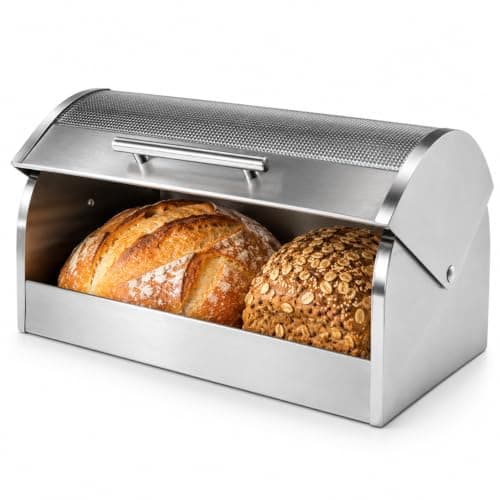
Oggi Stainless Steel Roll-Top Bread BoxA roll-top lid opens without needing clearance above it, which is the detail that decides whether a bread box fits under a wall cabinet.
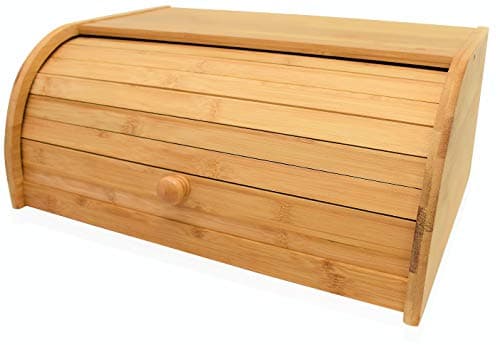
RoyalHouse Bamboo Roll-Top Bread Box, LargeBamboo at a fraction of the steel price, with the same roll-top mechanism and one real trade-off around humidity.
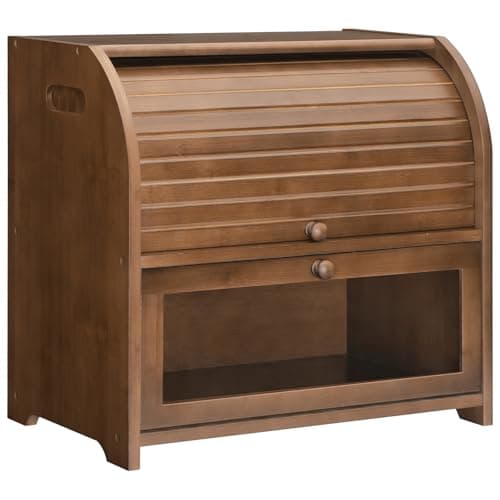
HOOBRO 2-Tier Bamboo Bread BoxGoes up instead of along, which is the right answer when the counter is full and the bread still needs somewhere to live.
Scores are our own, from the published rubric on the methodology page. They are editorial judgments about published specifications, not test results — we have not handled these units.
01
A counter you look at every day
Oggi Stainless Steel Roll-Top Bread Box
A roll-top lid opens without needing clearance above it, which is the detail that decides whether a bread box fits under a wall cabinet.
None beyond the box height, because the lid rolls back
Published interior dimensions
Not published by the manufacturer in a form we could verify in a form we could verify
What it gets right
Roll-top needs no headroom to open, so it works under a wall cabinet
Steel and glass wipe clean and do not absorb odors the way untreated wood does
Heavy enough that the lid does not drag the box across the counter
What it does not
Interior dimensions are not published, so whether a long sourdough fits is a gamble
Steel shows fingerprints on a daily-use item
Costs several times what a plastic bin holding the same bread costs
Who it is for
A visible counter where the bread box is furniture as much as storage.
Skip this if
You buy long artisan loaves. Without published interior dimensions this is the wrong category to guess in - measure your usual loaf and check the listing's stated size.
02
Warmth on the counter, cheaply
RoyalHouse Bamboo Roll-Top Bread Box, Large
Bamboo at a fraction of the steel price, with the same roll-top mechanism and one real trade-off around humidity.
Single-box footprint carrying two levels of storage
Published interior dimensions
Not published by the manufacturer in a form we could verify
What it gets right
Doubles the storage without taking more counter
The upper tier suits the things that migrate onto a counter anyway - wraps, snacks
Same roll-top access as the single-tier boxes
What it does not
Taller, so it needs headroom a wall cabinet may not leave
Two tiers of bamboo is heavier to move for cleaning
Interior dimensions unpublished, same as the rest of this category
Who it is for
A small kitchen where counter footprint is the binding constraint.
Skip this if
It has to live under a wall cabinet. Measure that gap first - the height is the whole point of this box and also its main constraint.
Nobody publishes the interior, and it matters
This is the honest weakness of the whole category. Sellers publish an exterior size and a material, and essentially none publishes an interior length, width and height — which is the only figure that tells you whether your loaf fits.
The gap between exterior and interior is not small on these products, because roll-top boxes carry the retracted lid inside the shell. A box that measures generously on the outside can be noticeably tighter within.
Measure your usual loaf — length first, then height with any bag gathered at the top.
Compare it against the stated exterior, then assume the interior is meaningfully smaller.
If you buy long artisan loaves, treat every box in this category as a risk until you have the interior figure, and prefer the largest stated size.
Every product on this page carries a "not published" row for interior dimensions rather than a number we estimated. That is the same standard we apply to shelf loads across the site, and the reason our container pages lead on published figures — see best airtight food storage containers.
Material, and what it does to the bread
Bread has two ways to go bad and they pull in opposite directions. It stales by losing moisture and it molds by keeping too much. A bread box is managing that trade, which is why an airtight container is actually the wrong tool — sealed, a fresh loaf sweats and molds faster.
Steel. Wipes clean, does not absorb odors, holds no moisture of its own. The most hygienic and the least forgiving of a damp loaf.
Bamboo and wood. Buffers humidity slightly, which suits bread, and looks like kitchen furniture. Absorbs odors and stains over time, and splits if it dries out beside a heat source.
Plastic. Cheapest and easiest to clean; tends toward the sealed end, which is the wrong end for a crusty loaf.
Ventilation. Most boxes have a small vent or a deliberately imperfect seal. That is a feature, not a defect — it is what stops the loaf sweating.
What else a bread box is good for
Once it is on the counter it becomes the most-used container in the kitchen, and a bread box with room to spare tends to absorb the things that otherwise clutter a worktop: wrapped snacks, rolls, bagels, the bag of crumpets nobody has a home for.
That is the argument for the two-tier version in a small kitchen — it takes one footprint and gives two levels, which is the same vertical-space logic that runs through pantry shelf depth and spacing.
What it is not good for is long-term dry-goods storage. Flour, rice and cereal want a genuine airtight seal, which a bread box deliberately does not provide — those belong in the containers on best containers for flour, sugar and rice.
What we are not telling you
We have not handled these bread boxes. Materials, lid mechanisms and stated sizes are the sellers' published figures. Interior dimensions are not published for any of them, and every product entry says so rather than carrying an estimate — which also means we cannot tell you whether a specific loaf fits a specific box.
The clearance table is geometry rather than a measurement: a retracting lid needs no headroom, a hinged one needs its own height. That reasoning is checkable and we would rather label it as reasoning than imply we measured it. The method is on how we pick.
FAQ
Questions people ask about this
What is the best type of bread box?
A roll-top, for most kitchens. The lid retracts into the box rather than swinging up, so it opens in the space the box already occupies and works under a wall cabinet. Hinged and lift-off lids need roughly their own height again in clear air above the counter.
Do bread boxes keep bread fresh?
They manage a trade rather than sealing. Bread stales by drying out and molds by staying damp, so a good bread box slows drying while still letting some moisture escape. That is why a fully airtight container is the wrong tool — a fresh loaf sweats and molds faster in one.
What size bread box do I need?
Measure your usual loaf, length first, then compare against the stated exterior size and assume the interior is meaningfully smaller — roll-tops carry the retracted lid inside the shell. Almost no seller publishes interior dimensions, so buy generously if you get long artisan loaves.
Is a wooden or steel bread box better?
Steel wipes clean, holds no moisture and never absorbs odors. Bamboo and wood buffer humidity slightly, which suits bread, and look like kitchen furniture, but they stain, absorb odors over time and can split beside a heat source. It is a genuine trade rather than a ranking.
Should a bread box be airtight?
No. Most have a small vent or a deliberately imperfect seal, and that is a feature. Sealed completely, a fresh loaf releases moisture that has nowhere to go and molds faster than it would on the counter.
Can you store other things in a bread box?
Yes, and most people end up doing it — wrapped snacks, rolls, bagels and the odd bag that has no home. What it is wrong for is flour, rice and cereal, which need a genuine airtight seal that a bread box deliberately does not provide.
Sources
Where these figures come from
Availability check, 13 September 2026Every product added for these pages was resolved through the Amazon Creators catalog on that date and carried a New buy-box offer at the time of writing. Products with no verifiable listing were not featured.
Where a figure is absentSeveral categories on these pages are dominated by sellers that publish a pack count and an overall size and nothing else - no load rating, no clearance height. Where that is the case the row says so rather than carrying an estimate.
What is not a source hereWe have not handled these products. Nothing on this page is a test result, and no figure comes from a retailer listing, another publisher, or memory.