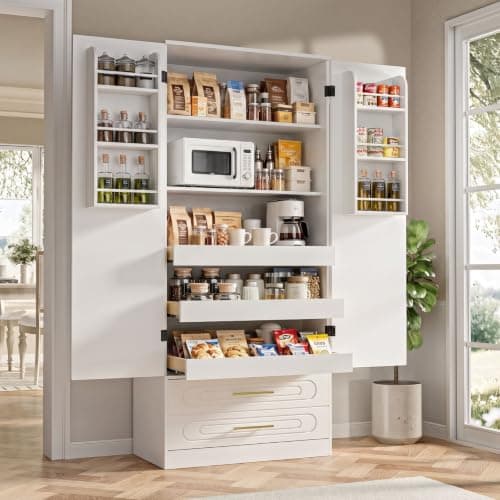
Every cabinet here publishes its height, width and shelf count. Only one publishes how tall its shelves are, which is the figure that decides what fits.
By Scooter M.Published September 21, 2026Content updated September 21, 2026Prices verified September 21, 2026How we pick
Bin & Basket earns a commission when you buy through our links, at no extra cost to you. We are an Amazon Associate. We accept no free products, no sponsored placements and no paid inclusion, and commission rate plays no part in what we recommend. Full disclosure.
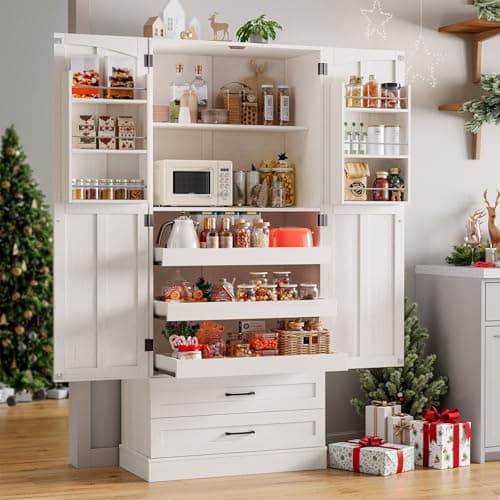
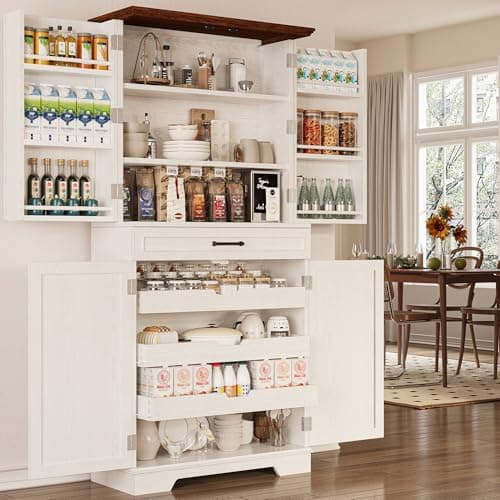
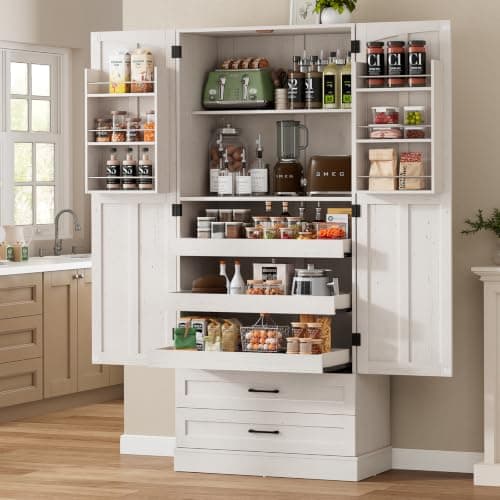
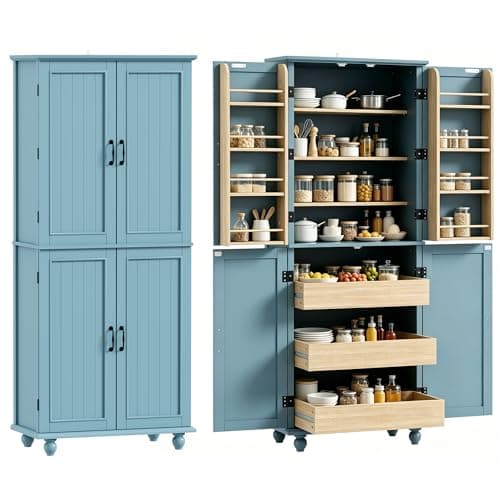
Buy the Gyfimoie, because it is the only cabinet here that publishes how tall its shelves are. Its door tiers are stated at 5.9, 7.8 and 8.46 inches, which you can check against a can, a spice jar and a cereal box before you order. If you want the layout rather than the figures, the ONBRILL gives three pull-out shelves and two drawers in a 71-inch cabinet; the IRONCK is the tallest and says its shelves adjust; the ComfyCorner is the widest at 32.3 inches; and the Scurrty is the one that looks like furniture.
All five are about 15 inches deep, all five weigh between 95 and 132 pounds, and four of the five tell you nothing whatsoever about the space inside them. That is the category in one sentence.
How this page is ranked
Does it publish any interior figure? Shelf spacing decides whether your cereal boxes stand up. One cabinet here publishes tier heights; the rest publish a shelf count and leave you to hope.
Pull-out shelves or fixed. A 15 in deep fixed shelf buries whatever is at the back. Pull-outs are the single feature that changes how a pantry cabinet is used day to day.
Depth against the pantry band. Twelve to sixteen inches is the depth pantry shelving actually wants, and every cabinet here lands inside it. That is the one thing the category gets right.
Door storage. Door shelves hold the packets and sachets that otherwise bury a main shelf. Counts here run from none to eight.
Weight and anti-tip. These are 95 to 132 lb of engineered wood standing over 5 ft tall. Every one of them needs anchoring, and none publishes a shelf load rating.
What each cabinet publishes
Listed figures for the pantry cabinets on this page
Cabinet
H x W x D
Pull-outs
Drawers
Door shelves
Weight
Gyfimoie 66 in
65.7 x 29.1 x 15 in
3
1
2 x 3 tiers, heights published
104 lb
ONBRILL 71 in
71 x 31.3 x 15 in
3
2
6
126 lb
IRONCK 72 in
73.2 x 31.3 x 15.7 in
3 sliding
0
6
132 lb
ComfyCorner 71 in
70.6 x 32.3 x 15 in
3
2
6
95 lb
Scurrty vintage
68.31 x 29.92 x 15.75 in
0
3
8 compartments
118 lb
Exterior dimensions and counts as listed in the retailer catalog on 21 September 2026. No cabinet here publishes an interior height, a shelf load rating or the spacing between its main shelves, apart from the Gyfimoie door tiers.
The spacing problem, and why it matters more than capacity
Our pantry shelf depth and spacing guide puts canned goods in a 7 inch band and taller boxed goods in a 12 to 14 inch band. Those are the numbers you are buying against. A cabinet with four fixed tiers in 71 inches of height sounds generous until the tiers turn out to be 16 inches apart, at which point you are storing cans in a space built for cereal and wasting half of it.
You cannot do that arithmetic on four of these five cabinets, because none of them publishes an interior height or a tier spacing. We are not going to estimate it from the exterior, because the base, the top panel, the shelf thickness and the drawer bank all come out of that number and none of those is published either. The Gyfimoie is the exception and the reason it leads this page: 5.9 inches takes a standard can, 7.8 inches takes taller jars, and 8.46 inches takes most of what is left.
Pull-out shelves are the real feature
A 15 inch deep fixed shelf has a front half you use and a back half you forget. That is not a criticism of the depth, which is correct for a pantry, it is a criticism of fixed shelving at that depth. Three of these cabinets ship pull-out shelves as standard and one ships none.
The Scurrty is the cabinet that goes without, and it is worth being clear about the trade: you get eight door compartments and three drawers and a finish that suits a dining room, and you keep the reach-to-the-back problem. If access is what you are solving, the pull-out cabinets are the answer, and if a cabinet you already own is the problem, pull-out cabinet organizers retrofit the same idea for a fraction of the price.
#
Product
Best for
Score
Price
01
Gyfimoie 66 in Kitchen Pantry Cabinet with Pull-Out ShelvesThe one cabinet here that tells you how tall its door shelves are - 5.9, 7.8 and 8.46 inches - which is the difference between planning a pantry and guessing at one.
ONBRILL 71 in Kitchen Pantry Cabinet, 3 Pull-Out ShelvesThree sliding shelves and two drawers in a 71-inch cabinet, which is the configuration that solves the real pantry problem: the back of a deep shelf.
IRONCK 72 in Kitchen Pantry Cabinet with Sliding RacksThe tallest cabinet here at 73 inches, and the one that says its main shelves adjust - which matters more than any other feature once you know what you store.
ComfyCorner 71 in Tall Kitchen Pantry Cabinet with DrawersThe widest at 32.3 inches and the lightest of the tall cabinets at 95 lb, with the same three-pull-out layout as the ONBRILL.
Scurrty Vintage Kitchen Pantry Cabinet with Door ShelvesEight door compartments and three bottom drawers in a painted vintage shell, for people whose pantry cabinet has to stand in a room people see.
Scores are our own, from the published rubric on the methodology page. They are editorial judgments about published specifications, not test results — we have not handled these units.
01
The only one that publishes its shelf heights
Gyfimoie 66 in Kitchen Pantry Cabinet with Pull-Out Shelves
The one cabinet here that tells you how tall its door shelves are - 5.9, 7.8 and 8.46 inches - which is the difference between planning a pantry and guessing at one.
71 in H x 31.3 in W x 15 in DSource: Retailer catalog listing, retrieved 21 September 2026
Weight
About 126 lbSource: Retailer catalog listing, retrieved 21 September 2026
Inside
3 pull-out shelves, 2 drawers, 6 door shelves and an adjustable upper shelfSource: Retailer catalog listing, retrieved 21 September 2026
Published shelf spacing
Not published by the manufacturer in a form we could verify. The listing states the shelf count, not the gap between them
Material
Engineered wood with a watertight surface, per the listingSource: Retailer catalog listing, retrieved 21 September 2026
Stability
Anti-tip hardware listedSource: Retailer catalog listing, retrieved 21 September 2026
What it gets right
Three pull-out shelves as standard, so nothing lives permanently at the back of a 15 in shelf
Six door shelves, which is where single-serve packets stop burying everything else
At 15 in deep it matches the 12 to 16 in band pantry shelving actually wants
What it does not
No interior shelf spacing is published, so you cannot check a tall cereal box or a 13 in container before ordering
Engineered wood carries no published shelf load rating, unlike the wire systems we cite elsewhere
About 126 lb flat-packed, so delivery and assembly are a two-person job
Who it is for
A kitchen with no built-in pantry and a 31 in stretch of wall to give it.
Skip this if
You store tall appliances or oversized containers. Without a published gap between shelves, tall items are a gamble.
03
The tallest, with adjustable shelves
IRONCK 72 in Kitchen Pantry Cabinet with Sliding Racks
The tallest cabinet here at 73 inches, and the one that says its main shelves adjust - which matters more than any other feature once you know what you store.
68.31 in H x 29.92 in W x 15.75 in DSource: Retailer catalog listing, retrieved 21 September 2026
Weight
About 118 lbSource: Retailer catalog listing, retrieved 21 September 2026
Inside
4 storage tiers, 8 door compartments with shelves and 3 bottom drawersSource: Retailer catalog listing, retrieved 21 September 2026
Published shelf spacing
Not published by the manufacturer in a form we could verify
Material
Engineered wood with a reinforced frameSource: Retailer catalog listing, retrieved 21 September 2026
What it gets right
Eight door compartments, the most door storage here, which is where small packets belong
Three bottom drawers rather than the usual two
A finished, furniture-like look that suits a dining room or hallway rather than a utility room
What it does not
No pull-out shelves at all, so the back of each fixed tier is still a reach
The most expensive cabinet here at the time of writing, for storage that is not obviously larger
No published spacing and no load rating, like the rest of the category
Who it is for
A pantry cabinet that has to live in a visible room and look deliberate.
Skip this if
Reaching the back of a shelf is your actual problem. Pull-outs solve that and this cabinet does not have them.
Depth: the one thing this category gets right
Every cabinet here is 15 to 15.75 inches deep. A standard kitchen base cabinet is roughly 24 inches, and a pantry shelf that deep is where food goes to be forgotten. Fifteen inches sits inside the 12 to 16 inch band that suits cans, boxes and jars in a single row, which means the front row is the only row and nothing hides behind anything.
It also means these cabinets project about 15 inches into the room, which is roughly the depth of a bookcase. In a galley kitchen that is a real cost, and a wall-mounted run or a pantry shelving unit may use the space better.
Weight, anchoring and the load nobody rates
These cabinets weigh 95 to 132 pounds empty and stand between 65.7 and 73.2 inches tall on a 15 inch base. Loaded with tins, the center of gravity rises. Every listing here mentions anti-tip hardware or a reinforced base, and not one publishes a shelf load rating.
Anchor it, and anchor it into a stud. Anti-tip hardware in the box is not the same as a fixing in the wall.
Put the heavy stock low. Tinned goods on the bottom tiers, packets and light boxes up high. That is free stability.
Do not treat an engineered-wood shelf like a wire one. ClosetMaid publishes about 83 lb per bracket for its wire ranges. Nothing here publishes anything, so keep the heaviest cases on the floor of the cabinet.
When a cabinet is the wrong answer
You have a closet or an alcove. Shelving the space you already have stores more per square foot than any freestanding box, because you lose no carcass thickness. The figures are on best pantry shelving units.
You need to store bulk or heavy stock. A steel wire unit publishes real per-shelf loads; an engineered-wood cabinet publishes none.
You rent and move often. At 95 to 132 lb flat-packed, these are not cabinets you will enjoy moving twice.
Measuring the space, including the parts that are not the cabinet
A cabinet 31.3 inches wide does not fit a 31.5 inch gap, and three separate things explain why people discover that on delivery day.
The baseboard. A cabinet stands off the wall by the thickness of the baseboard unless you notch it, so add that to the depth and expect the cabinet to sit slightly proud.
Door swing. These are all double-door cabinets roughly 29 to 32 in wide, so each door needs about half that again of clear floor in front of it. A kitchen island 30 in away will stop the doors opening fully.
Getting it upright. A flat-packed cabinet is assembled lying down and stood up, and on the way up it needs its diagonal rather than its height. For the 73.2 in IRONCK at 15.7 in deep, that is about 74.9 in - fine under an 8 ft ceiling, a problem in a basement or under a slope.
The route in. A 95 to 132 lb carton has to get through the door, round the turn at the top of the stairs and into the room. Measure the tightest point on that route, not just the destination.
What goes where inside it
A pantry cabinet holds more if it is loaded deliberately, and the logic is the same one that governs any shelving: weight low, frequency at eye level, dead stock high.
Floor of the cabinet: cases of cans, bulk bags of flour and rice, anything you buy by the box. This is the only part of the cabinet whose load is carried straight into the floor rather than into a shelf nobody has rated.
Pull-out shelves: the things you reach for daily. The pull-out is wasted on stock you touch twice a year, and it is the whole point for oils, pastas and tins in rotation.
Eye-level fixed shelf: the breakfast things, the jars, whatever is currently being cooked from.
Door shelves: packets, sachets, spice jars and single-serve items - the things that vanish behind larger items on a main shelf. This is the storage people under-use most.
Top shelf: duplicates and long-life stock. Anything you have two of, the second one lives here.
Loading heavy stock low is also the free half of anti-tip. A cabinet with 40 lb of tins on its top shelf and an empty base is a different object from the same cabinet loaded the other way round.
Assembly, honestly
Every cabinet here is flat-packed engineered wood with cam locks and dowels, and every listing describes numbered parts and clear instructions. What none of them says is how long it takes, so plan for an evening rather than an hour, and plan for two people at the point where the carcass is stood upright.
Two things are worth doing that the instructions will not insist on. Build it in the room it will live in, because a 71 inch assembled cabinet does not turn corners. And check the back panel is square before the final fixings go in, because a rack-shaped carcass is what makes doors sit unevenly, and the back panel is what holds a cabinet square.
The documentation gap, in one place
It is worth collecting what this category does not tell you, because it is unusual for furniture at this price. Not one of these five cabinets publishes an interior height, a shelf load rating, a shelf thickness, a warranty term or a material specification beyond the phrase engineered wood.
Compare that with the wall-mounted systems on this site, where ClosetMaid publishes a per-bracket load, a maximum standard spacing and the fixing condition all of it depends on. The freestanding pantry cabinet market is competing on photographs, and the practical consequence for a buyer is that the only figures you can plan with are the outside dimensions and the counts of things.
What we are not telling you
We have not assembled or loaded any of these cabinets. Every figure on this page is published by the seller or listed in the retailer catalog and retrieved on 21 September 2026, which is a weaker class of source than the manufacturer installation documents we cite for wire shelving, and each row is labeled that way.
No cabinet here publishes an interior height, a shelf load rating or a spacing figure, apart from the Gyfimoie door tiers, and we have not estimated any of them. Prices move, so every price on this page is live from the retailer when you look. The method is on how we pick.
FAQ
Questions people ask about this
What is the best freestanding pantry cabinet?
The Gyfimoie 66 inch cabinet, because it is the only one we found that publishes its shelf heights - 5.9, 7.8 and 8.46 inches on the door tiers - so you can check your own cans and boxes against real figures. If you want maximum height the IRONCK is 73.2 inches and says its shelves adjust; for width the ComfyCorner is 32.3 inches.
How deep is a pantry cabinet?
The five we measured are all 15 to 15.75 inches deep, which is inside the 12 to 16 inch band that suits pantry storage. That is shallower than a standard 24 inch kitchen base cabinet, and deliberately so: at 15 inches nothing hides behind anything.
Are pull-out shelves worth it in a pantry cabinet?
Yes, at this depth. A 15 inch fixed shelf has a back half you stop using within a month. Three of the five cabinets here ship three pull-out shelves as standard. If you already own a cabinet, retrofit pull-out organizers cost a fraction of a new one.
How much weight can a pantry cabinet shelf hold?
None of these cabinets publishes a shelf load rating, so there is no honest number to give you. For comparison, ClosetMaid publishes about 83 lb per bracket for its wire shelving. Keep heavy tinned stock low in the cabinet and treat the upper shelves as light storage.
Do pantry cabinets need to be anchored to the wall?
Yes. These are 95 to 132 lb cabinets standing up to 73 inches tall on a 15 inch base, and loading them with tins raises the center of gravity. Every listing mentions anti-tip hardware; use it, and fix into a stud rather than into drywall alone.
Is a pantry cabinet better than shelving?
Only where you have no alcove or closet to shelve. A cabinet brings its own walls, which costs you carcass thickness and floor space, and none of them publishes a load rating. Shelving an existing recess stores more per square foot, and steel wire units publish real per-shelf figures.
Sources
Where these figures come from
Product figures, as listed in the retailer catalog (21 September 2026)Dimensions, capacities, counts, materials and any stated load for every product added in this expansion, taken from the Amazon catalog and the sellers' own listing text through the Creators API on 21 September 2026. These are listing figures rather than manufacturer specification sheets, and each row is labeled that way. Where a listing states a load or a clearance requirement, it is quoted as the seller's figure. Where nothing is published, the row says so instead of carrying an estimate.
Availability check, 21 September 2026Every product added in this expansion was resolved through the Amazon Creators catalog on that date and carried a New buy-box offer at the time of writing. Products without a current offer were excluded before the pages were written.
What is not a source hereWe have not handled these products. Nothing on this page is a test result, and no figure comes from a retailer listing, another publisher, or memory.