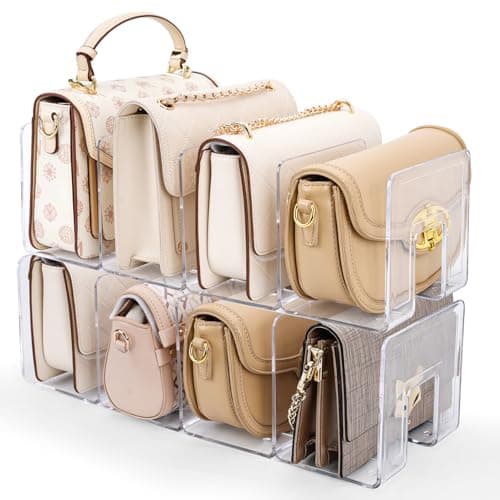
Storing bags is easy. Storing them without stretching handles or crushing structured leather is the part these products get right or wrong.
By Scooter M.Published September 21, 2026Content updated September 21, 2026Prices verified September 21, 2026How we pick
Bin & Basket earns a commission when you buy through our links, at no extra cost to you. We are an Amazon Associate. We accept no free products, no sponsored placements and no paid inclusion, and commission rate plays no part in what we recommend. Full disclosure.
For structured bags, keep them standing on their own bases: the AMZABBY acrylic slots do that on a shelf, and the SPACEKEEPER adjustable dividers do it on a shelf you already own. If your bags vary wildly in size, the HapiRm rack has four adjustable tiers. If you have no shelf to spare, the zebricolo hanging organizer moves the whole collection onto rod and publishes a 40 lb hanger rating. And if you simply want soft bags off the floor tonight, eight vinyl-coated hooks cost less than anything else here - at a real cost to the handles.
The thing most guides skip: how you store a bag changes the bag. That is the axis this page ranks on.
What each format does to the bag
A handbag is a structure held up by its own stiffness and by whatever is inside it. Storage either supports that structure or slowly works against it.
Standing on its base, supported at the sides. The kindest arrangement. The bag holds its own shape, the handles carry nothing and leather is not creased anywhere it was not designed to crease. This is what dividers and slotted organizers do.
Hanging by the handles. The hardest on a bag. All the weight, including whatever is left inside it, runs through two handle joins for months. On soft leather that stretches; on stitched joins it strains the stitching.
In a hanging pocket. A middle position - the bag sits in a compartment rather than hanging from its handles, but a soft-sided compartment lets a heavy bag slump out of shape over time.
Stacked or leaning. The default in most closets, and the one that crushes structured bags and creases the sides of soft ones.
How this page is ranked
What it does to the bag, as above. This outranks capacity.
Whether it adjusts, because a clutch and a tote need very different widths and most collections contain both.
What it costs you in space. Shelf dividers use a shelf you already have; a hanging organizer spends about a foot of rod per unit.
Published figures. Almost nothing here publishes a load; one hanging organizer publishes 40 lb and one hook set publishes its 1.8 in opening.
Visibility. A bag you cannot see is a bag you stop carrying.
#
Product
Best for
Score
Price
01
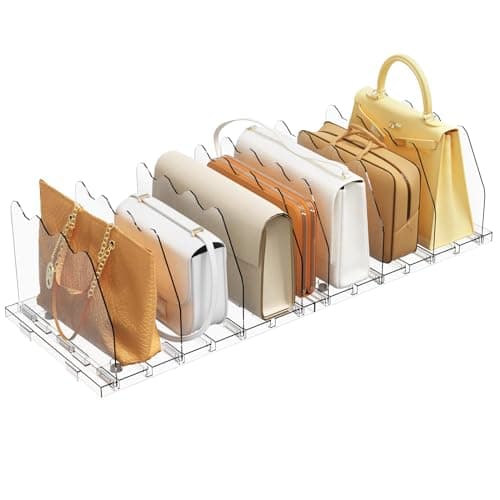
AMZABBY Acrylic Purse Organizer, 8 Slots, 2-PackEight slots across two clear units, which keeps structured bags standing on their own base instead of leaning into each other on a shelf.
SPACEKEEPER Adjustable Acrylic Shelf Dividers for BagsAdjustable clear dividers that slot onto an existing shelf, which is the least invasive fix when the bags are already where you want them and simply fall over.
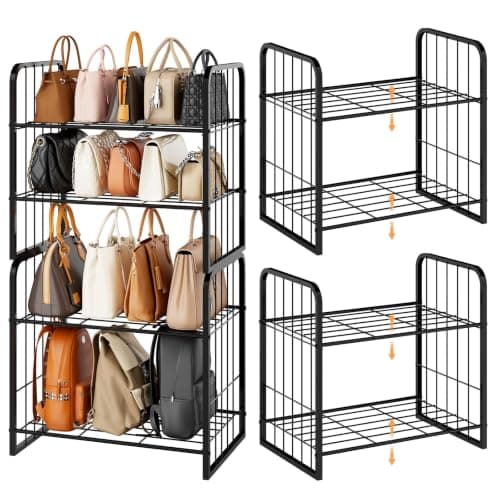
HapiRm Adjustable Purse Rack, 4 TiersA four-tier rack that separates and stacks, so the spacing between tiers can follow the bags you own rather than the shelf you have.
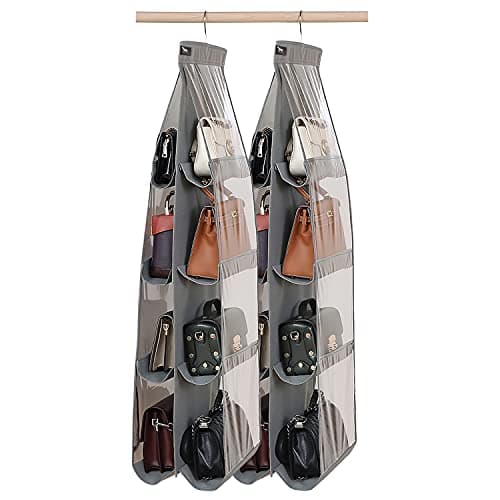
zebricolo Hanging Handbag Organizer, 2-PackA hanging column of clear pockets with a stated 40 lb hanger, which moves the whole bag collection off shelf space and onto rod you were not using.
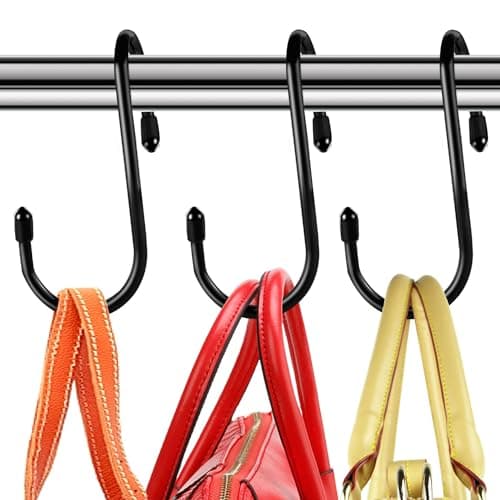
HiGift Purse Hanger Hooks for a Closet Rod, 8-PackEight vinyl-coated hooks that turn existing rod into bag storage, and the listing publishes the one figure that matters: a 1.8 inch opening.
Scores are our own, from the published rubric on the methodology page. They are editorial judgments about published specifications, not test results — we have not handled these units.
01
Standing bags upright on a shelf
AMZABBY Acrylic Purse Organizer, 8 Slots, 2-Pack
Eight slots across two clear units, which keeps structured bags standing on their own base instead of leaning into each other on a shelf.
16.5 in L x 5.71 in W x 5.12 in HSource: Retailer catalog listing, retrieved 21 September 2026
Slots
8 across the 2-packSource: Retailer catalog listing, retrieved 21 September 2026
Assembly
None stated as requiredSource: Retailer catalog listing, retrieved 21 September 2026
Material
Clear acrylicSource: Retailer catalog listing, retrieved 21 September 2026
Published load
Not published by the manufacturer in a form we could verify
What it gets right
Bags stand on their own bases, which is the only way a structured bag keeps its shape
Clear acrylic disappears on the shelf, so the bags are what you see
No assembly, and it can be lifted out and repositioned in seconds
What it does not
5.71 in of slot width suits clutches and small bags, not a wide tote
Acrylic scratches, and it cracks rather than bends if a heavy bag is dropped into it
It needs a shelf deep enough for 16.5 in front to back
Who it is for
A shelf of clutches, crossbodies and smaller structured bags.
Skip this if
Your bags are large totes. Measure a bag's base before assuming it stands in a 5.7 in slot.
02
Bags already on a shelf
SPACEKEEPER Adjustable Acrylic Shelf Dividers for Bags
Adjustable clear dividers that slot onto an existing shelf, which is the least invasive fix when the bags are already where you want them and simply fall over.
1.8 in, stated to fit any rod under 1.8 in thickSource: Retailer catalog listing, retrieved 21 September 2026
Pack
8 hooksSource: Retailer catalog listing, retrieved 21 September 2026
Finish
Vinyl-coated metalSource: Retailer catalog listing, retrieved 21 September 2026
Rod space used
Roughly the width of each bag, since bags hang face to face
Published load
Not published by the manufacturer in a form we could verify
What it gets right
Publishes the rod diameter it fits, which decides compatibility and is usually left out
Vinyl coating protects both the rod finish and the bag handle from bare metal
By far the cheapest way to get bags off a shelf and onto a rod
What it does not
Hanging a bag by its handles stretches and creases them over time, especially on leather
No load rating, so a heavy tote is a judgment call
Bags on a rod eat hanging space quickly - each one takes its own width
Who it is for
A closet with spare rod and a pile of soft bags on the floor.
Skip this if
Your bags are structured leather you care about. Hanging by the handle is how handles deform.
Hooks: cheap, effective, and hard on handles
Eight vinyl-coated hooks will get every soft bag in the house off the closet floor for the price of a sandwich, and they are genuinely the right answer for canvas totes, nylon shoppers and anything whose handles are webbing rather than leather.
They are the wrong answer for structured leather. Hanging a bag by its handles for a year puts a constant load through the two points the bag is weakest, and the result is stretched handles and a bag that no longer sits square. The listing publishes the one figure that matters for compatibility - a 1.8 inch opening, which fits any standard closet rod - and publishes no weight rating at all.
Dividers or slots on a shelf
Acrylic dividers and slotted organizers keep bags upright on their own bases, which is the arrangement that preserves shape. The difference between the two is whether you are adding a unit to a shelf or subdividing the shelf itself.
Adjustability is the thing to check. A fixed 5.7 inch slot takes clutches and crossbodies and will not take a tote. The SPACEKEEPER dividers adjust along the shelf, which is why they suit a mixed collection, and the HapiRm rack adjusts in height between tiers, which is the same idea vertically. If what you are actually storing is folded sweaters rather than bags, generic closet shelf dividers do the same job for less money.
Hanging organizers, and the rod they cost
A hanging column of pockets takes the whole collection off the shelf and puts it on the rod. Each unit here is about 12 inches wide, so two of them cost you two feet of hanging space - a real trade in a closet that is already full.
What you get for it is visibility and support: clear panels mean you can see which bag is which, and the bag sits in a compartment rather than swinging from its handles. The zebricolo publishes a 40 lb hanger rating, which is more than almost anything in this category tells you. Whether spending rod is worth it comes down to the same arithmetic as every other hanging organizer, set out on best hanging closet organizers.
Dust bags, and what to do if you threw them away
A dust bag does two jobs: it keeps dust off a bag you are not using, and it stops hardware on one bag scratching the leather of the next. Both matter more than the organizer they sit in.
Use the bag it came with if you still have it. It is sized right and it breathes.
A pillowcase is a genuine substitute. Cotton, breathable, and the right size for most totes.
Never plastic. A plastic cover traps moisture against leather, and that is how mildew starts on a bag stored for a season.
Keep the hardware apart. Chains and buckles on one bag against the side of another is where storage scratches come from, and a soft cover between them solves it.
Shelf height, and the mistake of one tall shelf
Handbags are stored badly in most closets for a structural reason: the shelf above the hanging rod is usually one tall shelf, and a tall shelf invites stacking.
A stack of bags crushes the one at the bottom and hides the ones in the middle. The fix is to divide the height rather than the width - a second shelf, a stackable rack, or slots that hold bags upright - and that is what every product on this page is really doing. The same vertical-space logic applies across a closet and is set out on organizing a small closet.
If you are choosing between spending shelf or spending rod, the practical tiebreaker is how often you carry the bags. Bags in rotation want to be visible at eye level; bags kept for occasions can go higher, in covers, where visibility matters less.
Totes, backpacks and the bags nobody plans for
Most purse organizers are designed around a structured handbag of moderate size, and most households own several bags that are nothing like that.
Canvas totes collapse flat and are best folded on a shelf or hung on hooks - they have no shape to protect, which makes them the one category where hooks cost nothing.
Backpacks are too deep for almost every slot organizer here, and they hang well from a sturdy hook by the top loop rather than the shoulder straps.
Large leather totes are the hardest case: too wide for a 5.7 in slot, too heavy to hang by the handles for long. An adjustable rack tier or a dedicated section of shelf is the honest answer.
Clutches and small crossbodies are what slot organizers are designed for, and they are also the bags most likely to disappear behind bigger ones without them.
A routine that keeps bags in use
Bag storage fails the same way jewelry storage does: the collection gets organized once, and then the two bags in rotation live on a chair while the organizer holds the other eight permanently.
Give the bags in rotation the easiest position - eye level, front, uncovered. These are the ones that need to be grabbed without thinking.
Empty a bag when it goes back. A bag stored with its contents in it sags under the weight for months, and it is also how you lose things for a season.
Stuff it, then store it. This is the single habit that keeps a structured bag square, and it takes five seconds with the dust bag or a pillowcase.
Look at the back row twice a year. A bag nobody has touched in twelve months is not being stored, it is being kept, and that is a different decision about space.
Where bags should not be stored
Leather responds badly to three conditions, and closets frequently supply all three.
Damp. A closet on an exterior wall or backing onto a bathroom is where mildew starts on leather, and a bag in a plastic cover in that closet is the worst case of all. If the closet has a musty signature, fix that before buying organizers - the diagnosis is on why your closet smells musty.
Direct sun. A bag stored on an open shelf in a sunlit bedroom fades unevenly, and the side facing the window ages faster than the rest of it.
Heat. Above a radiator or against a hot-water cupboard wall, leather dries and the finish crazes over a couple of years.
Compression. Anything stacked on top of a structured bag, including other bags, is slowly reshaping it.
None of that requires a special product. It requires choosing which shelf, which is free, and it matters more for an expensive bag than whichever organizer holds it.
Hooks on a door, and where not to put them
The cheapest bag storage of all is a hook on the back of a door, and it is the one arrangement that is nearly always wrong for a bag worth protecting.
A door hook holds a bag by its handles, the same as a rod hook, and adds two things that make it worse: the bag swings against the door every time the door moves, and it hangs in the path of the door frame where it gets squashed each time the door closes against a coat or another bag. For a canvas tote that is irrelevant. For structured leather it produces a scuffed corner and stretched handles within a season.
Where a door face genuinely helps is with the small, light, soft bags that would otherwise disappear on a shelf - and even then, the rule from the top of this page applies: if the bag has a shape worth keeping, store it standing on its base rather than hanging from anything.
What we are not telling you
We have not loaded or lived with any of these organizers. Dimensions, slot counts and the two published ratings are the figures sellers publish on their listings, retrieved on 21 September 2026. Where no load is published, the card says so.
What hanging does to a handle is mechanics rather than a test we ran: a bag hung by its handles puts its full loaded weight through two joins, continuously. We have not run a year-long comparison, and we would rather describe the mechanism than imply we measured the damage. Prices are live from the retailer. The method is on how we pick.
FAQ
Questions people ask about this
What is the best way to store handbags in a closet?
Standing upright on their own bases, supported at the sides so they cannot lean or slump - acrylic slots or adjustable shelf dividers do this. Stuff structured bags with tissue or their dust bag first, which does more for the shape than any organizer.
Do purse hangers damage bags?
They can. Hanging a bag by its handles runs its whole weight through two joins for months, which stretches soft leather handles and strains stitching. For canvas totes and webbing handles that is fine; for structured leather, store it standing on its base instead.
How do you store handbags so they keep their shape?
Fill them with something soft - acid-free tissue, a pillowcase, the original dust bag - store them upright on their base, and support the sides so they cannot lean. Leave zips slightly open so air can move rather than sealing moisture inside.
Are acrylic purse organizers worth it?
For structured bags on an open shelf, yes: they hold bags upright on their own bases and they disappear visually. Check the slot width against your widest bag first - fixed slots around 5.7 inches suit clutches and crossbodies, not totes.
How much closet rod does a hanging purse organizer use?
About 12 inches per unit for the one here, so a two-pack costs roughly two feet of hanging space. That is the real price of moving bags off a shelf, and it is worth comparing against simply giving them the shelf.
Should handbags be stored in dust bags?
For leather bags stored long term, a breathable dust bag is better than bare storage and much better than plastic, which traps moisture against the leather. The bag still wants to stand on its base rather than be stacked under other bags.
Sources
Where these figures come from
Product figures, as listed in the retailer catalog (21 September 2026)Dimensions, capacities, counts, materials and any stated load for every product added in this expansion, taken from the Amazon catalog and the sellers' own listing text through the Creators API on 21 September 2026. These are listing figures rather than manufacturer specification sheets, and each row is labeled that way. Where a listing states a load or a clearance requirement, it is quoted as the seller's figure. Where nothing is published, the row says so instead of carrying an estimate.
Garment rack load figures, as published by the sellerUnlike the closet systems on this site, garment racks are sold without manufacturer spec sheets. Where a capacity appears here it is the figure the seller states on the listing itself - useful, and a weaker class of source than an installation manual. Where no figure is stated, the row says so.
Availability check, 21 September 2026Every product added in this expansion was resolved through the Amazon Creators catalog on that date and carried a New buy-box offer at the time of writing. Products without a current offer were excluded before the pages were written.
What is not a source hereWe have not handled these products. Nothing on this page is a test result, and no figure comes from a retailer listing, another publisher, or memory.