01
Closet vs wardrobe
Built into the room, or standing in it. That single difference drives depth, cost, and whether you can take it with you.
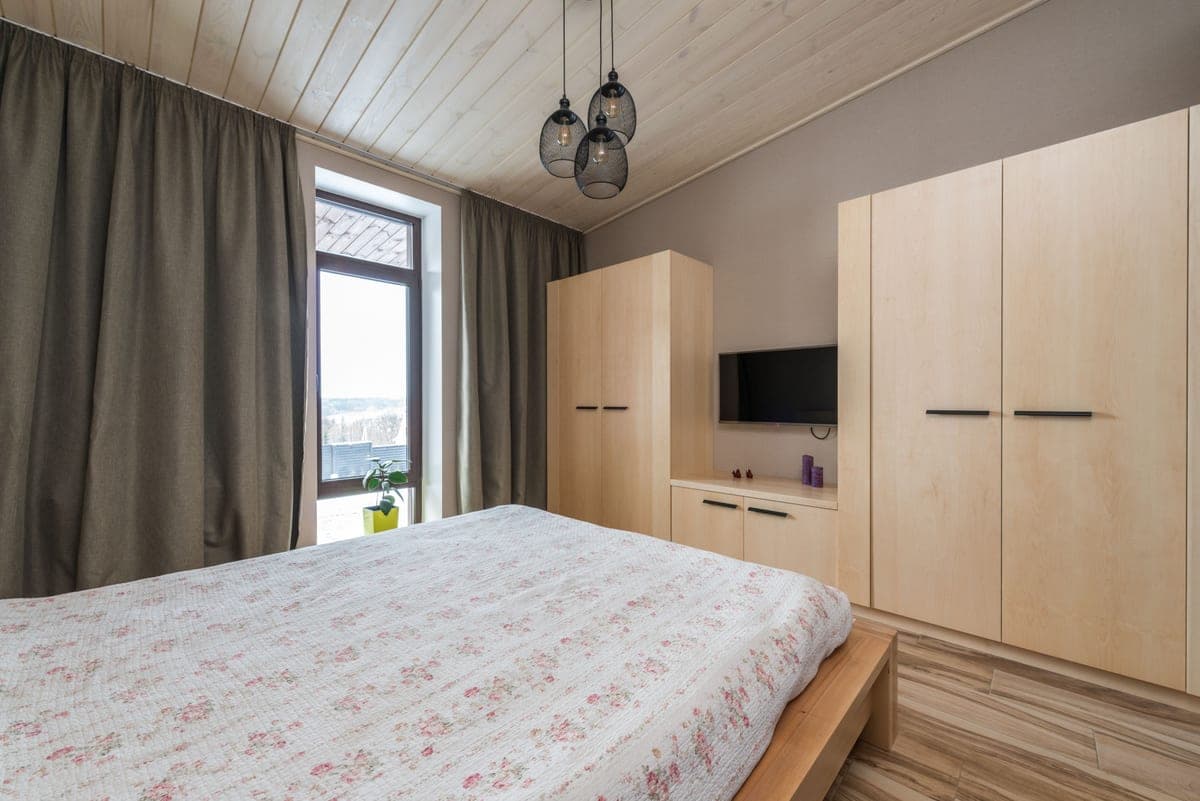
A closet is built into the room; a wardrobe is a freestanding piece of furniture that does the same job. An armoire is a wardrobe, usually older or more decorative, and often with shelves rather than a full hanging rail. A cabinet is any enclosed storage box and is the broadest term of the four. The practical consequence is depth: a built-in closet is conventionally 24 inches deep, while a freestanding wardrobe has to declare its own depth, and the two available depths on IKEA's PAX range are 35 cm (13 3/4 in) and 58 cm (22 7/8 in).
Everything else — cost, whether you can take it when you move, whether it needs a wall — follows from that one construction difference.
The four terms, defined
| Term | Construction | Typical depth | Moves with you |
|---|---|---|---|
| Closet | Built into the room; the walls are the structure | 24 in standard | No |
| Wardrobe | Freestanding furniture with its own carcass | Declared by the model — PAX offers 13 3/4 in and 22 7/8 in | Yes |
| Armoire | A wardrobe, generally older or decorative, often shelved rather than hung | Varies widely; frequently shallower than 24 in | Yes |
| Cabinet | Any enclosed storage box, hung or standing | Anything | Depends |
PAX depths per IKEA's published wardrobe frame specifications. Closet depth per standard US residential practice.
Why the depth figure is the whole decision
A clothes hanger is about 17 to 18 inches across. A closet at 24 inches deep holds it square with clearance to spare. IKEA's 58 cm PAX frame is 22 7/8 inches, which is just under a standard closet and still fine. Its 35 cm frame is 13 3/4 inches, which cannot hold a hanger front-to-back at all — that depth is designed for garments hung sideways on a pull-out rail, and buying it expecting normal hanging is the standard mistake.
The gap is the problem. PAX has nothing between 13 3/4 and 22 7/8 inches, and a great many alcoves fall in that band. If your space is 18 inches deep, a wardrobe range with two depths will not help you and a built-in with a side-hanging rail probably will. The full dimension set is on reach-in closet dimensions.
What freestanding wardrobes actually measure is a separate question, and the answer is mostly less than this. Of 40 wardrobe listings we pulled, one reached 22 inches, and the figures clustered at 45 and 50 cm. The ranked picks, ordered by depth, are on best wardrobe closets.
Choosing between them
Choose a built-in closet if
- You own the property, or the landlord permits fixings.
- You want maximum storage per square foot — a built-in uses the full cavity with no carcass thickness.
- The room already has an alcove or recess doing nothing.
- You want the doors to disappear into the wall line.
Choose a freestanding wardrobe if
- You rent, or expect to move. It comes with you.
- There is no alcove and building one is not proportionate.
- You want a known depth before you commit — a wardrobe publishes its dimensions; an alcove has whatever it has.
- You would rather assemble than build.
The cabinet question
Cabinet is a category, not a competitor. A kitchen cabinet, a bathroom cabinet and a bedroom wardrobe are all cabinets in the general sense. Where the word matters is in a pantry context: a cabinet pantry is enclosed shelving, whereas a walk-in pantry is a room. The depth conventions there are entirely different from a closet — pantry shelving sits in a 12 to 16 inch band, and the reasons are on pantry shelf depth and spacing.
FAQ
Questions people ask about this
What is the difference between a closet and a wardrobe?
A closet is built into the room and uses the room's walls as its structure. A wardrobe is freestanding furniture with its own carcass that does the same job and can be moved. That difference drives depth, cost, and whether it comes with you when you leave.
Is an armoire the same as a wardrobe?
Effectively yes — an armoire is a wardrobe, generally older or more decorative, and frequently shelved rather than fitted with a full hanging rail. Check the interior before assuming you can hang a full wardrobe in one.
How deep does a wardrobe need to be?
About 22 inches for conventional front-to-back hanging, because a hanger is 17 to 18 inches across. IKEA's PAX 58 cm frame at 22 7/8 inches clears that. Its 35 cm frame at 13 3/4 inches does not, and is designed for a side-hanging pull-out rail instead.
Is a closet or a wardrobe better for a small bedroom?
A built-in closet stores more per square foot because it has no carcass thickness and uses the full cavity. A wardrobe wins if there is no alcove to build into, or if you rent. In a small room the carcass thickness of a wardrobe is a real cost.
What is a cabinet compared with a closet?
Cabinet is the broad term for any enclosed storage box, hung or standing. Closet is specifically built-in storage you reach or walk into. In a pantry context, a cabinet pantry is enclosed shelving and a walk-in pantry is a room.
Sources
Where these figures come from
- IKEA, PAX wardrobe frame product specificationsPublished frame widths, heights and the two available depths.
- Dimensions.com, closet storage element dataStandard reach-in depth, rod heights and double-hang spacing used across the US residential market.
- What is not a source hereWe have not handled these products. Nothing on this page is a test result, and no figure comes from a retailer listing, another publisher, or memory.