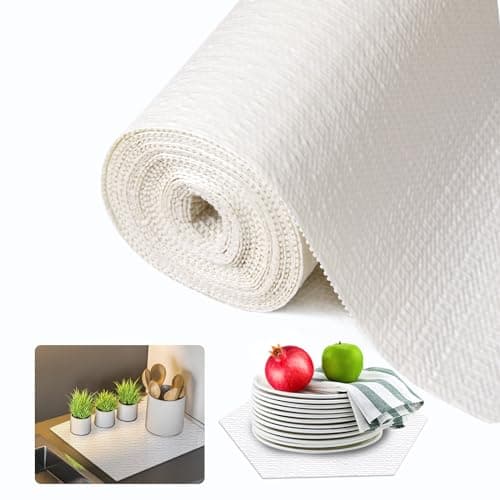
A liner is bought by the roll and fitted by the shelf. The width you need is the inside of the shelf, not the size printed on the shelving.
By Scooter M.Published October 3, 2026Content updated October 3, 2026Prices verified October 3, 2026How we pick
Bin & Basket earns a commission when you buy through our links, at no extra cost to you. We are an Amazon Associate. We accept no free products, no sponsored placements and no paid inclusion, and commission rate plays no part in what we recommend. Full disclosure.
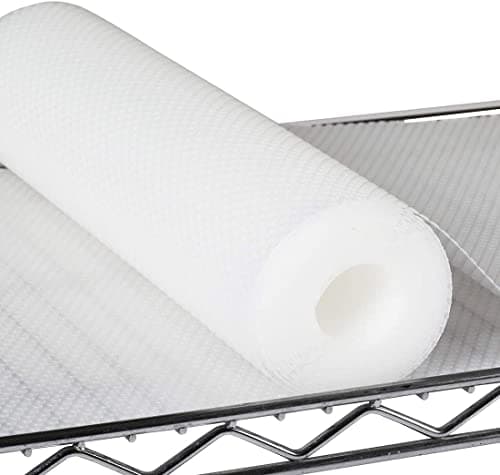
Buy by shelf type, because a liner that works on a flat cabinet shelf is the wrong product for wire shelving. For wire shelves, the PABUSIOR roll publishes a 1.2 mm thickness and tells you to size it by the shelf's inner width; the Gorilla Grip ShelfGuard panels are the rigid alternative and the Sliner 8-pack is pre-cut for 18 by 48 in shelving. For flat cabinet shelves, Duck's EasyLiner is 20 feet of clear non-adhesive for very little money. For drawers, where things slide every time you open them, the Gorilla Grip powerGRIP texture is the one that earns its place.
The category looks like one product sold in different colors. It is three different jobs, and the failure mode is buying for the wrong one.
The three jobs a liner does
Bridging gaps. On wire shelving, the job is to stop small items tipping through and stop stacks taking the wire pattern. This wants stiffness, which is why thickness is the figure that matters.
Stopping slide. In a drawer, the contents move every time it opens. This wants grip texture, and thickness is almost irrelevant.
Protecting the surface. On a painted or wood shelf, the job is to catch spills and stop rings. This wants a smooth, wipeable, replaceable sheet - the cheapest option in the category.
What no liner does: add strength. A liner spreads a point load slightly and changes nothing about what the shelf or its brackets can carry.
Size it by the inside of the shelf
The PABUSIOR listing contains the single most useful instruction in this category: pick the liner width by the shelf's inner width, not its nominal size. A shelf sold as 16 inches deep has rims, lips or a front edge, and the flat area inside it is smaller.
The Sliner panels make the same point from the other direction. They are sold as 18 by 48 inches and the listing states the actual panel is about 17.28 by 47 - deliberately undersized so it drops inside the shelf rather than buckling against the rims. That is a seller being straight with you, and it is the behavior to look for.
What each liner covers, and what it is for
Liner
Published size
Type
Covers
PABUSIOR EVA roll
15.5 in W x 290 in L, 1.2 mm thick
Wire shelving, cut to fit
About nine 32 in shelves - our arithmetic
Gorilla Grip ShelfGuard
14 x 36 in panels, set of 4
Wire shelving, pre-cut
Four shelves
Sliner 8-pack
Nominal 18 x 48 in, actual 17.28 x 47
Wire shelving, pre-cut
Eight shelves
Duck EasyLiner
12 in W x 20 ft L
Flat shelves, smooth
About eight 30 in shelves - our arithmetic
Gorilla Grip powerGRIP
12 in W x 10 ft L
Drawers, textured grip
About four 30 in drawers - our arithmetic
Beautysaid roll
12 in W x 118 in L
Flat shelves, budget
About three 36 in shelves - our arithmetic
Sizes as published by the sellers, retrieved 3 October 2026. Coverage figures are our arithmetic from the published roll lengths at the stated width, and assume no waste - in practice, cutting around brackets costs a few inches per shelf.
Thickness, and why it only matters on wire
On a flat shelf, a liner can be as thin as paper and still do its job. On wire shelving it is spanning gaps, and a thin sheet drapes into them - which means a jar still tips and a stack still prints the wire pattern through the bottom item.
Only one product on this page publishes a thickness: PABUSIOR, at 1.2 mm of EVA. The same listing is honest that this is a soft, bendable sheet rather than a rigid board, which is a useful admission - 1.2 mm is enough to stop small items falling through and not enough to make a wire shelf behave like a solid one. If you want rigidity, pre-cut panels are the format to buy, and none of them publishes a thickness at all.
How this page is ranked
Does the listing publish the figures that decide fit? Width, length and, for wire, thickness. Most publish two of the three.
Shelf type match. A grip roll on a wire shelf is the wrong product, and so is a smooth clear roll in a cutlery drawer.
Coverage per roll, because this is a category where the cheap roll is often the expensive one per shelf.
Adhesive or not. Non-adhesive lifts out to wash and leaves nothing behind in a rental. Nothing on this page is adhesive, and that is deliberate.
Cut quality. A roll you cut yourself is only as neat as your cut; pre-cut panels remove that variable at a price.
#
Product
Best for
Score
Price
01
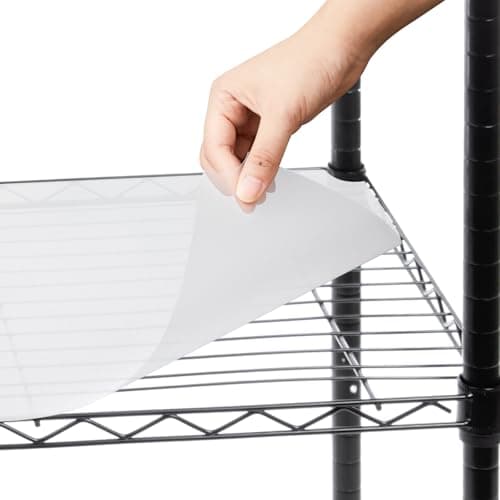
PABUSIOR EVA Shelf Liner for 16 in Wire ShelvingThe only liner here that publishes a thickness - 1.2 mm of EVA - which is the figure that decides whether a liner bridges wire or sags between it.
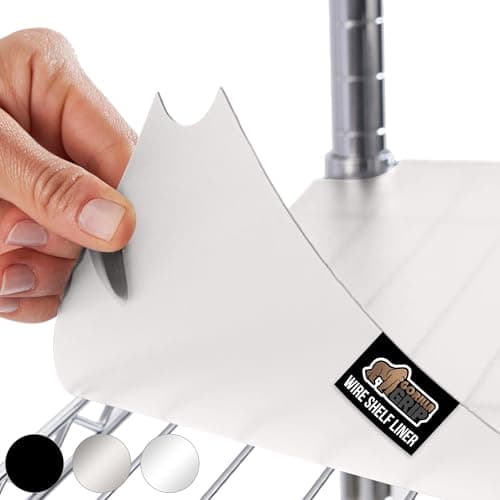
Gorilla Grip ShelfGuard Wire Shelf Liner, 14 x 36 inThe fix for the one real drawback of wire shelving in a linen closet, and the reason you can have ventilation and unmarked linen at the same time.
Sliner Plastic Shelf Liners for Wire Shelving, 8-PackPre-cut panels rather than a roll, and the listing is honest that an 18 by 48 inch panel actually measures about 17.3 by 47 - which is exactly what you want.
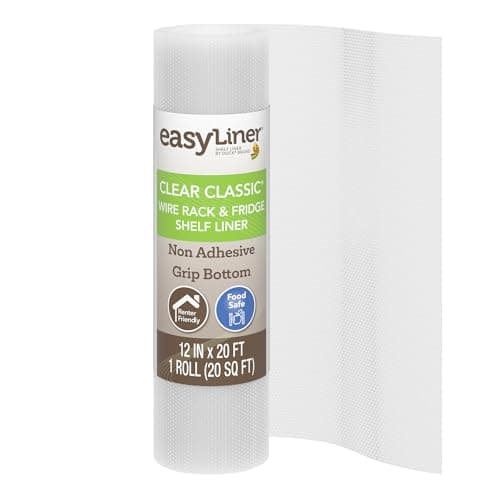
Duck EasyLiner Clear Classic Shelf LinerTwenty feet of clear non-adhesive liner from the brand that effectively defined the category. It does not grip like a textured liner and it does not need to.
Solid shelves, from a brand that has made this for decades
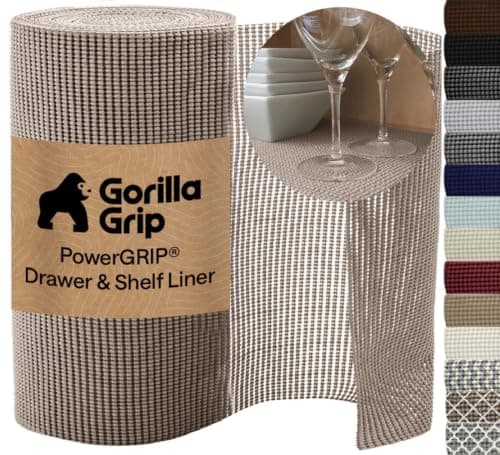
Gorilla Grip powerGRIP Drawer, Shelf and Cabinet LinerA textured grip liner rather than a smooth one, which is the right choice in a drawer where the contents move every time it opens.
Beautysaid Non-Adhesive Shelf and Drawer LinerJust under ten feet of non-slip liner at the lowest price here, which is the sensible way to find out whether you will actually keep liners in your cabinets.
Scores are our own, from the published rubric on the methodology page. They are editorial judgments about published specifications, not test results — we have not handled these units.
01
Wire shelving, with a published thickness
PABUSIOR EVA Shelf Liner for 16 in Wire Shelving
The only liner here that publishes a thickness - 1.2 mm of EVA - which is the figure that decides whether a liner bridges wire or sags between it.
Wire shelving; sits over the wires rather than adhering
Published load rating
Not applicable - it carries nothing itself
What it gets right
Stops the wire pattern embossing the bottom towel of a stack, which is the standard complaint about wire in a linen closet
Trimmable, so one set covers shelves of different widths
Non-adhesive, so it lifts out to wash and leaves nothing behind
What it does not
It reintroduces a solid surface, which is exactly the ventilation you chose wire to get - use it under the stacks that mark, not across every shelf
Clear plastic shows dust and looks tired before it fails
14 in deep suits a 12 or 14 in shelf; on a 16 in shelf it leaves a strip uncovered
Who it is for
A wire-shelved linen closet where folded towels sit long enough to take an impression.
Skip this if
Your linen closet runs damp. Covering the whole shelf removes the airflow that was keeping the stack dry, and a marked bottom towel is the lesser problem.
03
Big wire shelves, cut already
Sliner Plastic Shelf Liners for Wire Shelving, 8-Pack
Pre-cut panels rather than a roll, and the listing is honest that an 18 by 48 inch panel actually measures about 17.3 by 47 - which is exactly what you want.
18 x 48 in, to suit 18 x 48 in shelvingSource: Retailer catalog listing, retrieved 3 October 2026
Published actual size
About 17.28 x 47 in, deliberately undersized to drop between the shelf rimsSource: Retailer catalog listing, retrieved 3 October 2026
Pack
8 panelsSource: Retailer catalog listing, retrieved 3 October 2026
Form
Pre-cut panels, no cutting requiredSource: Retailer catalog listing, retrieved 3 October 2026
Published thickness
Not published by the manufacturer in a form we could verify
What it gets right
Publishes the actual cut size as well as the nominal one, which is the difference between a liner that drops in and one that buckles
Eight panels covers a full wire unit in one purchase
No cutting, so no wavy edges and no wasted roll
What it does not
No thickness published, so how well it bridges the wire is unknown until it arrives
Fixed size only - a 14 or 16 in deep shelf needs a different product entirely
Pre-cut panels cost more per square foot than a roll
Who it is for
A garage or pantry unit of standard 18 x 48 in wire shelves.
Skip this if
Your shelving is not 18 in deep. Pre-cut means pre-cut, and trimming a panel defeats the point of buying one.
04
Solid shelves, from a brand that has made this for decades
Duck EasyLiner Clear Classic Shelf Liner
Twenty feet of clear non-adhesive liner from the brand that effectively defined the category. It does not grip like a textured liner and it does not need to.
12 in W x 10 ft LSource: Retailer catalog listing, retrieved 3 October 2026
Type
Non-adhesive textured gripSource: Retailer catalog listing, retrieved 3 October 2026
Finish
BeigeSource: Retailer catalog listing, retrieved 3 October 2026
Published thickness
Not published by the manufacturer in a form we could verify
Coverage
About four 30 in drawers at 12 in deep - our arithmetic from the roll length
What it gets right
Grip texture stops cutlery trays and jars sliding every time a drawer is opened
Non-adhesive, so it lifts out for washing and leaves no residue
Half the roll length of the big rolls, which suits a drawer job rather than a whole pantry
What it does not
Ten feet goes quickly once you are lining more than a few drawers
Textured liner collects crumbs in the texture, so it needs washing more often than smooth
No published thickness or load figure
Who it is for
Kitchen drawers, especially under cutlery trays and spice jars.
Skip this if
You are lining shelves rather than drawers. A smooth clear roll costs less per foot and shows less.
06
Testing the idea cheaply
Beautysaid Non-Adhesive Shelf and Drawer Liner
Just under ten feet of non-slip liner at the lowest price here, which is the sensible way to find out whether you will actually keep liners in your cabinets.
12 in W x 118 in LSource: Retailer catalog listing, retrieved 3 October 2026
Type
Non-adhesive, non-slipSource: Retailer catalog listing, retrieved 3 October 2026
Published thickness
Not published by the manufacturer in a form we could verify
Coverage
About three 36 in shelves at 12 in deep - our arithmetic from the roll length
What it gets right
The cheapest way into the category, and liners are genuinely a matter of taste
Non-adhesive, so a bad decision costs nothing to undo
Standard 12 in width fits the most common cabinet depth
What it does not
118 in is a short roll - under ten feet, where the mainstream rolls are twenty
Nothing is published beyond the dimensions: no thickness, no material, no grip rating
An unbranded liner is the hardest product here to replace like-for-like in two years
Who it is for
One or two cabinets, or a first try before committing to a 20 ft roll.
Skip this if
You are lining a whole kitchen. The cost per foot is worse than the long rolls once you need several.
Adhesive liner, and why it is not here
Adhesive shelf paper exists, it is cheaper per foot, and we have not included any. The reason is removal: adhesive liner bonds to the shelf over a few years, and taking it off a painted or veneered surface frequently takes the finish with it.
In a rented kitchen that turns a protective measure into damage. In an owned kitchen it turns a five-minute refresh into an afternoon with a heat gun. Non-adhesive liner stays put through normal use because the contents hold it down, and it lifts out in one piece when you want to wash it. If you want it to stay put more firmly, a few small pieces of removable mounting tape at the back corners do the job without bonding the whole sheet.
Cutting it so it looks deliberate
Measure the inside of the shelf, front to back and side to side, and take the smaller of any two readings - shelves are rarely square.
Cut about 1/8 in under, not over. A liner forced in buckles at the edges, and the buckle is the first thing you notice every time you open the cupboard.
Cut on the printed grid if the roll has one. Several liners print a measuring grid on the back, which is faster and straighter than a tape and a marker.
Dry-fit before the second cut. On wire shelving, check the liner drops inside the rims rather than resting on them.
Cut notches rather than slits for brackets and uprights, because a slit tears from its end the first time the liner is lifted.
Where a liner is the wrong answer
The shelf sags. A liner hides a sagging shelf and changes nothing about it. That is a span and bracket problem, set out on shelf span and weight.
You need to stop things falling through wire. A thin liner is a partial fix; a bin is a complete one. The sizing guidance is on best pantry bins.
The shelf is damp. A liner over a damp shelf traps the damp underneath it, and that is how a cabinet base swells. Fix the damp first.
The cabinet is purely decorative. An open shelf of ornaments does not need lining, and a liner on an open shelf is visible in a way it never is inside a cupboard.
Liner by room, because the failure modes differ
The same roll behaves differently depending on where it goes, and the thing that destroys a liner in one room is irrelevant in another.
Kitchen cabinets: grease and crumbs. A smooth liner wipes clean; a textured one holds crumbs in the texture. The liner under a sink has a different job again - there, the point is catching a slow leak before it reaches the cabinet base.
Pantry shelving: dry spills and tin rings. Smooth and replaceable beats grippy here, because the contents are heavy and do not slide anyway.
Bathroom cabinets: standing water and bottle rings. Non-adhesive matters most, because you will want to lift the liner out and dry underneath it.
Closet shelving: the wire pattern pressing into folded knitwear. This is the one case where thickness beats everything, and a thin smooth sheet barely helps.
Garage and utility shelving: oil, grit and weight. A liner here is sacrificial, and the cheapest roll is the right roll.
That spread is why buying one 20 ft roll for the whole house tends to disappoint in two rooms out of five. If the budget allows, a smooth roll for shelves and a grip roll for drawers covers almost everything.
Shelves that are not flat
Liner assumes a flat surface, and plenty of shelves are not. Three cases come up repeatedly.
Wire shelves with a raised rim. The liner must sit inside the rim, not on it, or it rocks. This is exactly why the pre-cut panels here are deliberately undersized - 17.28 in for a nominal 18 in shelf.
Shelves with a front lip. Common on melamine closet shelving. Cut the liner to the flat area behind the lip rather than trying to bend it over.
Bowed or warped shelves. A liner will follow the bow and make it more obvious, not less. A bowed shelf is a span problem and the fix is another bracket, not a sheet of plastic.
Slatted or ventilated wood. Treat it like wire: you need thickness to bridge the slats, or you are simply putting a floppy sheet over a gap.
Cost per shelf, and the false economy
Liner is sold by the roll and used by the shelf, and the cheapest roll is frequently the most expensive way to line a kitchen. The arithmetic is worth doing once.
A 20 ft roll at 12 in wide covers about eight 30 in shelves. A 118 in roll covers about three. If a kitchen has fifteen shelves and drawers in it - which is a normal kitchen - that is two long rolls or five short ones, and the short ones rarely cost a fifth as much each. The pre-cut wire panels sit at the other end: they cost the most per shelf and remove the cutting entirely, which is a fair trade if cutting a straight line in thin plastic is not something you want to do eight times.
The second half of the economy is replacement. Liner is consumable - it gets cut wrong, stained, or simply looks tired after a few years - and the roll you can buy again in three years is worth more than the one you cannot. That is a genuine argument for the recognizable brands here over the unbranded rolls, and about the only argument in their favor, since none of them publishes anything the others do not.
What we are not telling you
We have not fitted, washed or load-tested any of these liners. Every width, length and thickness here is published by the seller or listed in the retailer catalog, retrieved on 3 October 2026, and the coverage figures are our arithmetic from those published lengths, labeled as ours.
Only one product publishes a thickness and none publishes a material weight, a grip rating or a temperature range. How a given liner behaves after two years in a warm cupboard is not something any listing in this category tells you, and we have not tested it. Prices are live from the retailer at the moment you look. The method is on how we pick.
FAQ
Questions people ask about this
What size shelf liner do I need?
Measure the inside of the shelf rather than its nominal size, because rims and front lips make the usable area smaller. One listing here says this explicitly: pick the liner width by the shelf's inner width. For 16 inch wire shelving that usually means a 15.5 inch liner, and for standard 12 inch cabinets a 12 inch roll.
What is the best shelf liner for wire shelving?
One thick enough not to drape into the gaps. The PABUSIOR roll is the only product here that publishes a thickness, at 1.2 mm of EVA, and pre-cut panels like the Gorilla Grip ShelfGuard set are the rigid alternative. A thin smooth roll meant for cabinets will sag between the wires.
Should shelf liner be adhesive or non-adhesive?
Non-adhesive in almost every case. Adhesive liner bonds over time and frequently lifts paint or veneer when removed, which is a real problem in a rental and an afternoon's work in an owned kitchen. Non-adhesive liner is held down by the contents and lifts out to be washed.
How much shelf liner do I need?
Divide the roll length by your shelf width and allow a few inches per shelf for cutting around brackets. A 20 ft roll at 12 in wide covers about eight 30 inch shelves; a 290 in roll at 15.5 in wide covers about nine 32 inch shelves.
Does shelf liner stop wire shelves marking clothes?
It helps, and thickness decides how much. The wire pattern presses into the bottom item of a stack over weeks, and a liner spreads that pressure. A thin liner reduces the marking; a rigid panel effectively removes it.
Can you wash shelf liner?
Non-adhesive liners lift out and wipe or rinse clean, which is most of the argument for them. Textured grip liner holds crumbs in the texture and needs washing more often than a smooth sheet, so it is worth cutting it slightly short of the shelf front so it lifts out easily.
Sources
Where these figures come from
Product figures, as listed in the retailer catalog (3 October 2026)Dimensions, capacities, published loads, materials and any stated fit requirement for every product added in this expansion, taken from the Amazon catalog and the sellers' own listing text through the Creators API on 3 October 2026. These are listing figures rather than manufacturer specification sheets, and each row is labeled that way. Coverage and clearance figures derived from them are our own arithmetic and are labeled as ours.
Availability check, 3 October 2026Every product added in this expansion was resolved through the Amazon Creators catalog on that date and carried a New buy-box offer at the time of writing. Products without a current offer were excluded before the pages were written.
What is not a source hereWe have not handled these products. Nothing on this page is a test result, and no figure comes from a retailer listing, another publisher, or memory.